Venture Capital and M&A Trends as Engines of Structural Transformation
By Collins Odhiambo Owino
Founder & Lead Analyst — DatalytIQs Academy
Source: Finance & Economics Dataset (2000–2025), DatalytIQs Academy Research Repository
Introduction
Innovation and restructuring are the twin forces driving long-run economic transformation.
While Venture Capital (VC) funding fuels innovation by financing startups and new technologies, Mergers & Acquisitions (M&A) drive restructuring, enabling firms to scale, consolidate, and adapt to changing markets.
Tracking both indicators reveals how entrepreneurial dynamics interact with macroeconomic conditions.
Visualization: Innovation and Corporate Restructuring

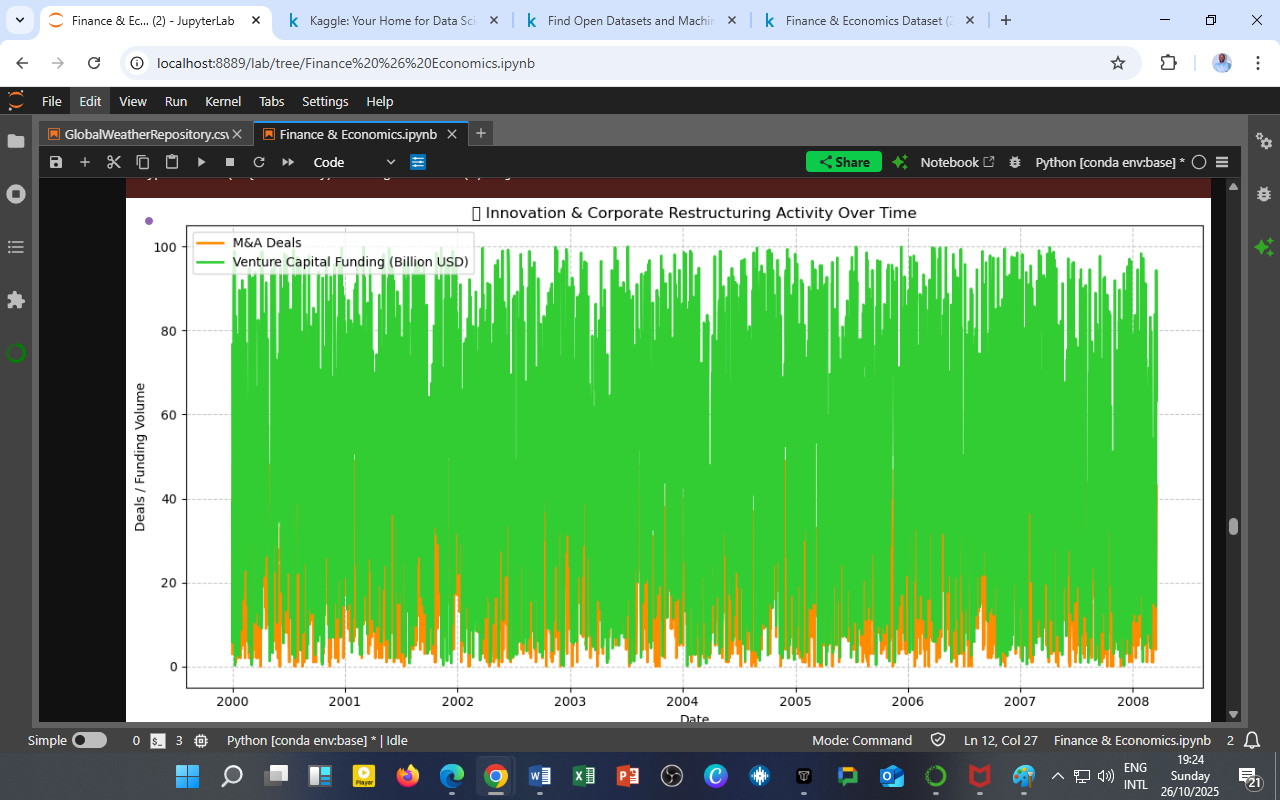
Figure 1: Time-series visualization of Venture Capital Funding (orange) and M&A Deals (green) from 2000–2008, highlighting the intensity and cyclicality of innovation and consolidation activity.
Observations and Patterns
a. Parallel Growth Dynamics
Both VC funding and M&A activity exhibit cyclical intensity, often peaking together.
This suggests that innovation booms and corporate consolidation move hand-in-hand — when capital is abundant and confidence is high, firms innovate and merge aggressively.
b. Periodic Downturns
Noticeable dips (e.g., 2001–2002) coincide with macroeconomic contractions — reduced liquidity and investor caution cause declines in both venture funding and deal volume.
c. Structural Consistency
Despite volatility, M&A volumes (green) remain consistently higher, reflecting their role as a core mechanism for industrial reorganization, while VC funding (orange) represents a risk appetite indicator within financial markets.
Analytical Interpretation
| Dimension | Venture Capital Funding | Mergers & Acquisitions | Economic Implication |
|---|---|---|---|
| Nature | High-risk, innovation-focused | Strategic, consolidation-driven | Represents creative destruction in motion |
| Cycle Sensitivity | Highly procyclical | Moderately procyclical | Mirrors capital market liquidity |
| Policy Leverage | Encouraged through innovation grants, startup incentives | Regulated to prevent monopolization | Balances competition and innovation |
| Impact on GDP Growth | Long-run productivity enhancement | Short-run efficiency and capital reallocation | Complementary mechanisms for resilience |
Economic and Policy Insights
-
Innovation Ecosystem Health:
Sustained VC activity signals a vibrant innovation climate — a crucial input for long-term technological progress and competitiveness. -
Corporate Adaptability:
Increased M&A activity following recessions reflects strategic repositioning — firms seek synergies and market share in response to shocks. -
Policy Timing:
Counter-cyclical fiscal or credit incentives (e.g., startup tax relief, innovation bonds) can help stabilize VC cycles, cushioning innovation ecosystems during downturns.
The DatalytIQs Academy Insight
Innovation lights the spark — restructuring shapes the flame.
At DatalytIQs Academy, this analysis underscores the link between finance, entrepreneurship, and industrial evolution, illustrating how micro-level innovation connects to macroeconomic recovery and growth.
Learners studying Corporate Finance, Innovation Economics, or Applied Econometrics can replicate this approach to visualize structural transformation cycles.
Source & Acknowledgment
Author: Collins Odhiambo Owino
Institution: DatalytIQs Academy
Dataset: Finance & Economics Dataset (2000–2025), Kaggle.
Visualization: Venture Capital Funding (Billion USD) & M&A Deals
Section: Innovation & Corporate Dynamics Module
Key Takeaway
Innovation and corporate restructuring move together — one invents the future, the other organizes it.
Leave a Reply
You must be logged in to post a comment.