By Collins Odhiambo Owino
Author | DatalytIQs Academy
Data Source: International Monetary Fund (IMF) World Economic Outlook – October 2025
Headline Overview
After two years of pandemic- and war-driven price surges, global inflation continues to decline in 2025. Yet the path of disinflation differs sharply between advanced and emerging economies.
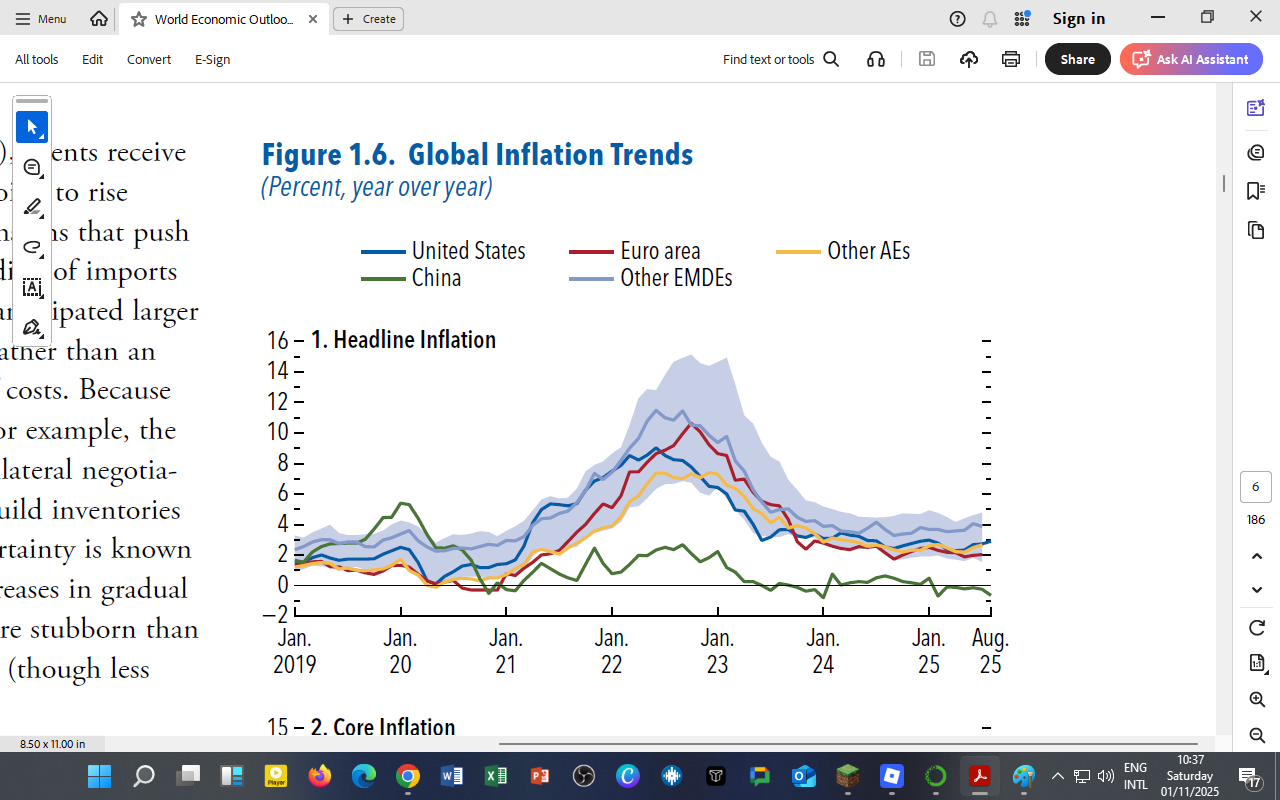
The IMF’s Global Inflation Trends chart shows year-on-year consumer-price movements from 2019 to 2025 for:
-
United States (blue)
-
Euro Area (red)
-
Other Advanced Economies (AEs) (gold)
-
China (green)
-
Other Emerging and Developing Economies (EMDEs) (light blue band)
Headline Inflation Patterns

Peak and Retreat:
-
Inflation spiked between 2021 and mid-2022, hitting double-digit levels in many advanced economies.
-
The drivers: global supply-chain bottlenecks, post-pandemic demand rebound, and energy-price shocks linked to the Ukraine conflict.
-
Since late 2023, inflation has gradually eased as commodity prices normalized and central banks raised interest rates aggressively.
Regional Highlights:
-
United States: Inflation peaked above 9% in 2022, falling below 3% by mid-2025 as monetary policy remained tight.
-
Euro Area: Slightly lagged the U.S., owing to persistent energy-price pressures and slower wage adjustments.
-
China: Experienced mild inflation averaging 1–2%, reflecting weaker domestic demand and overcapacity in manufacturing.
-
Other EMDEs: Displayed the widest volatility range (blue shaded band ≈ 4 – 16%), emphasizing exposure to currency depreciation and food-price shocks.
Core Inflation Dynamics
While headline inflation cooled, core inflation (excluding energy & food) remains elevated in many economies:
-
Sticky service prices and wage growth keep core inflation around 4–5% in advanced economies.
-
EMDEs face second-round effects from earlier commodity surges and exchange-rate passthrough.
Central banks must walk a fine line—maintaining credibility on inflation while avoiding over-tightening that could dampen growth.
Policy Responses and Outlook
| Policy Area | Advanced Economies | Emerging Economies |
|---|---|---|
| Monetary Policy | “Higher for longer” stance by the Fed and ECB to prevent inflation relapse. | Selective tightening—India and Brazil easing gradually; Kenya and Ghana remain hawkish. |
| Fiscal Policy | Gradual consolidation, targeting debt sustainability. | Fiscal discipline under IMF programs; focus on social protection and food security. |
| Inflation Target | 2 % targets remain intact but are challenged by wage persistence. | Flexible inflation targeting is gaining traction. |
Projection: Global inflation expected to average 4.8 % in 2025 and 4.2 % in 2026, still above pre-pandemic norms.
Implications for Africa and Kenya
-
Imported Inflation: Kenya’s price pressures mirror global energy and fertilizer costs.
-
Monetary Tightening: CBK rate at 9.25 % (Oct 2025) keeps inflation ≈ 4.6 %, within target.
-
Exchange-Rate Link: A weaker shilling raises import costs, but disinflation in global oil markets offsets part of the pressure.
-
Policy Advice: Kenya should maintain a cautious monetary policy while accelerating domestic food and energy resilience.
Inflation in Kenya cannot be viewed in isolation; it is interconnected with global monetary cycles and commodity markets.
For DatalytIQs Academy Learners
-
Build a Python notebook to replicate the IMF chart using Matplotlib (
fill_betweenfor the EMDE band). -
Apply rolling-window averages to study how inflation volatility differs between regions.
-
Simulate the impact of interest-rate changes on inflation trajectories via simple AR models.
-
Link global inflation trends to Kenya’s CPI data from KNBS and CBK for a comparative project.
Data and Acknowledgment
Source: IMF World Economic Outlook (October 2025) – Figure 1.6 Global Inflation Trends.
Additional References: OECD Statistics Portal and World Bank Commodity Outlook 2025.
Acknowledgment: IMF staff for data visualization and open access to macroeconomic datasets.
Author: Collins Odhiambo Owino, DatalytIQs Academy
Leave a Reply
You must be logged in to post a comment.