Understanding Inflation Pass-Through
Inflation doesn’t arise in isolation — it spreads through trade linkages, production costs, and consumer demand chains.
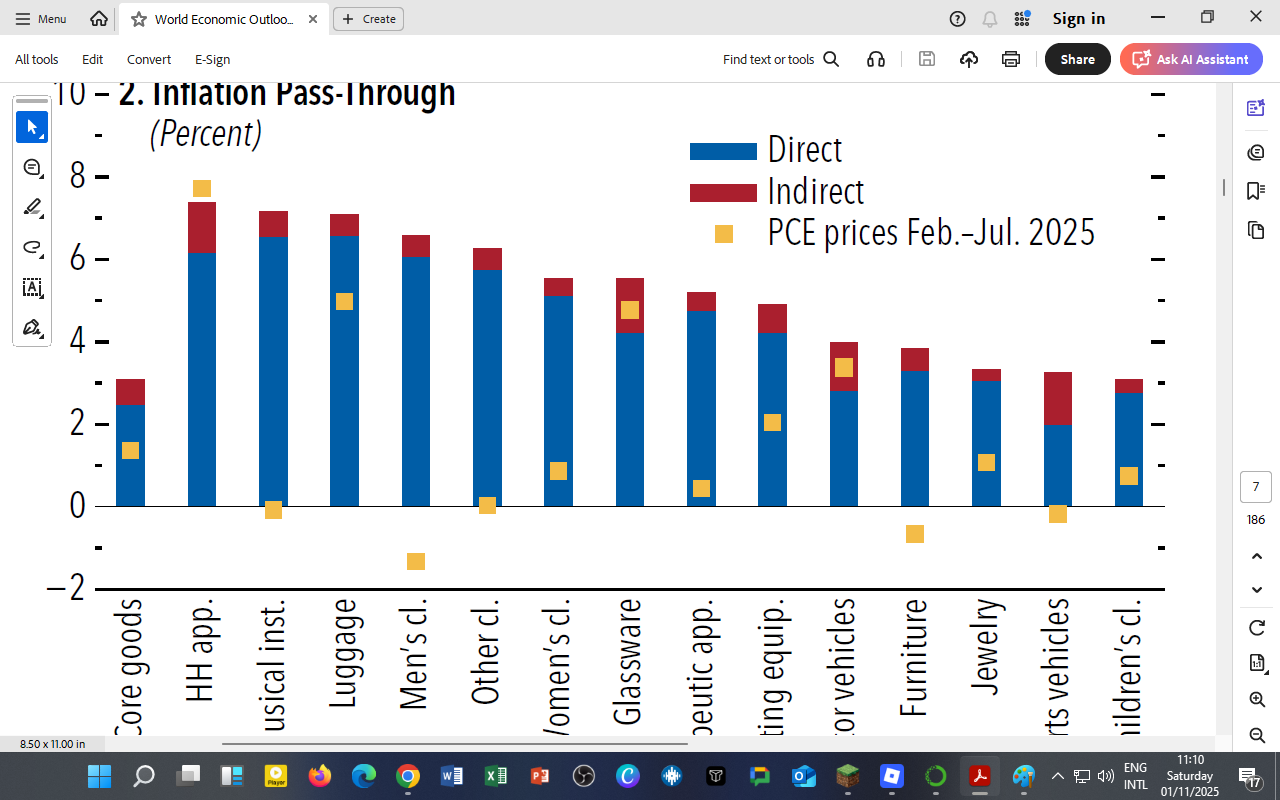
The IMF’s “Inflation Pass-Through” chart reveals how tariff changes and supply disruptions affect U.S. personal consumption expenditure (PCE) prices between February and July 2025.
Each bar in the figure shows the percentage contribution of:
-
🟦 Direct effects (immediate impact of import tariffs on final goods prices)
-
🟥 Indirect effects (cost increases from imported inputs used in domestic production)
-
🟨 Observed PCE price change for the period
Figure — Inflation Pass-Through by Product Category

Highlights:
-
Household appliances, musical instruments, and luggage show the largest total pass-through — 7–8 % — indicating high import dependency.
-
Clothing categories (men’s and women’s) record moderate effects (≈ 6–7 %).
-
Jewelry and furniture exhibit smaller but noticeable indirect inflation.
-
Children’s clothing and sports vehicles show near-zero or slightly negative price changes, implying substitution effects or reduced demand.
The data suggests that tariff-driven inflation was not only sector-specific but also regressive — affecting household goods and essentials more than luxury items.
Direct vs Indirect Transmission
| Transmission Channel | Description | Economic Impact |
|---|---|---|
| Direct Pass-Through | Imported goods become more expensive due to tariffs or shipping costs. | Consumers pay higher retail prices almost immediately. |
| Indirect Pass-Through | Firms using imported components face higher production costs. | Prices rise more gradually through domestic value chains. |
Inflation persists longer when indirect effects dominate — a key challenge in sectors reliant on global manufacturing networks.
Broader Global Context
-
Tariff escalation and geopolitical realignments since 2024 have elevated import prices globally.
-
Emerging markets faced compounded effects due to weaker currencies and energy import costs.
-
The IMF estimates total trade-related inflation added 0.8 % to global consumer prices by mid-2025.
Tariffs designed to protect domestic industries often raise living costs, especially for low- and middle-income households.
Implications for Africa and Kenya
-
Imported inflation: Kenya’s exposure is moderate but rising — household electronics, vehicles, and textiles are sensitive to global trade disruptions.
-
Policy response: Enhancing local value addition and intra-African supply chains (under AfCFTA) can reduce vulnerability to imported price shocks.
-
Monetary stance: CBK’s focus on maintaining a stable shilling helps cushion indirect pass-through effects.
A 10 % rise in shipping costs from Asia could increase local electronics prices by 3–4 % within a quarter due to high import reliance.
For DatalytIQs Academy Learners
You can replicate this IMF figure analytically:
-
Use a stacked bar chart to decompose inflation by sector (direct vs indirect).
-
Apply an input–output matrix to estimate second-round effects in Kenya’s manufacturing sector.
-
Analyze tariff elasticities to measure price sensitivity by product type.
Data and Acknowledgment
Source: IMF World Economic Outlook (October 2025), Figure 1.7 (2) “Inflation Pass-Through.”
Acknowledgment: IMF staff calculations using Haver Analytics and U.S. PCE data.
Author: Collins Odhiambo Owino, DatalytIQs Academy
Leave a Reply
You must be logged in to post a comment.