Seismic Features, Temporal Trends, and Global Distribution Analysis (2001–2022)
Overview
The Global Earthquake–Tsunami Risk Assessment Dataset is a comprehensive, machine learning–ready dataset covering 782 significant earthquakes recorded worldwide between 2001 and 2022. It integrates seismic characteristics with tsunami potential indicators — ideal for risk prediction, early warning systems, and geospatial hazard assessment.
This research forms part of DatalytIQs Academy’s global analytics initiative, combining earth science, data analytics, and artificial intelligence to model disaster risk and resilience.
Dataset Highlights
| Attribute | Details |
|---|---|
| Time Period | 2001 – 2022 |
| Total Records | 782 earthquakes |
| Geographic Range | −61.85° to 71.63° latitude, −179.97° to 179.66° longitude |
| Data Quality | 100% complete, zero missing values |
| Target Variable | Tsunami indicator (0 = No, 1 = Yes) |
| Format | CSV (~41KB) |
Classification Summary
-
Non-Tsunami Events: 478 (61.1%)
-
Tsunami-Potential Events: 304 (38.9%)
-
Balanced Dataset: Ideal for binary classification and supervised ML tasks.
1. Magnitude vs Depth of Earthquakes

Insights
-
High-magnitude events (≥8.0) are mostly shallow (≤100 km), and these pose a higher tsunami risk.
-
Deep-focus quakes (≥500 km) are less destructive and rarely tsunami-generating.
-
The dense clustering at low depths reflects tectonic boundary zones, where oceanic and continental plates interact.
Shallow quakes are nature’s loudest warnings — their energy release at the crust makes them the most devastating.
2. Earthquake Frequency Over Time

Observations
-
Between 2001–2022, global earthquake counts fluctuated between 25 and 55 events per year.
-
Activity peaks around 2010–2015, coinciding with the Chile (2010) and Japan (2011) mega-quakes.
-
No clear upward or downward trend — large quakes occur sporadically, driven by tectonic dynamics rather than cyclical time patterns.
Interpretation
Short-term trends can mislead policymakers; instead, real-time geophysical monitoring offers stronger predictive value than historical frequency alone.
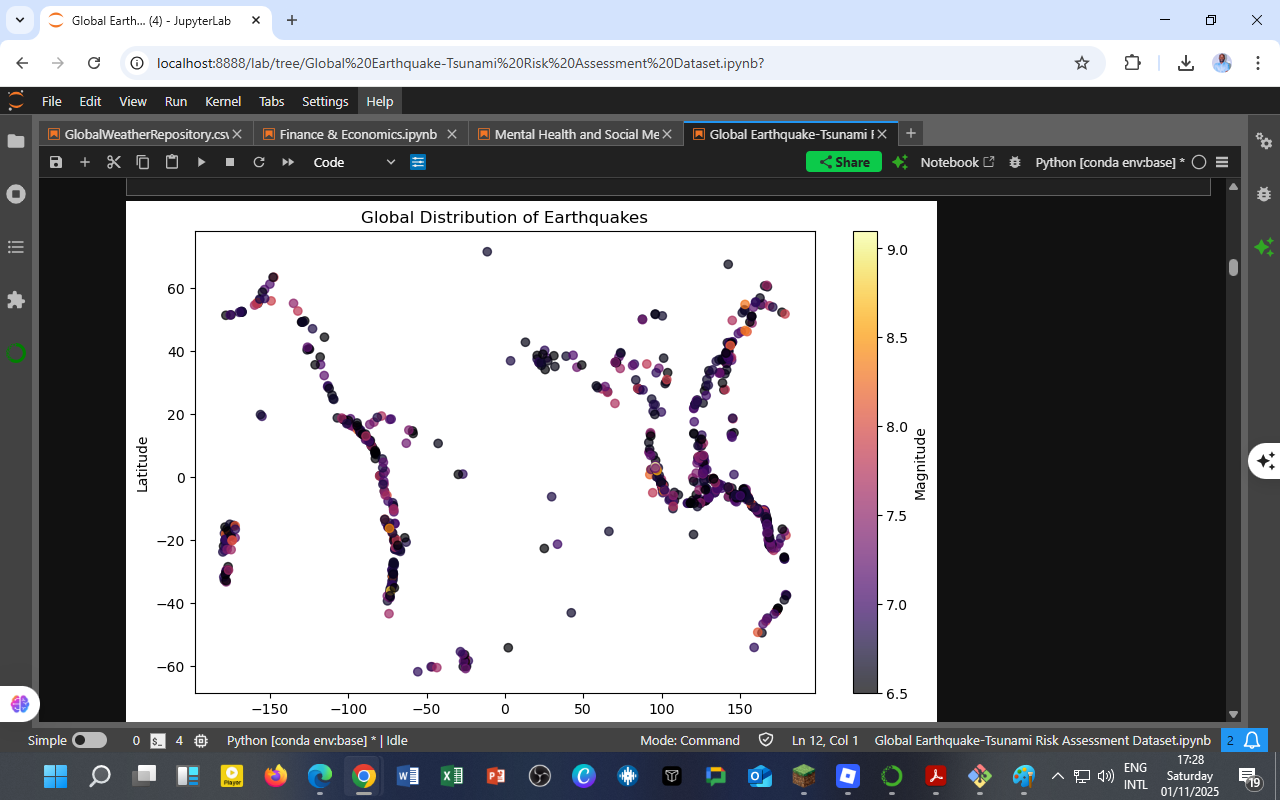
3. Global Distribution of Earthquakes

Geographic Patterns
-
Earthquakes align strongly with tectonic plate boundaries, notably:
-
The Pacific Ring of Fire stretches from Japan through Indonesia to Chile.
-
The Mid-Atlantic Ridge and the Himalayan belt.
-
-
Color gradients represent magnitude intensity — lighter shades indicate mega-quakes (>8.0).
-
These fault zones coincide with subduction zones, where the world’s most powerful tsunamis originate.
Scientific Relevance
This map underscores how plate tectonics controls global seismicity. Integrating spatial data with predictive models supports geospatial risk zoning, a crucial step for coastal planning and international disaster preparedness.
Machine Learning Applications
The dataset supports multiple applied analytics use cases:
-
Binary classification — predicting tsunami occurrence from seismic parameters.
-
Hazard mapping — identifying high-risk regions using geospatial clustering.
-
Magnitude estimation — predicting quake intensity from station network data.
-
Early warning systems — training models to detect high-risk seismic events in real time.
Data Quality & Reliability
-
Zero missing values across all 13 columns
-
782 complete earthquake records
-
Global spatial coverage
-
Balanced tsunami classes (ideal for supervised learning)
-
28 major earthquakes (≥8.0) included
Acknowledgment
This study was conducted by DatalytIQs Academy, a digital learning and analytics platform empowering students and professionals in Mathematics, Economics, and Geoscience through data-driven exploration.
Dataset Source: Kaggle — Global Earthquake–Tsunami Risk Assessment Dataset (2001–2022)
Analysis Tools: Python, Pandas, Matplotlib, Seaborn, and JupyterLab
“Transforming seismic data into global foresight — empowering resilience through analytics.”
— Collins Odhiambo Owino, Founder, DatalytIQs Academy
Leave a Reply
You must be logged in to post a comment.