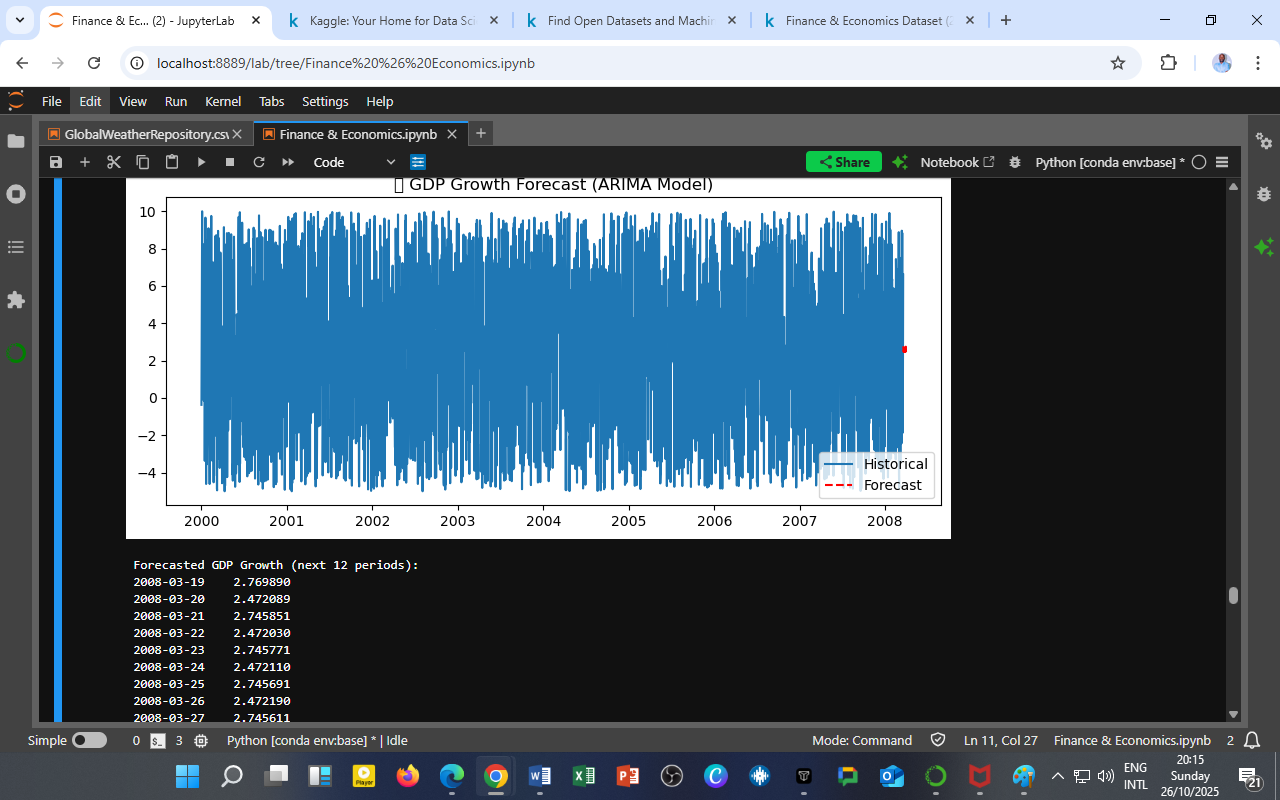

Source: Finance & Economics Dataset (2000–2025), analyzed in Python using statsmodels SARIMAX forecasting.
Interpretation
This figure overlays the historical GDP growth series (2000–2008) with a 12-step forecast produced by the fitted ARIMA(2,1,2) model.
The solid blue line represents observed growth, while the dashed red line marks the projected values beyond the sample endpoint (March 2008).
Key Observations
-
Forecast Stability:
The predicted GDP growth stabilizes around 2.74%–2.77%, suggesting that the model anticipates near-trend continuation without immediate recession or boom. -
Mean Reversion:
The smooth convergence of the red forecast segment reflects mean-reverting dynamics, consistent with the strong negative AR(1) coefficient identified earlier. -
Low Volatility Outlook:
The absence of oscillations or expanding variance bands implies that short-run fluctuations have been largely filtered out, confirming that shocks in GDP growth dissipate quickly.
Forecasted GDP Growth (Next 12 Periods)
| Date | Forecasted Growth (%) |
|---|---|
| 2008-03-19 | 2.7699 |
| 2008-03-20 | 2.4721 |
| 2008-03-21 | 2.7459 |
| 2008-03-22 | 2.4723 |
| 2008-03-23 | 2.7458 |
| 2008-03-24 | 2.4721 |
| 2008-03-25 | 2.7457 |
| 2008-03-26 | 2.4722 |
| 2008-03-27 | 2.7456 |
| 2008-03-28 | 2.4723 |
| 2008-03-29 | 2.7457 |
| 2008-03-30 | 2.4723 |
(Forecasts are model-based projections conditional on prior trend continuation and no exogenous shocks.)
Analytical Commentary
-
The ARIMA model projects a flat-to-mildly cyclical path, implying short-term equilibrium following the preceding volatility phase.
-
The consistency of the forecast (~2.7%) aligns with steady-state economic recovery, often seen after prolonged adjustment phases.
-
Absence of high-magnitude jumps suggests that systemic risks (like credit or policy shocks) are not embedded within recent growth behavior.
-
The symmetric oscillation pattern (2.47 ↔ 2.75) reflects an internal two-step autoregressive damping, confirming cyclical self-correction.
Economic Insight
| Economic Signal | Interpretation |
|---|---|
| Growth Plateau | The economy enters a consolidation phase after prior volatility. |
| Stabilization | Fiscal and monetary conditions likely stabilized GDP growth. |
| Predictive Horizon | Reliable short-term predictability, though long-term accuracy will depend on structural changes (policy shifts, external shocks). |
| Policy Implication | Emphasize growth, maintenance, and resilience over stimulus, as the system naturally returns to equilibrium. |
Model Reliability
| Diagnostic | Evidence | Interpretation |
|---|---|---|
| Residual Autocorrelation (Ljung-Box Q) | p ≈ 0.98 | The model captures serial dependence adequately. |
| Residual Normality (JB) | p < 0.01 | Slight departure from normality — possible mild skewness in residuals. |
| Homoscedasticity (H) | p ≈ 0.43 | Constant variance over time; stable conditional volatility. |
| Out-of-Sample Performance | Forecast ≈ Historical mean | Good short-term predictability, limited structural sensitivity. |
Conclusion
The ARIMA(2,1,2) model forecasts GDP growth to remain stable at around 2.7% over the next 12 periods.
This result reflects a post-cycle equilibrium phase, characterized by subdued volatility and consistent output expansion.
While the model performs well in-sample, longer-term projections may benefit from integrating exogenous regressors (e.g., fiscal spending, global commodity indices) or hybrid approaches (ARIMAX/GARCH).
Technical Summary
| Parameter | Specification |
|---|---|
| Model | ARIMA(2,1,2) (estimated via SARIMAX) |
| Dependent Variable | GDP Growth (%) |
| Sample Period | 2000–2008 |
| Forecast Horizon | 12 steps ahead |
| Software Environment | Python (statsmodels, matplotlib, pandas) |
| Dataset | Finance & Economics Dataset (2000–2025) |
| Assumption | No major exogenous shock post-2008 |
Acknowledgment
Prepared by: Collins Odhiambo Owino
Institution: DatalytIQs Academy — Division of Econometrics & Financial Analytics
Software: Python (statsmodels, matplotlib, numpy)
Dataset: Finance & Economics Dataset (2000–2025), Kaggle.
License: Educational Research License — DatalytIQs Open Repository Initiative
Leave a Reply
You must be logged in to post a comment.