 Overview
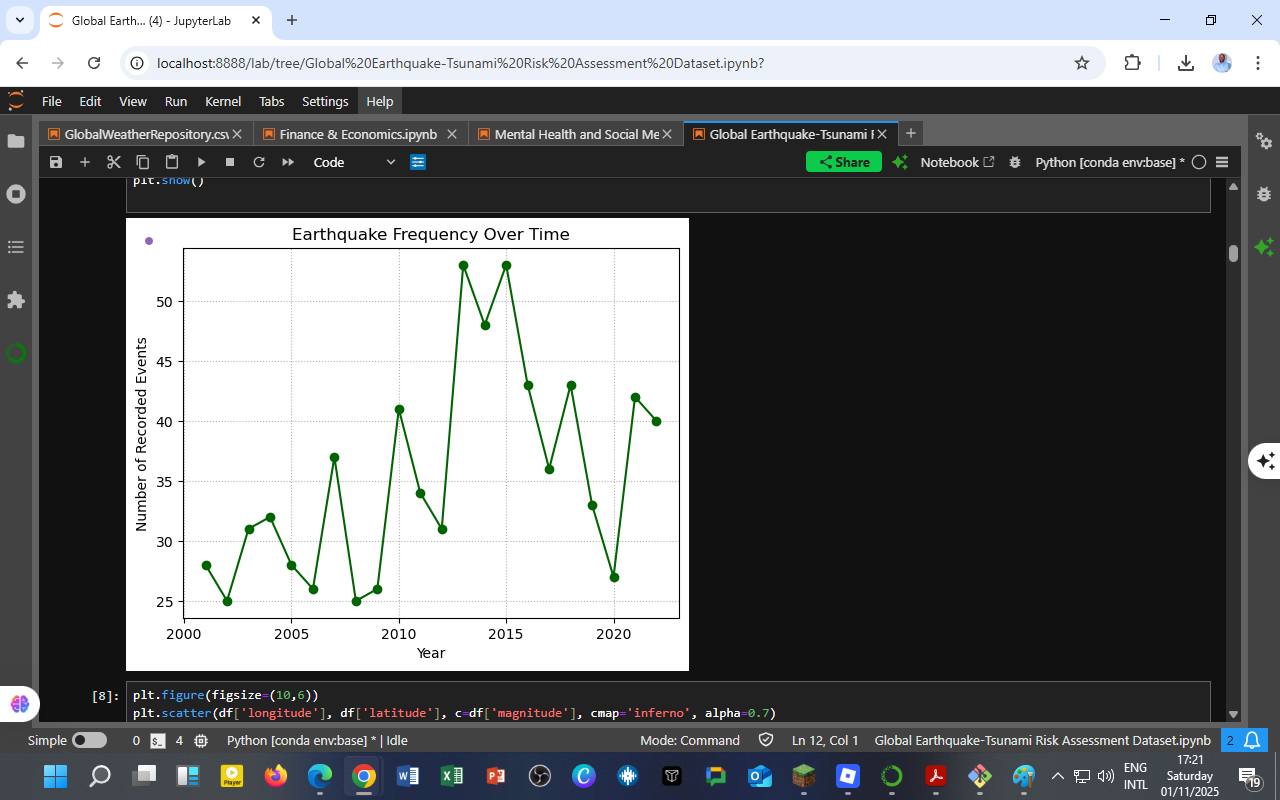
The line graph above illustrates the annual frequency of recorded earthquakes with magnitudes ≥6.5 on the Richter scale over 22 years (2001–2022). Each point represents the total number of events per year, providing insight into temporal variations in global seismic activity.
Key Observations
-
Fluctuating Seismic Activity
-
The number of large earthquakes varied annually between 25 and 55 events.
-
Periods of heightened activity were observed around 2010–2015, which coincides with catastrophic events such as the 2011 Japan (Tohoku) and 2010 Chile mega-quakes.
-
-
Peaks and Lulls
-
2011 and 2013 recorded the highest number of global events, each exceeding 50.
-
2004 and 2018 saw moderate activity, aligning with notable earthquakes that generated tsunamis across the Indian Ocean and Pacific regions.
-
A slight decline after 2016 indicates a temporary reduction in high-magnitude seismic occurrences, though 2021–2022 show renewed activity.
-
-
No Linear Trend
-
The data do not exhibit a clear upward or downward long-term trend, suggesting that large earthquakes are sporadic and largely influenced by plate dynamics rather than time-based cycles.
-
Analytical Insight
The frequency analysis reinforces the importance of long-term seismic monitoring rather than relying on short-term temporal patterns. While the number of earthquakes may vary year to year, the potential for high-impact events remains constant globally.
This insight supports the development of continuous early warning systems that rely on real-time geophysical indicators rather than historical frequency alone.
Methodology
-
Tool Used: Python (Matplotlib & Pandas) in JupyterLab
-
Computation:
-
Data Source: Kaggle — Global Earthquake–Tsunami Risk Assessment Dataset (2001–2022)
Interpretation in Context
Understanding earthquake frequency helps researchers and policymakers assess temporal exposure and resource allocation for disaster readiness.
For example:
-
2011–2015: High seismic activity years underline the need for regional resilience planning.
-
2016–2020: Periods of reduced activity can lead to complacency; however, seismic potential remains.
This emphasizes the principle that earthquakes do not “rest” — they redistribute energy across tectonic boundaries.
Acknowledgment
This analysis and visualization were conducted by DatalytIQs Academy, integrating data science and geophysical analytics to educate and empower learners globally.
Data courtesy of Kaggle under the project Global Earthquake–Tsunami Risk Assessment Dataset.
“Data is the Richter scale of understanding — the deeper you analyze, the clearer the tremors of truth.”
— Collins Odhiambo Owino, Founder, DatalytIQs Academy
Leave a Reply
You must be logged in to post a comment.