Insights from the Global Earthquake–Tsunami Risk Assessment Dataset
Overview
The depth of an earthquake’s focus is the point within the Earth where seismic energy is released. It plays a crucial role in determining the intensity of ground shaking, surface damage, and tsunami potential.
Using the Global Earthquake–Tsunami Risk Assessment Dataset (2001–2022), this analysis examines how earthquakes are distributed across three major depth zones:
-
Shallow (<70 km)
-
Intermediate (70–300 km)
-
Deep (>300 km)
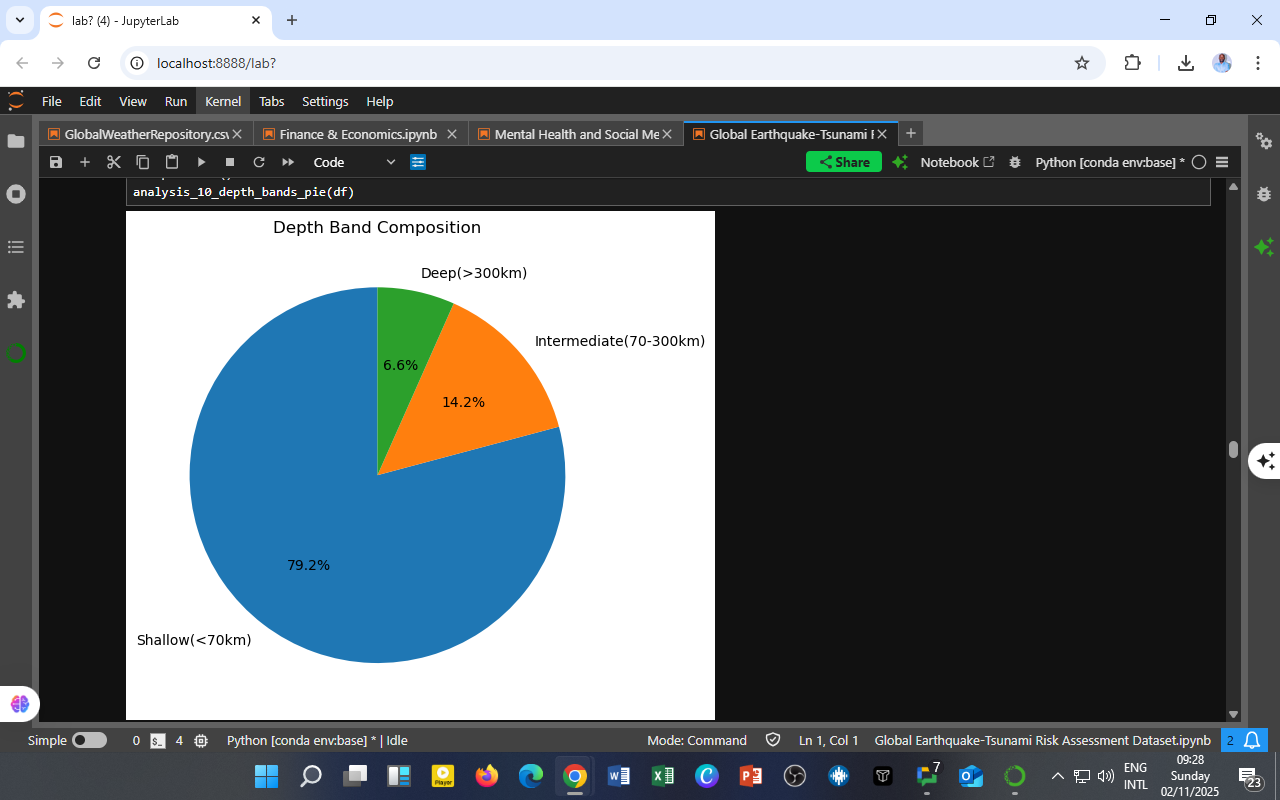
The resulting pie chart summarizes the proportion of global seismic events falling into each band.
Depth Band Distribution

Figure Description
The pie chart visualizes the percentage share of earthquakes based on their focal depth, derived from 782 global seismic events recorded between 2001 and 2022.
| Depth Category | Depth Range (km) | Percentage of Events | Interpretation |
|---|---|---|---|
| Shallow | <70 km | 79.2% | Most destructive; strongly felt at the surface; higher tsunami risk. |
| Intermediate | 70–300 km | 14.2% | Moderate shaking; less surface impact but still significant. |
| Deep | >300 km | 6.6% | Minimal surface impact; linked to deep subduction zones. |
Interpretation
-
Shallow-focus earthquakes dominate, accounting for nearly four out of every five global events.
These quakes are responsible for most of the world’s seismic destruction and tsunami generation. -
Intermediate-depth events occur within subducting tectonic slabs, where oceanic plates bend and descend beneath continental crust.
-
Deep-focus earthquakes, while rare, provide insight into mantle deformation and slab sinking dynamics hundreds of kilometers below the surface.
“Nearly 80% of earthquakes occur close to the Earth’s surface — where humans feel the planet’s shifting heart most intensely.”
Scientific Context
This distribution mirrors the structure of Earth’s lithosphere and upper mantle, where most tectonic friction and energy buildup occur.
The Pacific Ring of Fire, which hosts a majority of these shallow events, remains the world’s most active seismic belt.
Deep-focus earthquakes are primarily concentrated beneath subduction zones, such as those near Japan, Fiji, and South America — revealing the planet’s dynamic internal recycling of crustal material.
Implications
-
Disaster Preparedness: Focus on shallow quake regions for tsunami and infrastructure resilience.
-
Policy Planning: Prioritize monitoring and seismic building codes in subduction zones.
-
Research Modeling: Enhance earthquake risk simulations using depth-weighted hazard indices.
Acknowledgment
This analysis was performed by DatalytIQs Academy, a multidisciplinary platform dedicated to applied research and education in Mathematics, Economics, and Earth Science Analytics.
Dataset: Kaggle — Global Earthquake–Tsunami Risk Assessment Dataset (2001–2022)
Tools Used: Python | Pandas | Matplotlib | Seaborn | JupyterLab
“DatalytIQs Academy transforms seismic data into global insight — advancing education, resilience, and scientific literacy.”
— Collins Odhiambo Owino, Founder
Acknowledgment of Contributions:
Special recognition to the global open-data community and Kaggle contributors, whose transparent sharing of seismic data enables researchers, students, and policymakers to understand the Earth’s dynamic systems more deeply.
Leave a Reply
You must be logged in to post a comment.