About Course
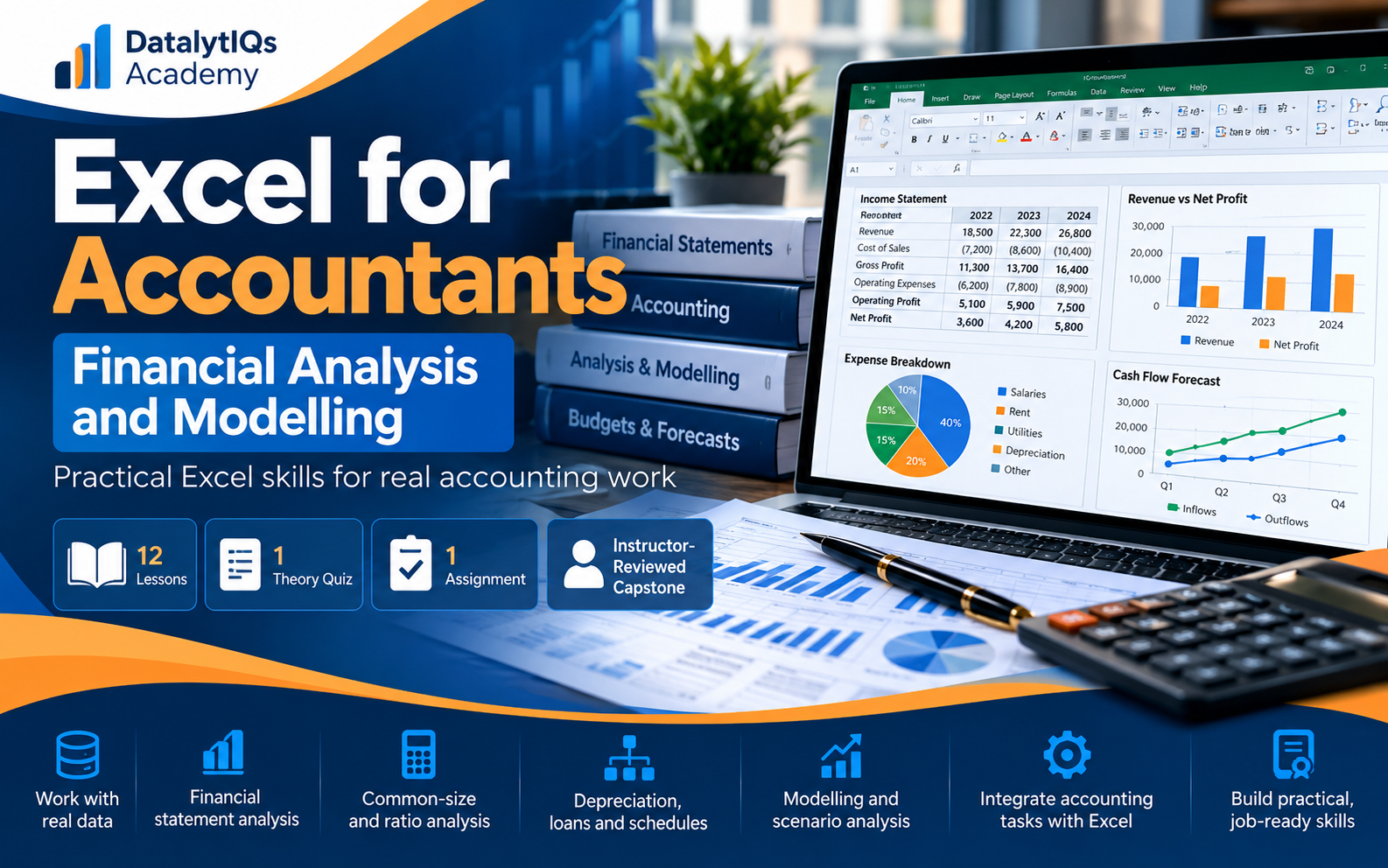
Develop practical Excel skills for accounting analysis using original fictional Kenyan cooperative records. The course contains 12 lessons, a theory quiz and an instructor-reviewed capstone.
What you will learn
- Preserve source records, map accounts and investigate exceptions.
- Build a simplified income statement and common-size analysis.
- Calculate straight-line and reducing-balance depreciation.
- Build a monthly loan schedule and compare interest-rate scenarios.
- Explain reconciliation limits and communicate findings clearly.
Practical case: Tulia Cooperative
Create your own Excel workbook from the eight-row fictional extract supplied in the lessons. Income totals KSh 256,000 and operating expenses KSh 121,000. Calculate annual depreciation from cost KSh 620,000, salvage KSh 20,000 and a five-year life; model a KSh 300,000 loan for 36 months at 12% annual interest. The extract deliberately omits opening balance-sheet records, so identify missing information rather than forcing a balanced statement.
How to study
Allow approximately 6–9 hours for lesson practice, plus time for the capstone. You need Excel or a compatible spreadsheet application; Power Query and XLOOKUP exercises require a version supporting those features. All case inputs are included in the enrolled lessons. Prepare your own workbook and retain source data, formulas, checks and a management brief.
Assessment
Complete the theory check and submit the capstone workbook and brief through the course assignment. The capstone uses a 100-mark rubric with a 70-mark pass requirement and instructor review. This course develops practical skills and does not award a professional accounting qualification.
Course Content
01 Source integrity and account mapping
-
Import and validate a synthetic ledger
-
Map transaction codes to statement lines
02 Financial statements and common-size analysis
03 Depreciation and loan calculations
04 Financial modelling and scenarios
05 Data integration and reconciliation
06 Integrated capstone and review
Student Ratings & Reviews
