About Course
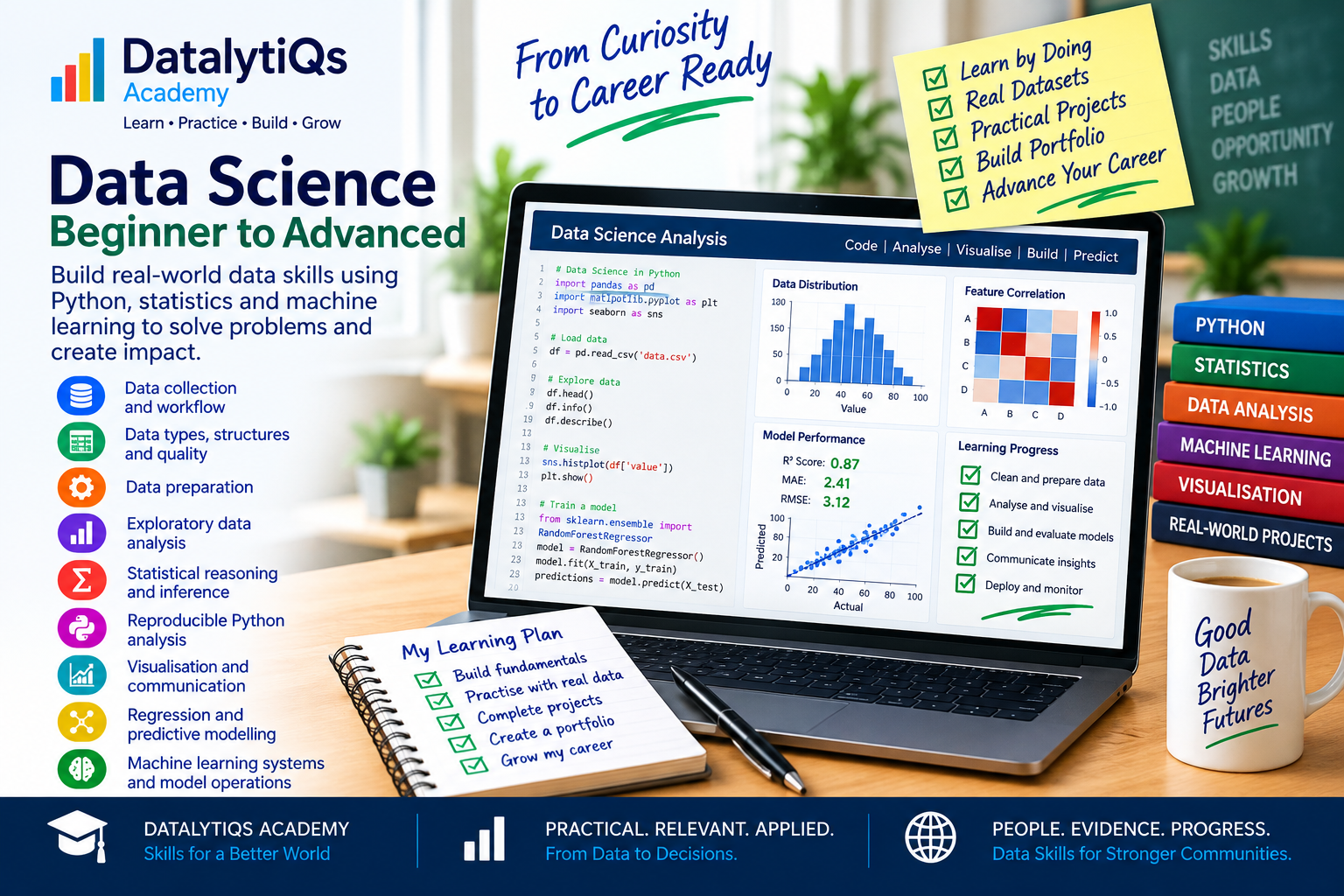
Programme purpose
Develop end-to-end data science capability: define the decision problem, acquire and prepare data, analyse, communicate findings and deploy responsible models.
Learning route
- Data, decisions and workflow
- Data types, structures and quality
- Data preparation
- Exploratory data analysis
- Statistical reasoning and inference
- Reproducible Python analysis
- Visualisation and communication
- Regression and predictive modelling
- Machine learning systems and model operations
- Capstone and professional portfolio
Tutor LMS delivers theory and knowledge checks; the Analytics Lab verifies practical performance.
Data Science course from foundations to advanced learning
The DatalytIQs Data Science pathway provides progressive learning from foundational ideas toward more advanced analytical work. It is intended for learners developing broader capability in working with data, analytical methods and evidence-based problem solving.
Who this course is for
- Aspiring data analysts and data scientists
- Graduates building analytical capability
- Researchers working with quantitative data
- Professionals extending their analytics skills
- Learners progressing from statistics or data analytics
What you will explore
- Explore Data science workflow.
- Explore Data acquisition and structures.
- Explore Cleaning and exploratory analysis.
- Explore Statistical reasoning and modelling.
- Explore Machine learning and responsible practice.
- Explore Professional evidence checkpoint.
Course curriculum
The current Tutor LMS curriculum contains the following learning areas and activities.
Data science workflow
- Frame decision problems and analytical questions
- Plan an end-to-end data science workflow
- Quiz: Data Science — Theory Check
Data acquisition and structures
- Identify trustworthy data sources and collection methods
- Work with tabular, text, spatial and time-series data
Cleaning and exploratory analysis
- Profile data, treat missingness and document transformations
- Explore distributions, relationships and anomalies
Statistical reasoning and modelling
- Apply sampling, uncertainty and hypothesis logic
- Build and interpret regression and predictive models
Machine learning and responsible practice
- Evaluate classification and regression models
- Address bias, privacy, reproducibility and model risk
Professional evidence checkpoint
- Submit a reproducible analysis notebook, model-validation summary and decision brief in the Analytics Lab
Learning with DatalytIQs
DatalytIQs Academy connects structured learning with applied analysis, evidence-based thinking and professional practice. Use the course curriculum and learning activities as your primary pathway through this course.
Course Content
Data science workflow
-
Frame decision problems and analytical questions
-
Plan an end-to-end data science workflow
-
Data Science — Theory Check
Data acquisition and structures
Cleaning and exploratory analysis
Statistical reasoning and modelling
Machine learning and responsible practice
Professional evidence checkpoint
Student Ratings & Reviews