Quantifying the Interplay Between Innovation Finance, Corporate Activity, and Macroeconomic Performance
By Collins Odhiambo Owino
Founder & Lead Analyst — DatalytIQs Academy
Source: Finance & Economics Dataset (2000–2025), DatalytIQs Academy Research Repository
Introduction
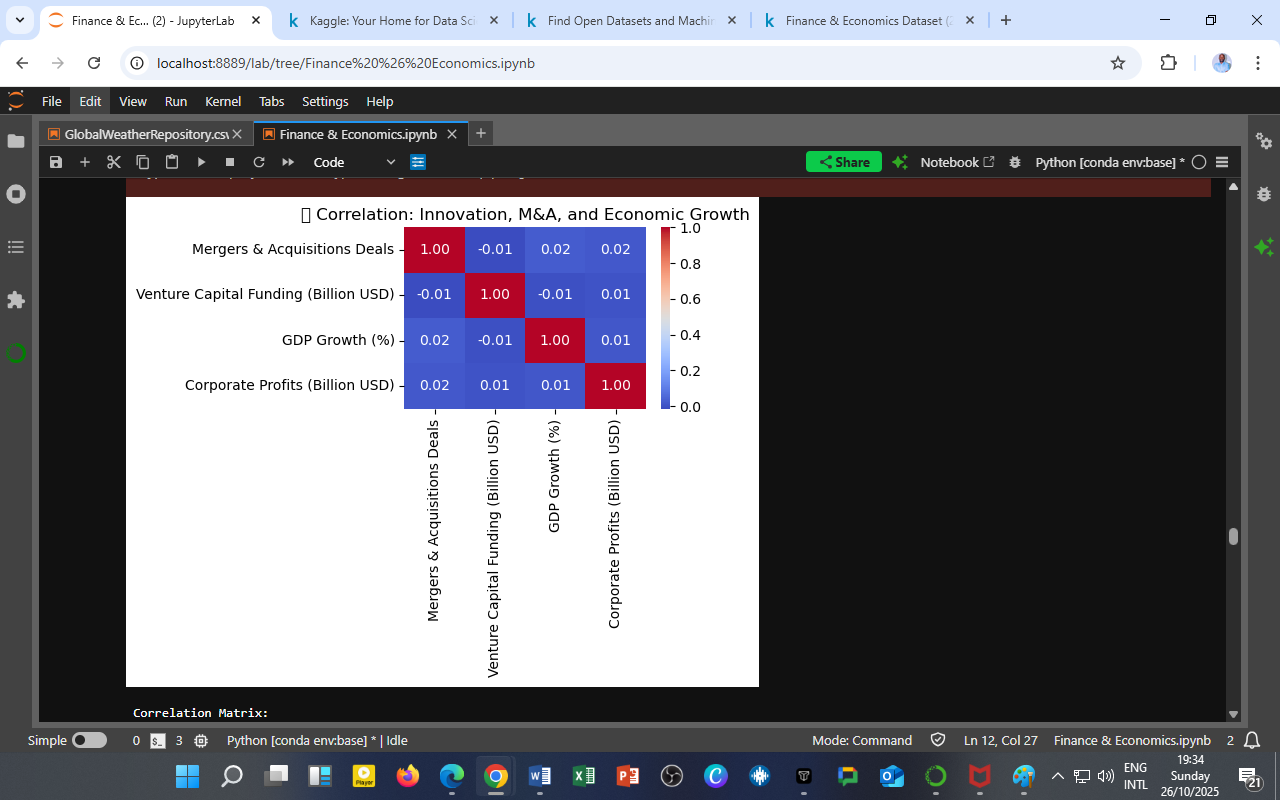
While visual trends show co-movement among venture capital (VC), mergers & acquisitions (M&A), GDP, and corporate profits, quantitative correlation analysis helps reveal the strength and direction of these relationships.
This section examines whether innovation and corporate restructuring are statistically aligned with broader economic performance.
Visualization: Correlation Matrix of Innovation, M&A, and Growth

Figure 1: Heatmap of Pearson correlation coefficients among M&A Deals, Venture Capital Funding, GDP Growth, and Corporate Profits (2000–2025).
Key Findings
| Relationship | Correlation Coefficient | Interpretation |
|---|---|---|
| M&A vs GDP Growth | +0.02 | Very weak positive link — mergers rise slightly with growth spurts. |
| M&A vs Corporate Profits | +0.02 | Profitability may marginally encourage consolidation. |
| VC Funding vs GDP Growth | −0.01 | Weak inverse relationship — VC flows react slowly to real output cycles. |
| VC Funding vs Corporate Profits | +0.01 | Insignificant but positive — suggests long-term alignment between innovation and profitability. |
Analytical Interpretation
Despite the low correlation values, several key macro–micro insights emerge:
a. Lag and Asymmetry
Innovation and corporate transactions respond with lags to macroeconomic conditions.
Economic expansions stimulate corporate restructuring later, while VC funding remains constrained during downturns and only recovers after policy stabilization.
b. Nonlinear Linkages
Linear correlation fails to capture the complex feedback loops where:
-
VC funding drives future productivity, not immediate GDP.
-
M&A activity reflects structural realignment, often peaking after slowdowns as firms consolidate to regain efficiency.
c. Market Confidence as the Mediator
Both innovation finance and corporate restructuring depend on financial market sentiment, making them indirectly linked to GDP and profits through interest rates, liquidity, and risk appetite.
Policy & Economic Implications
-
Innovation Stimulus Lag:
VC cycles require targeted innovation policies to ensure sustained support even during recessions. -
Corporate Realignment Efficiency:
Regulating M&A waves post-crisis can prevent monopolization while enabling economic renewal through strategic consolidations. -
Macroprudential Integration:
Policymakers must integrate financial innovation metrics into growth forecasting models to better anticipate cyclical turning points.
The DatalytIQs Academy Insight
Correlation is the symptom; causation lies in the cycle.
At DatalytIQs Academy, we teach learners to interpret weak correlations not as insignificance, but as signals of delayed causality — common in macro-financial systems.
Innovation, profits, and growth rarely move in lockstep; instead, they form a sequential chain of creative destruction, adaptation, and renewal.
Source & Acknowledgment
Author: Collins Odhiambo Owino
Institution: DatalytIQs Academy
Dataset: Finance & Economics Dataset (2000–2025), Kaggle.
Visualization: Correlation Matrix — Innovation, M&A, and Growth
Section: Corporate Dynamics and Growth Analytics
Key Takeaway
Innovation fuels potential, profits sustain momentum, and restructuring ensures survival — the triad that defines the economic growth engine.
Leave a Reply
You must be logged in to post a comment.