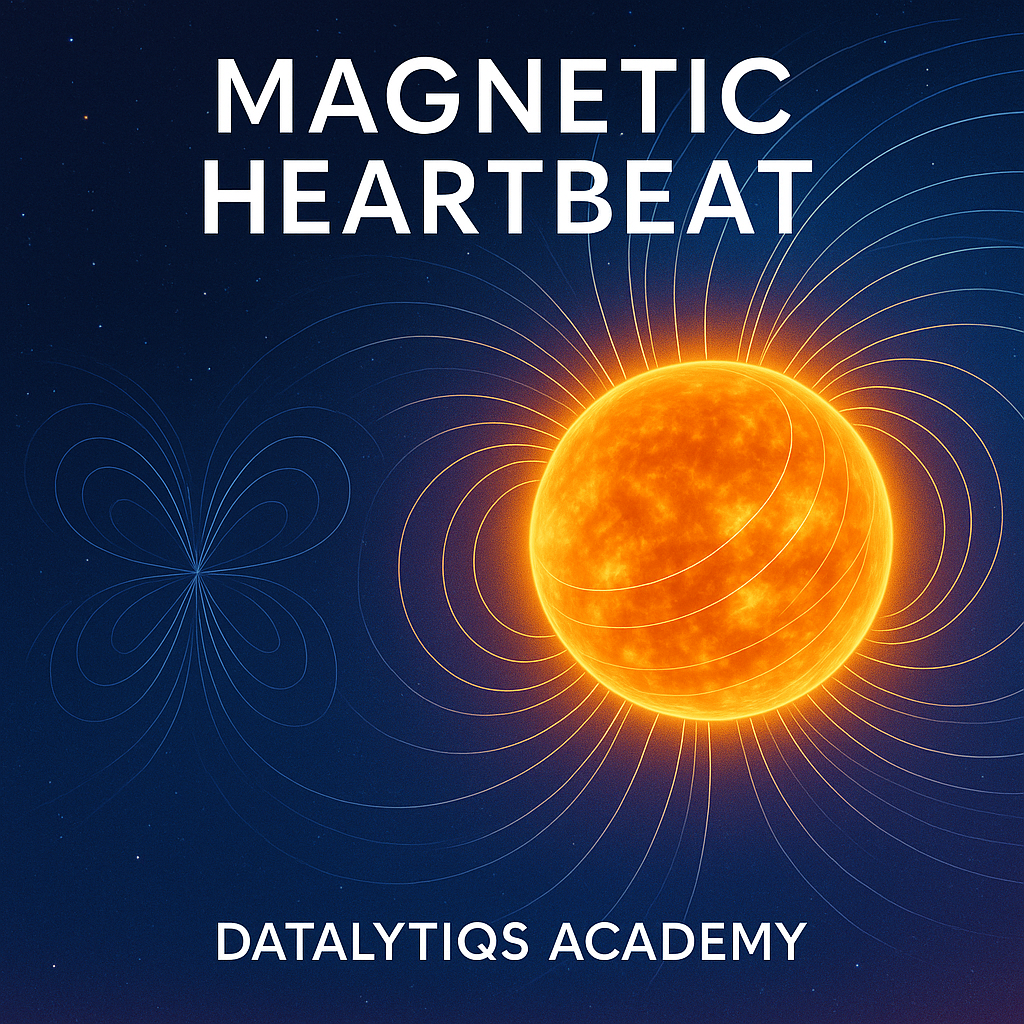
By Janine Fohlmeister, Leibniz Institute for Astrophysics Potsdam (AIP)
Edited by Sadie Harley • Reviewed by Robert Egan
Educational commentary by DatalytIQs Academy
A Star’s Magnetic Heartbeat
Astronomers at the Leibniz Institute for Astrophysics Potsdam (AIP) have observed a star astonishingly similar to our Sun—but much younger and more energetic—completing a full magnetic cycle in just two years.
The star, known as Iota Horologii (ι Hor), lies 56 light-years away in the southern constellation Horologium, the “pendulum clock.” At 600 million years old, it offers a vivid glimpse into the early magnetic life of stars like our Sun.
This discovery is part of AIP’s “Far Beyond the Sun” campaign and is published as “Far Beyond the Sun III: The Magnetic Cycle of ι Horologii” on the arXiv preprint server.
Mapping a Magnetic Dynamo
Using the HARPS polarimeter on the 3.6-meter telescope at La Silla Observatory in Chile, researchers collected nearly 200 nights of spectropolarimetric observations across six observing seasons.
By applying Zeeman Doppler Imaging (ZDI), they reconstructed 18 magnetic field maps spanning roughly 140 full rotations of the star. These maps charted the emergence, disappearance, and reversal of magnetic regions — a dynamic portrait of the stellar dynamo at work.
The team discovered that ι Hor’s magnetic poles flip every 773 days, completing a full 22-year solar equivalent in just two years — a breathtakingly rapid rhythm compared to our Sun’s slow magnetic heartbeat.
Magnetic Butterfly Diagrams Beyond the Sun
For the first time, scientists have created “magnetic butterfly diagrams” for a star other than our own.
On the Sun, these diagrams track sunspot migration from mid-latitudes toward the equator as magnetic polarity reverses.
For ι Hor, the team averaged magnetic field strengths by latitude, revealing that:
-
Poleward flows of the radial field reached speeds of 15–78 m/s,
-
Equatorward drifts of the toroidal field moved at 9–19 m/s —
Both are significantly faster than on the Sun.
These measurements mark the first-ever detection of meridional (poleward) and equatorward flows on any star besides our own.
Why This Matters
According to Dr. Julian Alvarado Gómez, lead investigator at AIP:
“These results offer a critical benchmark for understanding magnetic dynamos — the engines that drive stellar and solar activity.”
By comparing ι Hor’s rapid cycle and intense activity to the Sun’s slower 22-year cycle, scientists can infer how rotation rate and stellar age shape the evolution of magnetic fields.
Magnetic activity also dictates the intensity of stellar winds, flares, and high-energy radiation — factors that determine planetary habitability. Since ι Hor hosts at least one known exoplanet, its magnetic behavior provides clues about how young sunlike stars influence their planetary environments.
DatalytIQs Academy Perspective: Stellar Dynamos and Data Modeling
At DatalytIQs Academy, this discovery serves as a rich teaching case for students in Stellar Physics, Space Data Analytics, and Exoplanetary Environments.
Learners explore:
-
Magnetohydrodynamic (MHD) modeling of stellar interiors,
-
Spectropolarimetric data processing for detecting magnetic fields,
-
Comparative analyses between solar and stellar cycles, and
-
Statistical modeling of activity patterns using time-series data.
This case also reinforces the interdisciplinary nature of modern astronomy — where data science, physics, and machine learning converge to reveal the unseen engines powering the stars.
In Summary
Iota Horologii’s rapid magnetic cycle is more than a stellar curiosity — it’s a window into our Sun’s past and a key to understanding the magnetic lives of stars across the galaxy.
From solar flares to stellar dynamos, the pulse of the cosmos beats faster than we once imagined — and DatalytIQs Academy is here to decode every rhythm.
Leave a Reply
You must be logged in to post a comment.