Effort is the invisible force behind every academic outcome. While intelligence and environment matter, the number of hours a student spends studying remains one of the strongest predictors of success.
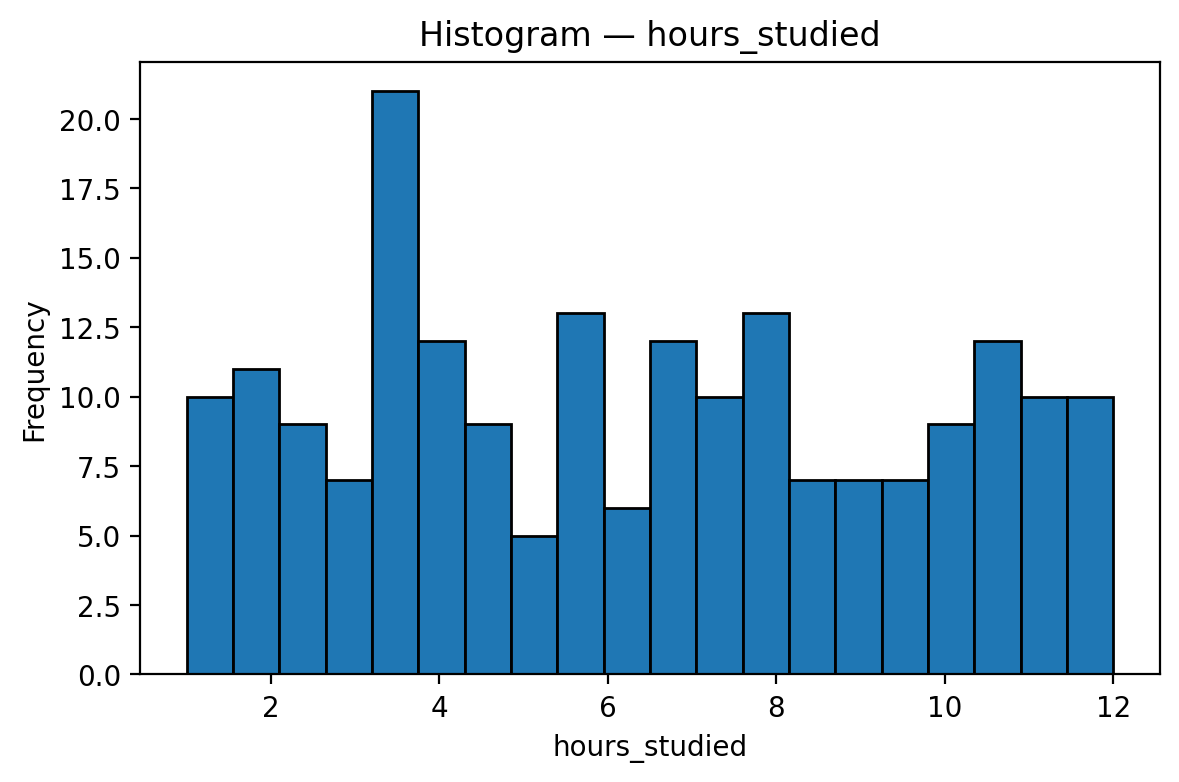
This visualization, based on the Kaggle — student_exam_scores.csv dataset, explores how students distribute their study hours and what this means for learning discipline and performance outcomes.
Understanding the Histogram
 The histogram presents the frequency of students according to their hours studied per day, ranging roughly from 1 to 12 hours.
Unlike attendance or exam scores, the distribution here is uneven and scattered; some students study for long periods, while others commit only a few hours.
Key takeaways:
-
Most students fall between 3–8 hours, representing moderate study engagement.
-
A small but significant group studies 10 hours or more, showing exceptional dedication.
-
A few learners spend less than 2 hours, which could affect their mastery of the course material.
Interpretation
-
Midrange Cluster (3–8 hrs):
The majority of students fall into this category, indicating steady but varied learning habits. -
Low Study Hours (≤2 hrs):
These learners may be underprepared, struggling with time management, or balancing other commitments. -
High Study Hours (≥10 hrs):
Intense study patterns may reflect strong motivation — but could also hint at exam pressure or inefficient study techniques.
Educational Insights
| Observation | Implication | Recommendation |
|---|---|---|
| Moderate range (3–8 hrs) dominates | Healthy study rhythm | Reinforce through balanced coursework and scheduled breaks |
| Few below 2 hrs | Risk of poor performance | Offer time-management and study-skills coaching |
| Few above 10 hrs | High motivation, possible burnout | Encourage smart studying and rest routines |
Strategic Takeaways
Effective studying is not about duration alone; it’s about consistency and focus.
Institutions can use this kind of analysis to:
-
Identify students who may need study-planning support,
-
Encourage evidence-based learning strategies, and
-
Promote the principle of “study smarter, not longer.”
Acknowledgment
Data Source: Kaggle — student_exam_scores.csv
Analysis and Visualization: Education Analytics Unit, DatalytIQs Academy (2025)
Leave a Reply
You must be logged in to post a comment.