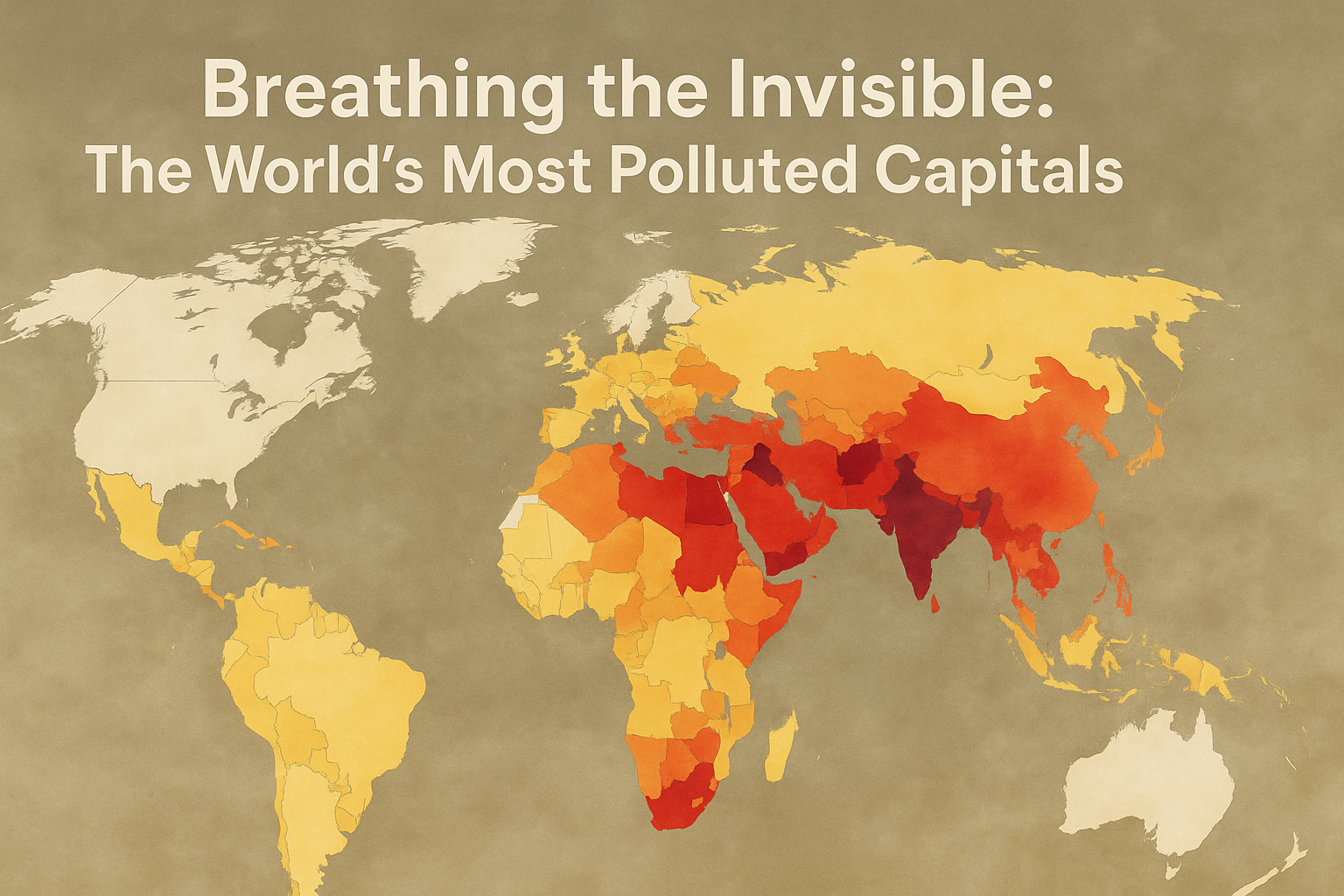
Air pollution is the silent climate crisis; it kills more people each year than traffic accidents, malaria, or war.
Using the Kaggle — Global Daily Weather Dataset (August 2023–2024), we identified the Top 10 countries with the highest concentrations of fine particulate matter (PM2.5), along with their corresponding PM10 levels.
These micro-pollutants, smaller than 2.5 micrometers, penetrate deep into the lungs, enter the bloodstream, and are linked to heart disease, stroke, and respiratory illnesses.
Top 10 Countries with the Highest PM2.5 Concentrations
| Rank | Country | PM2.5 (µg/m³) | PM10 (µg/m³) |
|---|---|---|---|
| 1 | Chile | 195.06 | 223.91 |
| 2 | Saudi Arabia | 145.47 | 1301.13 |
| 3 | China | 140.35 | 171.91 |
| 4 | India | 110.60 | 243.76 |
| 5 | Kuwait | 102.84 | 463.23 |
| 6 | Indonesia | 96.54 | 111.13 |
| 7 | Mauritania | 76.02 | 369.14 |
| 8 | Bahrain | 73.95 | 208.32 |
| 9 | Malaysia | 72.37 | 80.42 |
| 10 | Südkorea (South Korea) | 70.20 | 74.90 |
🔍 Interpretation and Key Insights
-
Chile Tops the Global PM2.5 Chart:
Despite its clean image, Chile’s readings are driven by industrial emissions and seasonal wildfires, especially in mining and forest regions.
This highlights how natural and industrial sources jointly elevate fine-particle concentrations. -
The Middle East’s Dust Burden:
Saudi Arabia, Kuwait, and Bahrain face extreme PM levels, largely due to frequent sandstorms, desert winds, and oil refining activities.
Saudi Arabia’s staggering PM10 value (1301 µg/m³) underscores coarse dust dominance. -
Asia’s Industrial Belt:
China, India, and Indonesia show high PM2.5 from industrial emissions, traffic congestion, and crop-burning, aligning with decades of environmental stress linked to rapid urbanization. -
African Aridity and Dust:
Mauritania demonstrates how natural desert dust, not industry, can cause serious air quality degradation across the Sahel and Sahara regions. -
Southeast Asia’s Subtle Strain:
Malaysia’s and South Korea’s elevated yet lower PM levels reflect mixed causes, vehicular traffic, transboundary haze, and urban density.
Health and Environmental Implications
| Impact Area | Description |
|---|---|
| Human Health | Chronic exposure to PM2.5 is linked to heart disease, asthma, cancer, and shortened life expectancy. |
| Climate Change | Fine particles alter cloud formation and absorb solar radiation, intensifying heat waves. |
| Economic Costs | Countries spend billions annually addressing pollution-related healthcare and lost productivity. |
| Policy Urgency | These results call for stronger air quality monitoring, green energy transitions, and emission regulations. |
Global Perspective
-
🌆 Urban industrial nations need tighter emission controls and clean transport policies.
-
🌬️ Desert and arid regions require dust management programs (windbreaks, vegetation cover).
-
🌱 International cooperation is vital — air doesn’t respect borders, and transboundary haze requires regional collaboration.
Key Takeaway
The air we breathe connects us all. From Santiago to Riyadh to Beijing, the data remind us that economic progress must not come at the expense of planetary health.
Investing in renewable energy, cleaner transport, and smarter city planning is the only sustainable way forward.
Acknowledgment
Dataset Source: Kaggle — Global Daily Weather Data (2023–2024)
Analysis and Visualization: Climate and Environmental Analytics Unit, DatalytIQs Academy (2025)
Leave a Reply
You must be logged in to post a comment.