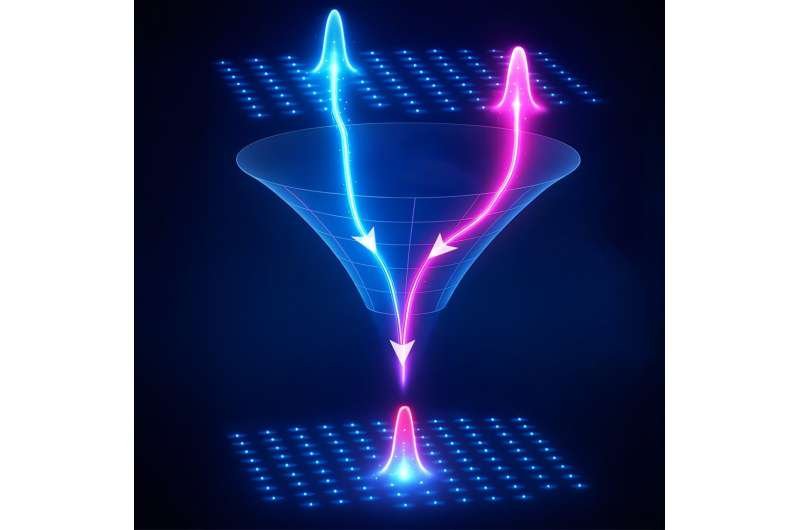
In a leap that could reshape the future of computing and communications, researchers from the University of Southern California (USC) have unveiled the first-ever optical device designed using the principles of “optical thermodynamics.”
The breakthrough—published in Nature Photonics—marks a revolutionary step in photonics, the science of controlling light. Unlike conventional optical routers that depend on electronic switches or external controls, this new device allows light to route itself naturally, guided by the same fundamental rules that govern heat and energy flow in the physical world.
When Light Behaves Like Heat
The research team from USC’s Ming Hsieh Department of Electrical and Computer Engineering discovered that light in complex nonlinear optical systems behaves much like a gas reaching thermal equilibrium.
In classical thermodynamics, gas molecules move, collide, and distribute energy until a stable balance—an equilibrium—is achieved. Similarly, in nonlinear optical lattices, light waves interact and self-organize until they find a natural pathway through the system.
This realization led to the creation of a new theoretical and practical framework: optical thermodynamics. It treats light not merely as a wave or particle, but as a thermodynamic medium—capable of expansion, compression, and even phase transitions.
“What was once viewed as an intractable challenge in optics has been reframed as a natural physical process,” explains Professor Demetrios Christodoulides, the Steven and Kathryn Sample Chair in Engineering at USC Viterbi.
“This may redefine how engineers approach the control of light and other electromagnetic signals.”
A Device That Routes Light by Itself
To appreciate the power of this idea, imagine a marble maze that arranges itself. Normally, you would have to lift barriers and manually guide the marble toward its destination. In the USC device, however, the maze is built so perfectly that no matter where you drop the marble, it rolls on its own toward the right exit.
That’s exactly what happens to light in the optical thermodynamics system:
-
It begins with an optical expansion, analogous to the Joule–Thomson process in gases.
-
It then naturally redistributes its intensity—like heat spreading evenly through a room—until it reaches optical equilibrium.
The outcome? Light automatically routes into the correct channel—no external switches, no digital control, no manual adjustment.
Implications for Computing and Industry
This new paradigm could transform multiple industries that depend on the manipulation of light. From chip-scale optical interconnects used in high-speed computing to data center communications and quantum information systems, the potential applications are immense.
Tech giants like NVIDIA and others are already exploring optical data transfer to overcome the speed and power limits of traditional electronics. The USC team’s work provides a simpler, self-organizing foundation for such systems—reducing complexity while increasing efficiency.
“By allowing light to find its own path,” says Hediyeh M. Dinani, the study’s lead author and a Ph.D. researcher in the Optics and Photonics Group at USC Viterbi, “we’re introducing a new way to design photonic systems that are both self-regulating and scalable.”
Turning Chaos Into Predictability
Nonlinear optical systems have long been considered chaotic and hard to control. Their unpredictable behavior has limited their use in real-world technology. But optical thermodynamics flips this challenge into an opportunity.
By treating the apparent randomness as a natural form of equilibrium-seeking behavior, the USC researchers have found a way to turn chaos into order—allowing light to guide itself within devices once thought too complex to manage.
This discovery is not just a technical feat—it represents a conceptual shift. It shows that nature’s most elegant laws, like thermodynamics, can provide blueprints for designing the next generation of self-organizing technologies.
A New Frontier in Photonics
The implications of this research go beyond optical routing. It opens new doors for:
-
Autonomous optical computing systems
-
Energy-efficient communication networks
-
Advanced photonic materials that self-balance and self-heal
-
Exploration of fundamental physics at the intersection of light, heat, and information
By blending thermodynamic reasoning with modern photonics, the USC team has introduced a framework that could underpin the next era of light-based computation—where devices no longer require complex circuitry, because light itself does the work.
Citation & Acknowledgments
Source Article:
University of Southern California (2025). “First device based on ‘optical thermodynamics’ can route light without switches.”
Published on Phys.org, written by University of Southern California staff.
Edited by: Sadie Harley
Reviewed by: Robert Egan
Photo Credit: Yunxuan Wei, USC Viterbi School of Engineering.
Original Research: Nature Photonics (2025) – “Optical Thermodynamics and Self-Routing of Light in Nonlinear Systems” by Hediyeh M. Dinani, Demetrios N. Christodoulides et al.
Author: Collins Odhiambo — DatalytIQs Academy Science & Emerging Technologies Blog
Category: Photonics & Applied Physics
Leave a Reply
You must be logged in to post a comment.