A Landmark in Quantum Computing
For decades, scientists have been chasing one elusive goal: unquestionable proof that quantum computers can outperform classical computers — not just in theory, but in real, measurable experiments.
Now, a team led by researchers from The University of Texas at Austin (UT Austin) has achieved exactly that. Their new study, published on arXiv (2025), demonstrates a clear and unconditional quantum advantage, proving that no classical computer, regardless of future optimizations, can match the efficiency of their quantum setup.
This result sets a new benchmark called quantum information supremacy, representing a profound leap forward in computing science.
How the Quantum Challenge Was Designed
To test quantum supremacy rigorously, the team created a communication game between two quantum “players”:
-
Alice, who prepares a quantum state (a message), and
-
Bob, who must measure it and predict its contents before Alice is done.
This setup forces the system to rely on quantum memory — the ability of qubits to exist in superpositions, simultaneously holding multiple pieces of information.
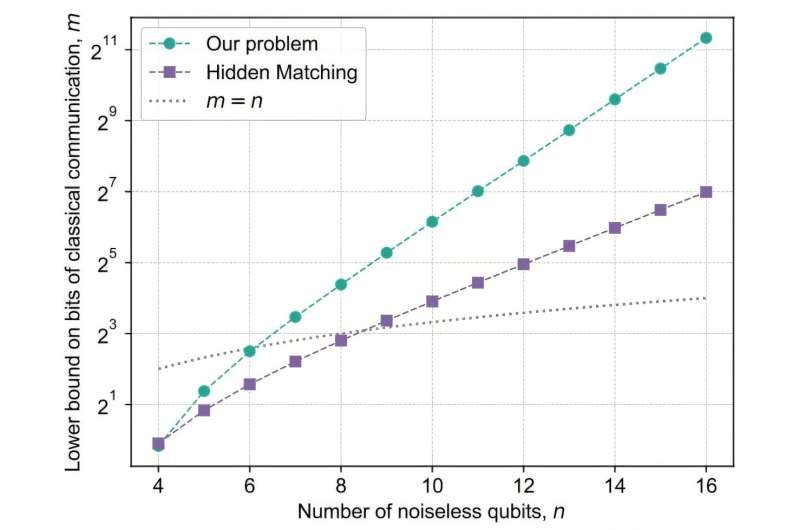
Over 10,000 trials, the quantum processor demonstrated that it could perform the task with only 12 qubits, while a classical system would require at least 62 bits of memory to achieve the same result.
That’s not just a difference in scale — it’s an exponential gap.
Why This Matters: The Quantum Memory Breakthrough
Previous claims of “quantum advantage” often depended on assumptions or computational conjectures — leaving open the possibility that faster classical algorithms might someday close the gap.
This study, however, provides an unconditional mathematical proof. The researchers confirmed that the quantum device accessed parts of the Hilbert space (the vast multidimensional space where quantum states exist) that classical computers fundamentally cannot reach.
In their own words:
“Our result provides the most direct evidence yet that currently existing quantum processors can generate and manipulate entangled states of sufficient complexity to access the exponentiality of Hilbert space.”
In essence, quantum computers have now demonstrated they can do things classical computers simply cannot — ever.
What Does This Mean for the Future?
This proof of true quantum superiority isn’t just theoretical — it paves the way for revolutionary real-world applications:
-
🔐 Next-generation cryptography: Ultra-secure communication protocols based on quantum keys.
-
💊 Drug discovery: Modeling molecular interactions far too complex for classical simulations.
-
⚙️ Materials science: Designing superconductors, catalysts, and nanostructures faster than ever before.
-
🧮 Optimization problems: Solving logistics, finance, and data-mining challenges exponentially faster.
By fully unlocking quantum memory, researchers have opened a door to computing beyond human imagination — and perhaps, beyond classical physics as we know it.
A New Era: From Quantum Promise to Quantum Proof
This experiment confirms what quantum theorists have long anticipated: quantum information is a fundamentally different resource — one that grows exponentially, not linearly.
The distinction between classical and quantum computation is now no longer philosophical or potential — it is proven.
As researchers continue to refine qubit stability, reduce noise, and expand system size, this demonstration will stand as the moment when quantum computing truly stepped out of theory and into verified reality.
Key Takeaway
Quantum supremacy has now crossed from speculation to certainty — marking a turning point in the history of computation. The age of unconditional quantum advantage has begun.
References
Arnold, P. (2025). Scientists have finally proven that a quantum computer can unconditionally outperform classical computers. Phys.org.
arXiv preprint: 10.48550/arxiv.2509.07255
Leave a Reply
You must be logged in to post a comment.