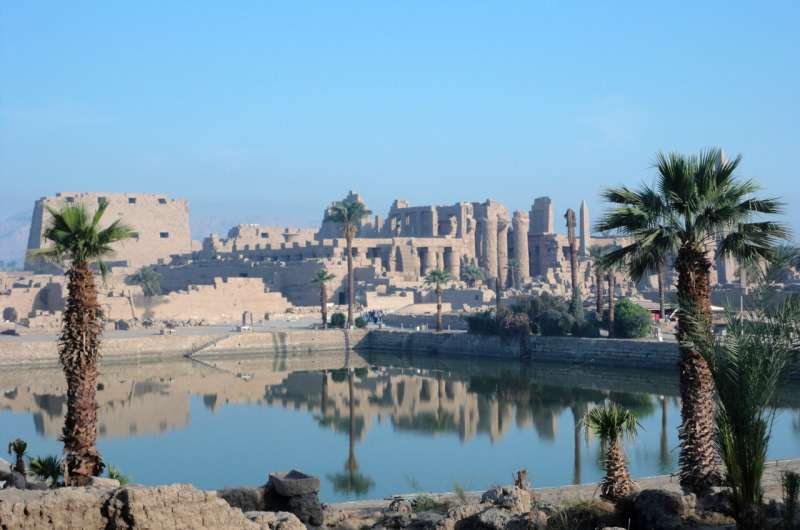
For over 3,000 years, the Temple of Amun-Ra at Karnak stood as one of the most magnificent spiritual centers of the ancient world — a sprawling complex where pharaohs worshipped, priests performed rituals, and the god Amun was believed to dwell. Now, researchers have uncovered new evidence revealing how this temple came to be — and why it was built exactly where it stands.
A team from the University of Southampton, working alongside Uppsala University and international collaborators, has conducted the most comprehensive geoarchaeological study ever performed at the site. Their findings, published in Antiquity under the title “Conceptual origins and geomorphic evolution of the temple of Amun-Ra at Karnak (Luxor, Egypt)”, provide remarkable insights into how geology, river dynamics, and mythology intertwined in the birth of Ancient Egypt’s greatest temple.
“This new research provides unprecedented detail on the evolution of Karnak Temple — from a small island to one of the defining institutions of Ancient Egypt,” said Dr. Ben Pennington, Visiting Fellow in Geoarchaeology at the University of Southampton and lead author of the study.

The River and the Temple: A Sacred Landscape
Karnak lies about 500 meters east of today’s River Nile, within the ancient city of Thebes (modern-day Luxor). But 4,500 years ago, the landscape looked very different. Using 61 sediment cores and tens of thousands of ceramic fragments, the researchers reconstructed the ancient river channels that once carved through the area.
Their results show that before around 2520 BCE, the land on which Karnak now stands was flooded by fast-flowing Nile waters — an inhospitable floodplain. But as the river’s channels shifted west and east, an island of higher ground emerged.
That island — rising above the chaotic waters — became the foundation of the temple of Amun-Ra.
“The age of Karnak Temple has been hotly contested,” said Dr. Kristian Strutt, co-author from the University of Southampton. “Our new evidence now places a clear temporal constraint on its earliest occupation and construction — during the Old Kingdom, between about 2305 and 1980 BCE.”
Rivers That Built a Civilization
The research team found that two Nile channels — one to the west and another to the east — once surrounded the site like a pair of arms. Over the centuries, these channels diverged further apart, allowing the temple to expand across newly formed land as silt and sand filled the old riverbeds.
Dr. Dominic Barker, another co-author, noted that the Ancient Egyptians didn’t just adapt to the river — they shaped it:
“We see how the people of Thebes intentionally redirected the river’s flow, possibly by dumping desert sand into channels to create new land for building.”
This intricate relationship between hydrology and human ingenuity reveals how environmental knowledge and engineering were already deeply embedded in ancient Egyptian temple planning.
A Temple Born from Creation Itself
Perhaps the most captivating finding is how the temple’s geography mirrors Egyptian creation mythology.
According to ancient texts, the creator god emerged from the “Waters of Chaos” upon a primeval mound — the first piece of land to rise from the infinite flood. This mythic imagery may not have been metaphorical at all.
“It’s tempting to suggest that Theban elites chose Karnak’s location for the dwelling place of a new form of the creator god, Ra-Amun, precisely because it reflected the cosmogonical scene of high ground emerging from surrounding water,” said Dr. Pennington.
During the Middle Kingdom (c.1980–1760 BCE), as the Nile’s floods receded each year, the rising mound at Karnak would have appeared to “emerge” from the waters, echoing the myth of creation — a divine cycle reflected in the landscape itself.
The Science of Sacred Ground
The study combines geoarchaeology, sedimentology, and ceramic analysis to trace how the interplay of natural processes and human activity gave birth to one of antiquity’s greatest wonders.
What was once thought to be merely symbolic may now be understood as literal geography inspiring theology — a place where myth, environment, and human devotion converged.
This insight transforms our understanding of Karnak, showing it not simply as a monument to power or architecture, but as a living embodiment of the ancient Egyptian worldview — where creation, nature, and divinity were inseparably linked.
With new concessions granted to study the entire Luxor floodplain, the team now plans to expand their work to nearby temples to map out how water, land, and belief shaped the sacred geography of Egypt’s ancient capital.
Citation & Acknowledgments
Source Article:
University of Southampton (2025). “Researchers unearth origins of Ancient Egypt’s Karnak Temple.” Phys.org.
Edited by: Sadie Harley
Reviewed by: Robert Egan
Image Credits: Dr. Ben Pennington
Original Study: Pennington, B., Graham, A., Strutt, K., Barker, D. et al. (2025). “Conceptual origins and geomorphic evolution of the temple of Amun-Ra at Karnak (Luxor, Egypt).” Antiquity.
Author: Collins Odhiambo — DatalytIQs Academy Archaeology & Human Origins Blog
Category: Geoarchaeology & Ancient Civilizations
Leave a Reply
You must be logged in to post a comment.