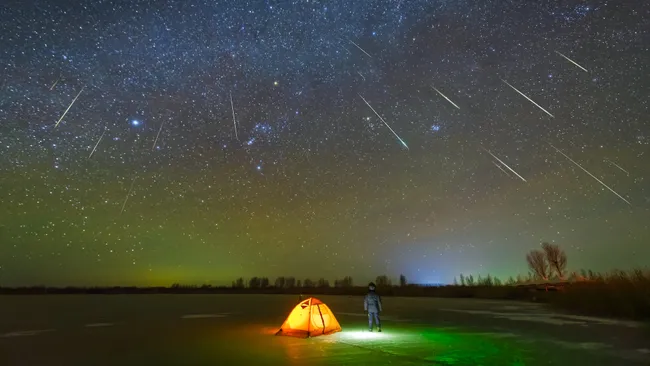
A Celestial Symphony of Fire and Ice
This October, the heavens will stage one of the most dazzling performances of the year — the Orionid meteor shower, produced by dust and debris from Halley’s Comet, will reach its 2025 peak on the nights of October 20–21.
But that’s not all: two newly discovered visitors — Comet Lemmon (C/2025 A6) and Comet SWAN (C/2025 R2) — will be at their brightest almost simultaneously, making this a rare triple-comet spectacle under a moonless sky.
According to the American Meteor Society (AMS), this year’s Orionids coincide with a new moon, meaning the darkened sky will offer exceptional viewing conditions for both meteors and comets — weather permitting.
The Orionids: Halley’s Legacy Returns Every Year
Every October, Earth passes through a trail of dust left behind by Halley’s Comet, which last visited the inner solar system in 1986 and won’t return until 2061.
When these dust particles collide with our atmosphere at 66 kilometers per second (41 miles per second), they ignite in brilliant streaks of light known as “shooting stars.”
During the Orionid peak:
-
Expect 15–25 meteors per hour under ideal dark-sky conditions.
-
Meteors will radiate from near Betelgeuse in the constellation Orion — hence the name “Orionids.”
-
Best viewing: after midnight local time, facing east.
NASA calls the Orionids “one of the most beautiful meteor showers of the year” due to their fast, bright trails and frequent long-lasting fireballs.
Bonus Spectacle: Two Comets Brighten the Sky
Adding to the excitement are two bright comets sharing the October sky:
Comet Lemmon (C/2025 A6)
-
Discovered: January 2025 by the Mt. Lemmon SkyCenter, Arizona.
-
Visibility: Low in the northwest, between the handle of the Big Dipper and the bright star Arcturus.
-
Best Time: About 1.5 hours after sunset on Oct. 20.
-
Appearance: A faint green glow — visible with binoculars, possibly to the naked eye from dark-sky sites.
Comet SWAN (C/2025 R2)
-
Discovered: September 2025 by NASA’s Solar Dynamics Observatory (SDO) using its SWAN (Solar Wind ANisotropies) instrument.
-
Visibility: Low in the southern sky, just beneath Altair in the Summer Triangle.
-
Best Time: Shortly after sunset, Oct. 20–21.
Together, they frame a sky where comets and meteors share the same stage — a rare event for observers and astrophotographers alike.
How to Watch the 2025 Orionids & Comets
| Event | Peak Date | Best Viewing Time | Direction | Visibility Tip |
|---|---|---|---|---|
| Orionid Meteor Shower | Oct. 20–21 | After midnight | East / near Orion’s Belt | Look away from Orion to catch the longest trails |
| Comet Lemmon (C/2025 A6) | Oct. 20 | ~1.5 hrs after sunset | Northwest, near Arcturus | Use binoculars; best from dark sky areas |
| Comet SWAN (C/2025 R2) | Oct. 20–21 | Dusk to early evening | South, below Altair | Visible near the horizon — unobstructed southern view |
Moon Phase: New Moon → ideal dark sky
☁️ Best Conditions: Clear, dry nights away from city lights
📸 Astro Tip: Use a wide-field lens (24mm–35mm) with long exposure to capture meteors and faint comet tails simultaneously.
Scientific Context: Cosmic Time Capsules
Halley’s Comet, Lemmon, and SWAN represent different epochs of our solar system’s history:
-
Halley’s dust trail offers a glimpse of cometary material ejected thousands of years ago.
-
Lemmon and SWAN, new arrivals from the outer solar system, are pristine icy bodies carrying clues about early solar chemistry.
Together, they help astronomers study:
-
The composition of cometary dust and gas,
-
The interaction between solar wind and comet tails, and
-
The longevity of periodic vs. non-periodic comets in near-Earth space.
Why This Event Matters
This triple alignment of Halley’s meteors and two active comets is a once-in-decades opportunity to connect visible phenomena with real astrophysical processes.
For learners at DatalytIQs Academy, it’s a natural case study in:
-
Celestial mechanics,
-
Orbital resonance modeling, and
-
Time-based observational astronomy.
It also reinforces how predictable mathematical patterns — like orbital periods — yield profoundly beautiful real-world effects visible to the naked eye.
Acknowledgments
This article draws on reporting by Jamie Carter (Live Science, 2025), with data from:
-
American Meteor Society (AMS)
-
NASA Jet Propulsion Laboratory (JPL)
-
European Space Agency (ESA) ephemeris data
-
Mt. Lemmon SkyCenter and NASA’s Solar Dynamics Observatory (SDO)
Curated and adapted by Collins Odhiambo Owino for DatalytIQs Academy – Astronomy & Space Analytics Series, where celestial events meet scientific interpretation.
Leave a Reply
You must be logged in to post a comment.