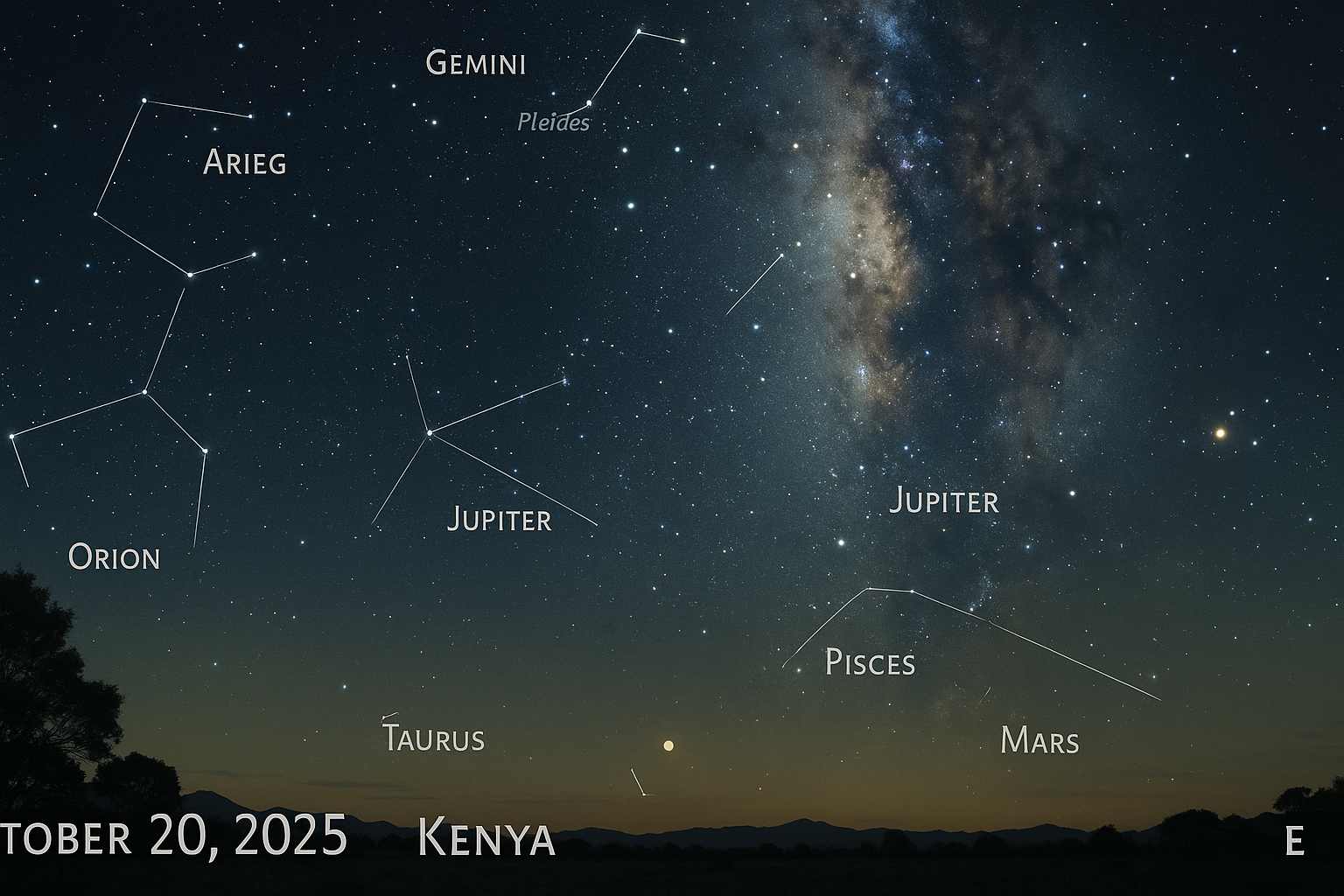
Every clear night in October 2025 offers a chance to witness the silent ballet of the cosmos — planets glowing in the twilight, constellations rising and setting, and occasional meteor showers lighting up the heavens. Whether you’re a beginner with binoculars or an experienced observer using a telescope, there’s something for everyone in this month’s night sky.
This guide highlights the main celestial events, visible planets, and best observing times, helping you connect astronomy with real-time observation and data analytics — the DatalytIQs way.
October 2025 Skywatching Calendar
| Date | Event | Description |
|---|---|---|
| Oct. 1–3 | Mercury at Greatest Western Elongation | The best time to spot Mercury is in the eastern sky before sunrise. |
| Oct. 6 | Moon near Saturn | A beautiful pairing visible after sunset. Use binoculars for the best contrast. |
| Oct. 9–10 | Draconid Meteor Shower | Up to 10 meteors/hour; look toward the northern sky near the constellation Draco. |
| Oct. 13 | First Quarter Moon | Perfect phase for lunar observation — craters and shadows are most detailed. |
| Oct. 17–21 | Orionid Meteor Shower Peak | One of October’s best shows — 20 meteors/hour from debris of Halley’s Comet. |
| Oct. 23 | Venus at Greatest Brightness | Brilliant “evening star” in the west after sunset. |
| Oct. 26–28 | Jupiter at Opposition | Closest to Earth and fully illuminated — ideal for telescope viewing. |
| Oct. 31 | Halloween Full Moon | The “Hunter’s Moon” lights up the night sky — perfect for eerie photo sessions. |
Visible Planets in October 2025
-
Mercury – Visible just before dawn early in the month.
-
Venus – Dazzling in the evening sky, especially mid-month.
-
Mars – Faint but visible before sunrise; will brighten toward the year’s end.
-
Jupiter – Dominates the night sky in opposition — see its moons through any telescope.
-
Saturn – High in the southern sky at dusk, with rings beautifully tilted.
-
Uranus & Neptune – Require telescopes; Uranus reaches opposition on Oct. 29.
Moon Phases
| Phase | Date |
|---|---|
| New Moon | Oct. 1 |
| First Quarter | Oct. 13 |
| Full Moon | Oct. 31 |
| Last Quarter | Oct. 21 |
Top Telescope Pick (Beginner-Friendly)
Celestron StarSense Explorer DX 130AZ
Recommended for entry-level astrophotography and real-time sky mapping. Connect your smartphone and use the StarSense app to identify celestial objects instantly.
Track Satellites & the ISS
Use the DatalytIQs Academy SkyTracker Tool (integration coming soon) to locate and track the International Space Station (ISS), Starlink satellites, and other visible spacecraft in real-time using N2YO data feeds.
Astrophotography Tip
Use a DSLR or mirrorless camera on a tripod. Set exposure between 10–25 seconds, ISO 1600–3200, and a wide-angle lens. Stack multiple shots using DeepSkyStacker or PixInsight for crisp results.
Sky Map: October 2025

-
Northern Hemisphere: Orion rising in the east, Pegasus overhead, and the Andromeda Galaxy visible.
-
Southern Hemisphere: Sagittarius sets early; Scorpius fades while Canopus begins to rise.
Did You Know?
-
The Orionids come from debris left by Halley’s Comet, the same comet visible from Earth every 75–76 years.
-
The Hunter’s Moon follows the Harvest Moon, symbolizing traditional autumn hunts in northern cultures.
Explore More with DatalytIQs Academy
Our Astronomy & Space Analytics track introduces learners to:
-
Celestial navigation and coordinate systems
-
Data visualization using real astronomical datasets (NASA, ESA, Hubble, JWST)
-
Photometric and spectroscopic data analysis using Python
By DatalytIQs Academy — Adapted from Chris Vaughan (Space.com, Oct. 10, 2025)
Leave a Reply
You must be logged in to post a comment.