A Deeper Look into a Cosmic Powerhouse
The galaxy M87, located about 53 million light-years away in the Virgo Cluster, has fascinated astronomers for decades. It hosts one of the most massive black holes ever discovered—the same one that produced the first-ever black hole image from the Event Horizon Telescope (EHT) in 2019.
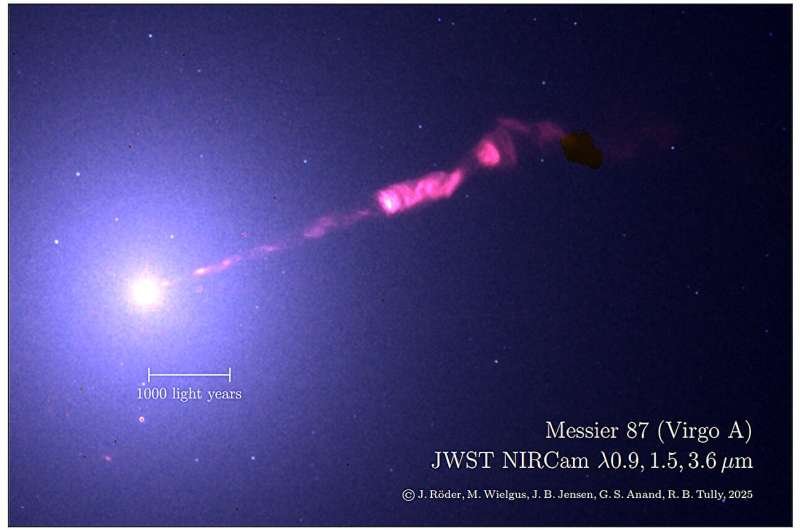
Now, thanks to the James Webb Space Telescope (JWST), scientists have captured the most detailed infrared view yet of M87’s iconic black hole jet — a stream of high-energy particles traveling nearly at the speed of light.
This groundbreaking study, published in Astronomy & Astrophysics (2025), unveils new substructures, knots, and counter-jet features that deepen our understanding of how black holes release energy across the cosmos.
A Jet that Defies Imagination
First cataloged by Charles Messier in the 18th century, M87 appeared at first glance as just a fuzzy nebula. Modern telescopes later revealed it as a giant elliptical galaxy with an extraordinary feature:
a relativistic jet shooting out from its central supermassive black hole — a structure extending thousands of light-years into space.
This jet is famous for its synchrotron emission, radiation produced as charged particles spiral along magnetic field lines at near-light speeds. Previous studies using radio, X-ray, and optical observations have traced its general shape and energy, but infrared details were missing — until now.

How JWST’s Infrared Eyes Transformed the View
Using JWST’s Near Infrared Camera (NIRCam), astronomers observed M87’s jet in four infrared bands (0.90, 1.50, 2.77, and 3.56 µm).
Through advanced data processing — including galaxy modeling, background subtraction, and stellar light removal — they isolated the jet’s own glow from the galaxy’s overwhelming brightness.
What emerged was a highly detailed image of both the main jet and the elusive counter-jet, revealing features invisible in optical light.
Key Findings: The Anatomy of M87’s Jet
-
Helical Jet Structure:
The main jet shows a twisting, helical shape, suggesting the influence of strong magnetic fields and relativistic rotation. -
Bright Knot “L” and HST-1:
-
Knot L: A slowly moving, luminous region close to the nucleus.
-
HST-1: A famous, fast-moving “superluminal” component discovered by the Hubble Telescope — now resolved into two substructures with distinct spectral indices, offering clues about particle acceleration.
-
-
Counter-Jet Revealed:
For the first time in this wavelength, JWST captured a clearer image of the counter-jet, located about 24 arcseconds from the galaxy’s nucleus.
It forms a C-shaped filament structure connected by a bright hotspot — consistent with radio observations, but far sharper in detail.
Why This Discovery Matters
The ability to trace both the main jet and counter-jet in infrared allows researchers to probe:
-
The magnetic field geometry shapes the jet’s spiral motion,
-
The energy distribution of relativistic particles, and
-
How material is accelerated outward from the black hole’s accretion disk.
This data also bridges observational gaps between radio, optical, and X-ray studies — giving scientists a complete multi-wavelength picture of jet physics in active galactic nuclei (AGN).
A Glimpse into the Future of Black Hole Science
Infrared astronomy, powered by JWST, has opened a new frontier in studying the invisible forces sculpting galaxies.
Future missions combining JWST data with polarimetric and high-resolution radio observations could reveal:
-
The exact magnetic field orientations,
-
How energy is transported along jets, and
-
How these colossal outflows shape their host galaxies.
As the lead authors note:
“The residual jet images are consistent with the radio to optical spectrum… We identified all distinct jet components up to 24 arcseconds from the nucleus, including HST-1 and the upstream knot L.”
Key Takeaway
The James Webb Telescope is not just looking farther into the universe — it’s looking deeper into its hidden structures.
With these infrared insights, we now see M87’s black hole jet not as a distant cosmic flare, but as a finely sculpted engine of energy and motion, powered by one of nature’s most extreme objects.By Krystal Kasal, Phys.org
Edited by Lisa Lock, reviewed by Robert Egan
Published in: Astronomy & Astrophysics (2025)
DOI: 10.1051/0004-6361/202556577
References:
Kasal, K. (2025). Infrared data from the James Webb Telescope reveal more structural details of M87’s black hole jet. Phys.org.
Published in Astronomy & Astrophysics (2025). DOI: 10.1051/0004-6361/202556577
Leave a Reply
You must be logged in to post a comment.