 Heart disease remains a leading cause of mortality globally, yet its clinical presentation varies significantly across individuals. One of the most telling indicators is chest pain type, which provides early diagnostic clues for clinicians and health policy planners alike.
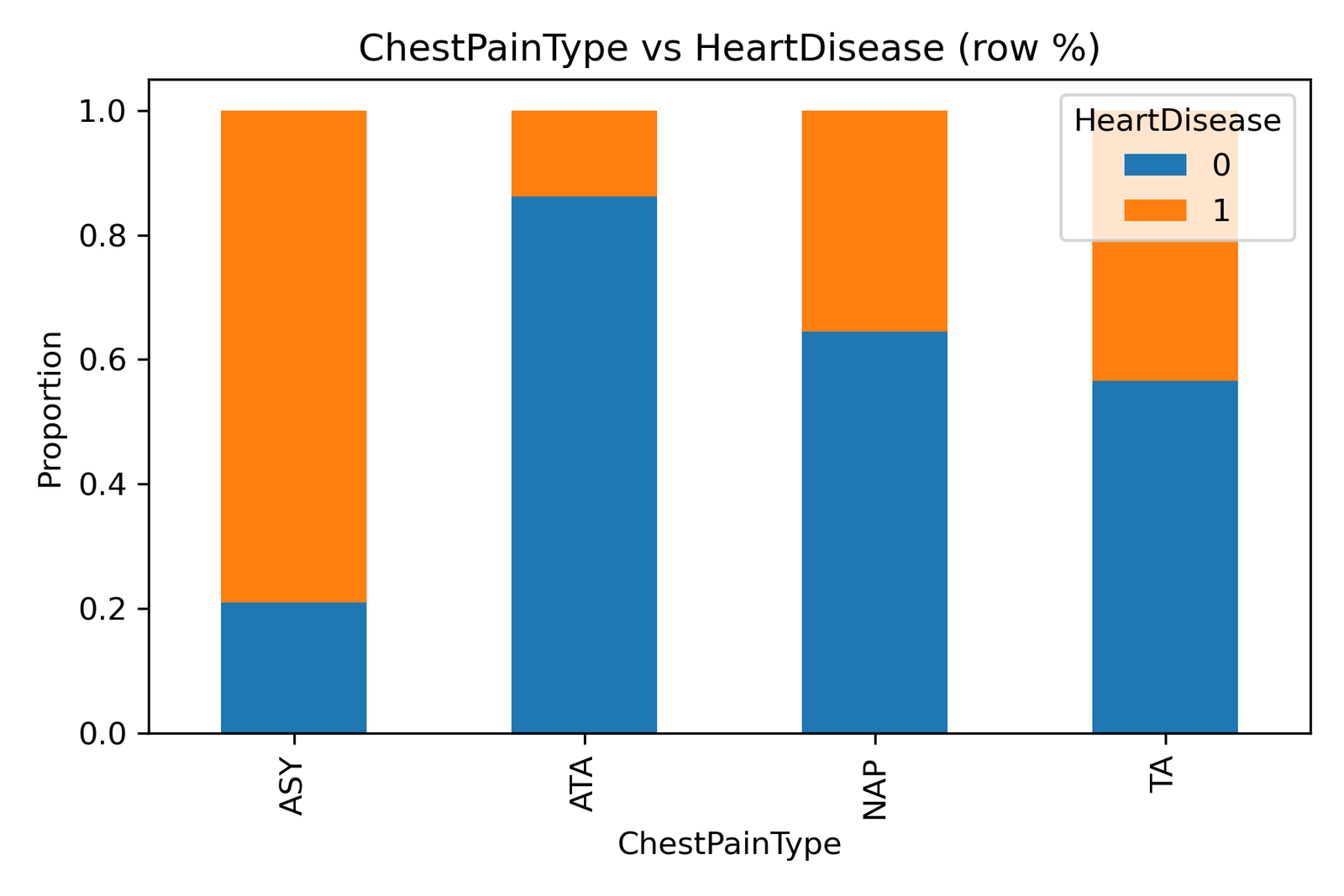
The visualization above explores the relationship between Chest Pain Type and Heart Disease prevalence, offering proportional insights derived from patient data.
2. The Visualization Explained
The stacked bar chart titled “ChestPainType vs HeartDisease (row %)” above compares four categories of chest pain — ASY, ATA, NAP, and TA — against the occurrence of heart disease (HeartDisease = 1) and non-occurrence (HeartDisease = 0).
Each bar represents the proportion of patients within a given chest pain category, subdivided by disease status:
-
Blue (0): No heart disease diagnosed.
-
Orange (1): Heart disease confirmed.
3. Key Insights
-
Asymptomatic (ASY) patients stand out with the highest proportion of positive heart disease cases. This highlights a silent risk factor — individuals without typical chest pain symptoms may still have underlying cardiac issues.
-
Atypical Angina (ATA) and Non-Anginal Pain (NAP) show a lower prevalence of heart disease, suggesting that atypical pain presentations may often lead to false alarms but still warrant medical evaluation.
-
Typical Angina (TA) patients exhibit a moderate association with confirmed heart disease, reinforcing traditional diagnostic pathways.
4. Implications for Healthcare Practice and Policy
From a public health perspective, this analysis emphasizes the importance of comprehensive screening beyond symptomatic complaints. Policymakers and healthcare planners can leverage such findings to:
-
Refine screening guidelines by incorporating risk stratification for asymptomatic individuals.
-
Promote early intervention programs targeting silent cardiovascular risks.
-
Enhance data-driven policy frameworks for the prevention and management of heart diseases.
5. Acknowledgements
This analysis was conducted as part of ongoing data analytics research under DatalytIQs Academy, an educational and professional analytics platform committed to transforming data into actionable insights in Mathematics, Economics, and Finance.
The data originates from Kaggle’s open cardiovascular datasets, analyzed using Python libraries such as pandas, matplotlib, and seaborn.
6. About the Author
Written by Collins Odhiambo Owino, founder of DatalytIQs Academy, passionate about bridging data science and decision-making for real-world impact across education, finance, and public health.
Leave a Reply
You must be logged in to post a comment.