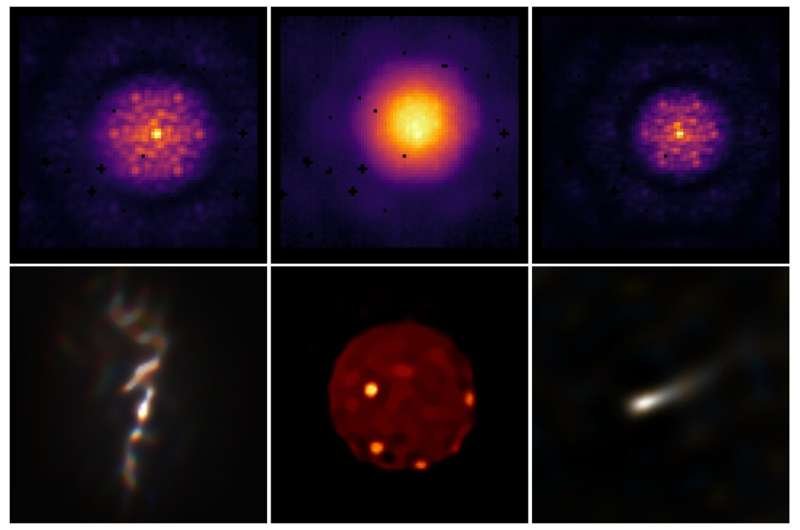
Two Ph.D. students, Louis Desdoigts and Max Charles, have achieved what once required a space mission: they restored the James Webb Space Telescope’s sharp focus using only software.
Working under Professor Peter Tuthill (creator of JWST’s Aperture Masking Interferometer), the pair developed AMIGO (Aperture Masking Interferometry Generative Observations)—a neural network–based correction system that simulates JWST’s optics and detector behavior.
Problem:
The telescope’s infrared camera suffered from subtle electronic distortions — known as the “brighter-fatter effect” — that blurred images from its interferometer.
Solution:
AMIGO models these imperfections and applies AI-driven deblurring algorithms, restoring JWST’s interferometric precision without physical intervention.
Results:
-
Sharper direct images of a faint exoplanet and a brown dwarf orbiting HD 206893 (≈133 light-years away).
-
Renewed captures of a black hole jet, Io’s volcanic surface, and WR 137’s dusty stellar winds.
-
Demonstration that AI calibration can extend the telescope’s capabilities from the ground.
Why It Matters:
This marks a new paradigm in space instrumentation—where machine learning can correct optical distortions remotely, ensuring multibillion-dollar telescopes remain in peak form without human missions.
Dr. Desdoigts is now at Leiden University; Max Charles continues work at Sydney. Their work appears on arXiv and will soon be published in the Publications of the Astronomical Society of Australia.
Leave a Reply
You must be logged in to post a comment.