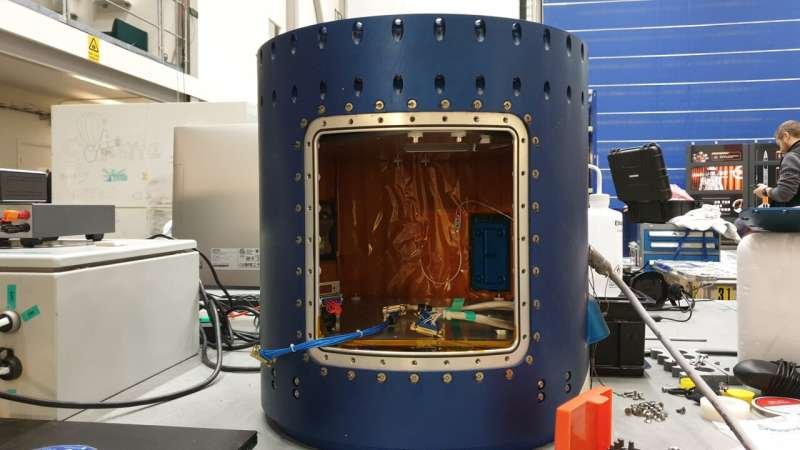
In a world-first experiment, researchers from RMIT University have confirmed that microbes essential to human health can survive the extreme conditions of space travel—from the explosive acceleration of rocket launch to the violent heat and pressure of re-entry into Earth’s atmosphere.
Published in npj Microgravity, the study tested spores of Bacillus subtilis, a bacterium known for supporting gut health, immunity, and blood circulation. These hardy spores were launched 260 kilometers above Earth aboard the Suborbital Express 3 – M15 59 sounding rocket. Despite being exposed to forces of up to 13 g during ascent, microgravity for over six minutes, and 30 g during re-entry, the bacteria survived completely intact and viable.
“Our research showed that an important type of bacteria for human health can withstand rapid gravity changes, acceleration, and deceleration,” said Distinguished Professor Elena Ivanova, co-author from RMIT University.
“This helps us understand how microorganisms might behave in long-term spaceflight and supports the development of healthier, more sustainable life-support systems for astronauts.”
What This Means for the Future of Space Travel

For upcoming missions to Mars and beyond, this research is groundbreaking. It shows that life-supporting microbes can endure the rigors of space, meaning astronauts could carry their microbiome safely across the solar system. Maintaining beneficial bacteria in the human body is crucial for digestion, immune function, and mental well-being, especially during missions lasting years.
RMIT space scientist Associate Professor Gail Iles explained that this study also broadens our understanding of life’s resilience:
“Knowing how microorganisms survive in space enhances our understanding of how life endures harsh environments. It also informs the search for extraterrestrial life on other planets.”
The experiment provides a blueprint for designing future biological and pharmaceutical experiments in space. For instance, scientists could test drug delivery systems in microgravity, explore bacterial adaptation for biotechnology, and even develop new treatments for antibiotic-resistant bacteria on Earth.
Beyond Space: Benefits for Life on Earth
While the study strengthens prospects for sustainable space colonies, it also has profound terrestrial applications. Understanding microbial resilience could:
-
Lead to new antibacterial materials and medical therapies.
-
Inspire industrial biotechnology in extreme environments (like deep-sea or volcanic regions).
-
Advance drug delivery research by testing how medicines behave under changing gravitational forces.
Collaboration and Innovation
This cutting-edge research was made possible through partnerships between RMIT University, ResearchSat, and Numedico Technologies, with the Swedish Space Corporation hosting the launch. The team even designed a custom 3D-printed microtube holder to secure bacterial samples during flight—a small but critical innovation for conducting life science research in real space conditions.
Looking Ahead
The RMIT-led team is now seeking further funding to expand their microgravity life sciences program, with future experiments planned to explore drug formulation, microbial genetics, and cellular responses under space-like conditions. These advancements could not only safeguard the health of future astronauts but also transform medicine, biotechnology, and planetary science here on Earth.
Credits:
-
Author: RMIT University
-
Editors: Sadie Harley, Robert Egan
-
Image Credit: Gail Iles, RMIT University
-
Adapted and Explained by: DatalytIQs Academy
Educational Insight:
This research reminds us that life is remarkably resilient. As humanity prepares to become a multi-planetary species, understanding how even the smallest forms of life survive space conditions will be key to colonizing Mars, advancing biotechnology, and redefining what “living beyond Earth” truly means.
Leave a Reply
You must be logged in to post a comment.