By University of Michigan | Edited by Sadie Harley | Reviewed by Robert Egan
Blog Commentary & Reflections by DatalytIQs Academy
The Hidden Emissions Behind What’s on Your Plate
When you bite into a juicy steak or enjoy a crispy piece of fried chicken, it’s easy to forget the complex web of environmental interactions that brought that meal to your table. But a groundbreaking study from the University of Michigan and the University of Minnesota, recently published in Nature Climate Change (2025), reveals the true extent of these impacts—coining a striking new term: the “carbon hoofprint” of meat.
This hoofprint represents the greenhouse gas (GHG) emissions associated with meat consumption per person, and it varies significantly across U.S. cities. The study reveals that the carbon footprint of urban America is so large that it surpasses the entire carbon footprint of Italy.
Mapping Meat’s Carbon Journey
Researchers analyzed supply chains for beef, pork, and chicken—each with vastly different environmental footprints. Using the Food System Supply-Chain Sustainability (FoodS³) platform, they mapped how meat travels from rural farms to city plates, tracing emissions from fertilizer use, feed production, livestock rearing, processing, and transportation.
In Los Angeles, for example, beef is processed in just 10 counties—but that beef originates from livestock raised in 469 counties and fed by crops grown in 828 counties across the nation. Every stop in that chain—each truck, farm, and feed mill—adds another layer to the city’s overall carbon footprint.
Surprising Findings
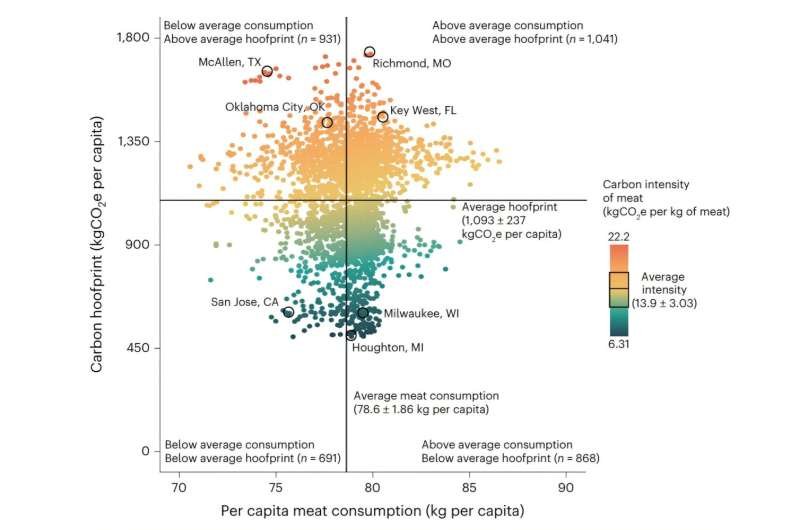
Contrary to expectations, cities that consume more meat per person don’t always have the largest hoofprints. Milwaukee, Wisconsin, and Houghton, Michigan, for example, both have above-average meat consumption but below-average emissions per capita.
Why? Because what truly matters is where and how meat is produced, not just how much people eat. Production methods, feed sources, and farming efficiency can cause massive variations in emissions.
Why It Matters
The study underscores that dietary choices can be as powerful as home energy upgrades when it comes to cutting carbon emissions. “If you just cut out half of your beef consumption and maybe switch to chicken,” says lead author Benjamin Goldstein, “you can get similar amounts of greenhouse gas savings depending on where you live.”
That’s a striking comparison—swapping steaks for chicken could rival installing solar panels in terms of personal impact, but at a fraction of the cost.
Urban–Rural Connections
Beyond personal choices, the research highlights a deeper truth: cities and rural areas are connected in a shared environmental system. Urban diets shape rural economies and landscapes. The authors urge cities to collaborate with agricultural regions to create win–win solutions.
For example, instead of cutting out pork entirely, urban governments could fund anaerobic digesters that reduce methane emissions on hog farms—balancing environmental goals with rural livelihoods.
As Jennifer Schmitt of the University of Minnesota notes, “We are all connected. This should be the beginning of an urban–rural conversation.”
DatalytIQs Academy Perspective
At DatalytIQs Academy, we see this research as a data-driven call to rethink how we measure and act on sustainability. It’s a perfect case study in “data for impact”—where analytics illuminate the hidden pathways linking our consumption to global environmental outcomes.
Our analytics and sustainability courses explore similar intersections of data science, climate policy, and public behavior, helping learners connect evidence to action. Whether in Kenya, the U.S., or beyond, the message is clear: data empowers change.
Just as cities can trace their “carbon hoofprints,” individuals, institutions, and governments can use data to track—and transform—their footprints toward a sustainable future.
Acknowledgments
This blog commentary was inspired by the research article “Revealing the Carbon Hoofprint of Meat Consumption for American Cities” published in Nature Climate Change (2025) by the University of Michigan and the University of Minnesota team led by Benjamin P. Goldstein, Rylie Pelton, Joshua Newell, Jennifer Schmitt, Dimitrios Gounaridis, and Nathaniel Springer.
Special Acknowledgment:
DatalytIQs Academy — for its commitment to data-driven learning, sustainability education, and bridging the gap between science, analytics, and actionable policy through open knowledge and global collaboration.
Leave a Reply
You must be logged in to post a comment.