A historic ocean mission has begun.
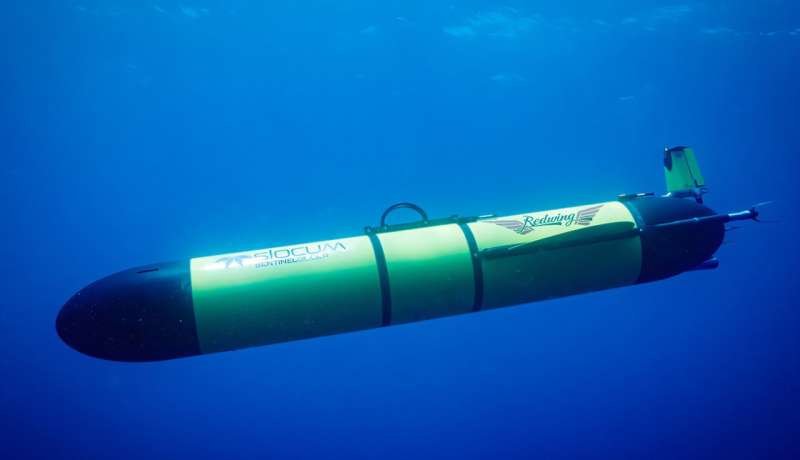
Rutgers University, in collaboration with Teledyne Marine, has launched Redwing — an advanced autonomous underwater glider designed to circumnavigate the globe in a five-year scientific mission. If successful, it will be the first underwater robot to achieve this feat, marking a new era in global ocean observation.
Engineering Marvel of the Deep
Unlike traditional propeller-driven vehicles, Redwing moves gracefully by adjusting its buoyancy, sinking and rising in a zigzag pattern that saves energy.
Key innovations include:
-
A carbon fiber hull for endurance and pressure resistance.
-
Advanced navigation and avoidance algorithms to dodge fishing nets and marine hazards.
-
Sensors to measure salinity, temperature, and depth, offering a real-time, 3D view of the ocean.
-
A fish-tracking system capable of detecting tagged marine life, opening new frontiers in behavioral ecology.
It’s built to stay operational for 1–2 years continuously, sending data to scientists via satellite every 8–12 hours.

Journey Around the Planet
Redwing’s global route is as ambitious as its design:
-
Launch Point: Woods Hole Oceanographic Institution (WHOI), Massachusetts.
-
Atlantic Leg: Riding the Gulf Stream to Europe, stopping at Gran Canaria.
-
Southern Crossing: To Cape Town, then across the Indian Ocean to Western Australia and New Zealand.
-
Antarctic Circuit: Through the Antarctic Circumpolar Current, the planet’s most powerful ocean current.
-
Final Stretch: Via the Falkland Islands, Brazil, and the Caribbean, back to the Atlantic.
This full-circle path mirrors the global flow of ocean currents — essentially, Redwing will travel with the heartbeat of the planet.
Science with Purpose
Redwing’s mission supports one of the greatest scientific needs of our time — understanding the ocean’s role in Earth’s climate system.
By measuring how warm, salty, and deep the waters are across various regions, Redwing will help:
-
Refine climate models and hurricane forecasts.
-
Track marine heatwaves and biodiversity shifts.
-
Study how ocean currents influence weather systems worldwide.
“This is a historic moment for ocean science,” said mission co-leader Prof. Scott Glenn. “We’re deploying a robot that will travel the world’s oceans, gathering data — and we’re doing it with students, educators, and international collaborators every step of the way.”
A Global Classroom in Motion
Beyond its scientific goals, Redwing doubles as an educational experiment in global collaboration.
More than 50 Rutgers undergraduates are currently enrolled in a class that monitors Redwing’s progress and shares updates through a mission blog. Schools and universities around the world will join in — connecting students through virtual sessions, storytelling, and cultural exchanges as Redwing passes near their regions.
This initiative builds on Rutgers’ earlier success with the Scarlet Knight glider (2009) — the first robot to cross the Atlantic, paving the way for today’s global mission.
Legacy and Inspiration
The name Redwing pays tribute to:
-
Rutgers’ scarlet colors, and
-
Doug Webb, the late inventor of the original Slocum glider and founder of the research company that became Teledyne Marine.
His motto — “Work hard, have fun, and change the world” — lives on through this mission.
Why It Matters
Redwing represents the fusion of robotics, climate science, and education — a symbol of how data-driven technology can help humanity adapt to a changing planet.
By mapping the ocean’s inner workings, Redwing could become a vital tool in forecasting extreme weather, protecting marine ecosystems, and refining global climate predictions for generations to come.
In essence:
Redwing isn’t just a robot — it’s a messenger from the deep, carrying the story of Earth’s oceans to classrooms and research labs across the globe.
Leave a Reply
You must be logged in to post a comment.