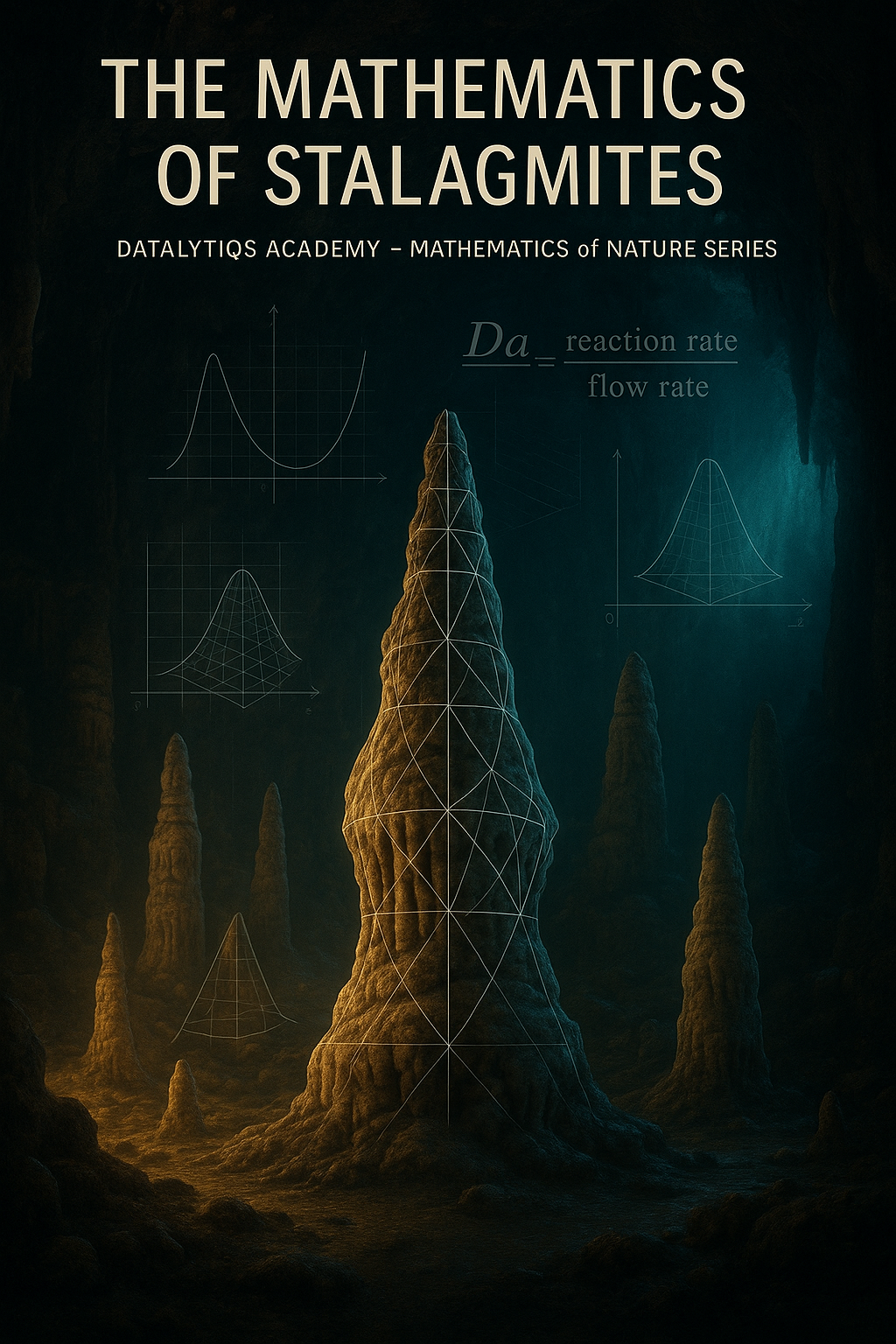
Where Geometry Meets Geology
Hidden deep within the world’s caves, stalagmites rise like ancient sculptures — silent witnesses of passing millennia. But beneath their beauty lies a remarkable simplicity: a single mathematical law governs their diverse forms.
In a breakthrough study published in PNAS (Proceedings of the National Academy of Sciences, Oct. 2025), physicists and geoscientists from Poland, Slovenia, and the U.S. found that all stalagmites follow one mathematical rule that predicts their shape — from sharp cones to wide columns — based on just one parameter: the Damköhler number.
“The rich diversity of stalagmite shapes can be explained by one simple parameter,” said Dr. Piotr Szymczak, physicist at the University of Warsaw.
“This is a rare case where the beauty we see in nature corresponds directly to a clean mathematical law.”
The Science: Decoding Stalagmite Geometry

Stalagmites form when mineral-rich water drips from cave ceilings, leaving behind calcite deposits that build upward over centuries.
The researchers derived a set of equations that model how the drip rate and calcite deposition rate determine the stalagmite’s eventual shape.
This relationship is captured by the Damköhler number (Da) — a dimensionless ratio used in chemical kinetics that compares reaction rate to transport rate.
The team discovered that:
-
High Da values (fast deposition) → produce thick, blunt-topped stalagmites.
-
Low Da values (slow deposition, fast dripping) → form tall, slender cones.
-
Irregular drip positions or high ceilings → create flat-topped or complex shapes.
The model elegantly explains why cave formations vary so dramatically despite similar environmental conditions.
From Equations to Caves: Real-World Validation
To test their equations, scientists examined real stalagmites in Postojna Cave, Slovenia — one of Europe’s most studied karst systems.
Their analytic models precisely matched observed stalagmite profiles, confirming that mathematics can predict natural growth even in “messy” cave environments.
“When we compared our analytic solutions with real cave samples, the match was remarkable,” said Dr. Matej Lipar, physical geographer at the Research Centre of the Slovenian Academy of Sciences and Arts.
“Even under natural, chaotic conditions, the underlying geometry holds.”
Beyond Aesthetic: A New Tool for Climate Science
Stalagmites are natural climate archives — their layers store isotopic records of rainfall, temperature, and atmospheric composition.
However, this study reveals that shape geometry affects how those isotopic layers form, influencing how scientists interpret past climate data.
“Recognizing this geometric effect will allow us to extract more reliable information about past climates,” said Dr. Anthony Ladd, chemical engineer at the University of Florida.
This insight means climate scientists can now refine paleoclimate reconstructions using geometry-adjusted isotopic models, enhancing accuracy in understanding ancient rainfall and drought patterns — much like reading tree rings with a new lens.
Mathematical Elegance in Nature
| Parameter | Meaning | Effect on Shape |
|---|---|---|
| Damköhler Number (Da) | Ratio of calcite deposition rate to drip rate | Controls overall growth geometry |
| Drip Frequency | How often does water fall from the cave ceiling | Determines height and taper |
| Calcite Saturation | Concentration of dissolved minerals | Influences width and density |
| Cave Height / Ceiling Distance | Affects drop velocity and spread | Alters flatness or curvature |
At its core, this research shows that complexity in nature can emerge from simple rules — echoing the mathematical patterns seen in snowflakes, dunes, and river deltas.
Why It Matters for DatalytIQs Academy Learners
For students of mathematics, physics, or Earth systems:
-
This study is a real-world example of applied differential equations.
-
It illustrates how dimensionless analysis (Da) bridges chemistry and fluid dynamics.
-
It provides a template for modeling natural growth processes using mathematical constants.
Learners can simulate similar relationships using Python or MATLAB — plotting stalagmite height vs. drip rate under different Da values to visualize growth morphologies.
Acknowledgments
This article draws upon the research “Geometry of Stalagmite Growth Controlled by the Damköhler Number” (PNAS, 2025) and the reporting of Skyler Ware (Live Science).
Special recognition is extended to:
-
Dr. Piotr Szymczak, University of Warsaw – theoretical modeling.
-
Dr. Matej Lipar, Slovenian Academy of Sciences and Arts – field validation.
-
Dr. Anthony Ladd, University of Florida – isotopic and fluid mechanics analysis.
-
The Postojna Cave Research Team, Slovenia – field data and imagery.
Curated and interpreted by Collins Odhiambo Owino for DatalytIQs Academy – Mathematics of Nature Series, bridging natural beauty and mathematical precision.
Leave a Reply
You must be logged in to post a comment.