Introduction: A Troubling Signal from the Deep
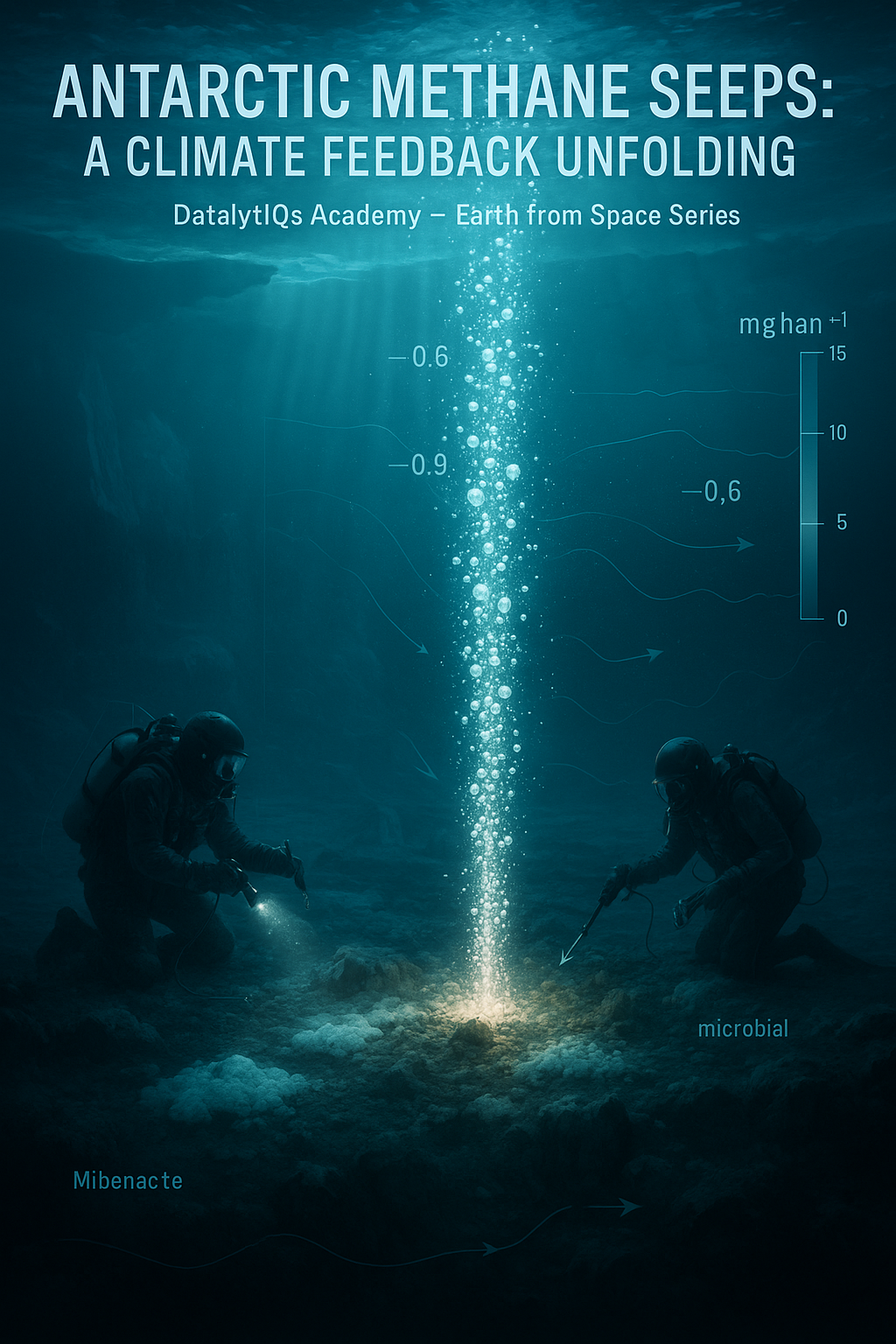
In the icy depths of Antarctica’s Ross Sea, a new and alarming phenomenon is unfolding — methane seeps are multiplying across the ocean floor.
Researchers have discovered dozens of these bubbling vents, releasing a potent greenhouse gas into the frigid waters — a process that could trigger a self-reinforcing “climate feedback loop” accelerating global warming.
The study, published October 1, 2025, in Nature Communications, reveals that methane is leaking from previously frozen sediments as rising global temperatures thaw the seabed. For scientists, this discovery evokes both excitement and dread — an event that may represent another threshold in Earth’s climate system.
“Every time we discover or hear of a new one, we feel immediate excitement, but that excitement is quickly replaced with anxiety and concern about what it all means,”
— Dr. Sarah Seabrook, Marine Scientist, Earth Sciences New Zealand
What Exactly Are Methane Seeps?
Methane seeps are submarine vents where gas escapes from sediments beneath the ocean floor. When methane bubbles rise, much of it dissolves into seawater. Still, in shallow coastal areas like Cape Evans in the Ross Sea, some gas can escape directly into the atmosphere — amplifying greenhouse warming.
Methane (CH₄) is especially worrisome because:
-
It is ~80 times more potent than CO₂ in trapping heat during its first 20 years in the atmosphere.
-
It contributes to near-term climate forcing, driving abrupt warming episodes.
-
Natural seeps are not accounted for in many current global climate models.
Why This Discovery Matters
Until recently, scientists had confirmed only one Antarctic methane seep (in 2011). The newly documented dozens represent an exponential jump — suggesting that warming ocean waters and melting ice shelves may be destabilizing methane hydrates (frozen methane-water compounds) trapped under the seabed.
If this process continues unchecked, it could lead to:
-
Increased methane fluxes are entering the ocean and atmosphere.
-
Enhanced microbial activity converts methane into CO₂ underwater.
-
A positive feedback loop, where warming triggers more methane release, which in turn accelerates further warming.
This feedback is sometimes called a “climate doom loop.”
The Antarctic Context: A Tipping Point Emerging
The Ross Sea, located off the southern coast of Antarctica, has historically been one of the most stable marine ecosystems. However, its shallow coastal zones are now showing signs of stress:
-
Thinning sea ice allows more sunlight and heat to penetrate the water column.
-
Ocean currents are altering seabed temperatures.
-
Microbial mats—white films marking active seeps—are spreading, signaling rapid microbial methane oxidation.
These developments mirror trends seen in the Arctic Ocean, where tens of thousands of methane leaks have already been mapped. The difference is that Antarctica was thought to be geologically “sealed” by its cold stability — a belief now being challenged.
Research and Data Highlights
| Parameter | Observation |
|---|---|
| Study Area | Ross Sea, Antarctica |
| Published in | Nature Communications (Oct 1, 2025) |
| Lead Author | Dr. Sarah Seabrook, Earth Sciences NZ |
| Observation Method | Diver sampling, seafloor imaging, microbial analysis |
| Findings | Dozens of new methane seeps; rapid microbial response |
| Climate Implication | Potentially unaccounted methane feedback loop |
The Methane Feedback Loop Explained
-
Warming Oceans → Heat penetrates seabed layers.
-
Destabilized Methane Hydrates → Methane released into sediments.
-
Bubble Streams Form → Methane seeps appear on the seafloor.
-
Microbes Partially Consume CH₄ → Remaining methane escapes upward.
-
Methane Enters Atmosphere → Traps heat, causing further warming.
-
Feedback Loop → Accelerated destabilization → more methane release.
Earth Observation and Monitoring
Satellite data and undersea drones are now key to tracking these emissions.
-
NASA’s ICESat-2 measures sea ice thickness and water temperature changes.
-
ESA’s Sentinel-3 satellites monitor ocean color and chlorophyll concentration, indicators of microbial activity.
-
Autonomous underwater vehicles (AUVs) collect real-time methane concentration data, complementing diver samples.
These datasets help climate modelers integrate natural methane emissions into Earth system models — a vital step for more accurate climate forecasting.

Implications for Global Climate Policy
The discovery underscores an urgent need to:
-
Incorporate natural greenhouse sources into IPCC climate scenarios.
-
Intensify Antarctic seabed monitoring using satellite–sensor fusion analytics.
-
Reduce anthropogenic methane emissions (from agriculture, energy, and waste) to offset potential natural surges.
If methane seepage continues to expand, climate stabilization efforts may require faster global decarbonization timelines.
Acknowledgments
This article was inspired by research published in Nature Communications (2025) and coverage by Patrick Pester (Live Science).
Gratitude is extended to:
-
Dr. Sarah Seabrook and her team at Earth Sciences New Zealand for their fieldwork and analysis.
-
Leigh Tait, for providing underwater imagery documenting methane seeps in Cape Evans.
-
NASA Earth Science Division and ESA’s Copernicus Program for ongoing open-access ocean monitoring data.
-
The Scientific Committee on Antarctic Research (SCAR) is for the global coordination of polar environmental studies.
Curated and interpreted by Collins Odhiambo Owino for DatalytIQs Academy – Climate & Earth System Analytics Series, connecting cutting-edge research with data-driven education.
Leave a Reply
You must be logged in to post a comment.