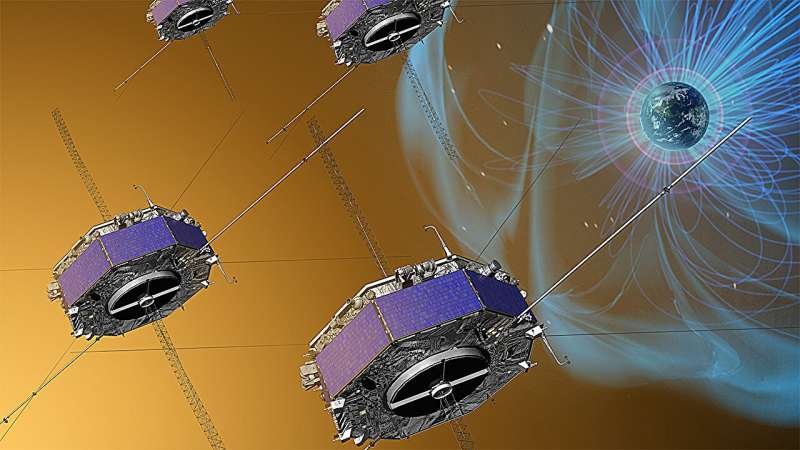
For decades, scientists believed that magnetic “switchbacks” — sharp bends or kinks in solar magnetic field lines — were phenomena limited to the Sun’s atmosphere. But in a groundbreaking discovery, researchers have now detected such a switchback structure near Earth, providing new insights into how solar and planetary magnetic fields interact.
The finding, published in the Journal of Geophysical Research: Space Physics by E. O. McDougall and M. R. Argall, marks the first time this phenomenon has been observed so close to home. It offers a fresh perspective on the magnetic dynamics that shape our planet’s near-space environment — and the powerful space weather events that can follow.
From the Sun’s Corona to Earth’s Magnetosphere
The story of magnetic switchbacks begins with NASA’s Parker Solar Probe, launched in 2018 to study the Sun up close. The probe’s daring orbits through the solar corona revealed numerous “kinks” in magnetic field lines — regions where the magnetic field suddenly reverses direction in a zigzag pattern.
These kinks are believed to arise from a process known as magnetic reconnection, in which field lines pointing in opposite directions break and reconnect, snapping into a new configuration and flinging energy outward.
Until now, scientists thought such structures existed only in the turbulent outer atmosphere of the Sun. The new study, however, shows that Earth’s own magnetic bubble — the magnetosphere — can host similar magnetic twists.
NASA’s Four-Satellite Mission: The Eyes on the Magnetosphere
The discovery came from data gathered by NASA’s Magnetospheric Multiscale (MMS) Mission, a quartet of spacecraft flying in tight formation around Earth. The mission is designed to study magnetic reconnection, the same process responsible for auroras, solar flares, and geomagnetic storms.
While analyzing MMS data, McDougall and Argall noticed a twisting disturbance in the magnetosphere’s outer region — where Earth’s magnetic field meets the incoming solar wind, a continuous stream of charged particles from the Sun.
The disturbance contained a blend of two plasmas:
-
Terrestrial plasma trapped within Earth’s magnetic field
-
Solar plasma carried by the solar wind
This mix of particles rotated, rebounded, and twisted back into place, forming a zigzag pattern — the hallmark of a magnetic switchback.
Magnetic Reconnection: The Cosmic Snap
The researchers concluded that this switchback likely formed when solar wind magnetic field lines reconnected with Earth’s magnetic field, creating a temporary structure that flipped direction before relaxing again.
This observation confirms that magnetic reconnection — a fundamental plasma process — can generate switchbacks not only near the Sun but also wherever magnetic fields interact in space. That includes planetary magnetospheres, comet tails, and possibly even exoplanetary systems.
“The discovery of a switchback in Earth’s magnetosphere means we can study these events directly—without sending a spacecraft into the Sun,” the authors note. “It opens the door to understanding solar phenomena using near-Earth observations.”
Why This Matters: Closer to Understanding Space Weather
Switchbacks are more than just magnetic curiosities. They play a role in how solar energy is transported through space and how geomagnetic storms form when that energy interacts with Earth’s magnetic field.
Understanding these interactions is critical because geomagnetic storms can:
-
Disrupt satellite communications and GPS systems
-
Overload power grids
-
Pose radiation hazards to astronauts and aircraft
By studying switchbacks near Earth, scientists can refine models of solar-terrestrial coupling, helping to predict space weather more accurately and safeguard both technology and astronauts.
The Bigger Picture: A Local Laboratory for Cosmic Physics
This discovery transforms Earth’s magnetosphere into a natural laboratory for exploring magnetic reconnection and plasma behavior under controlled, observable conditions.
Instead of relying solely on missions like Parker Solar Probe — which must endure extreme heat and radiation — researchers can now observe similar physics safely from near-Earth orbit.
As our planet continues to dance with the solar wind, each twist and rebound of magnetic field lines brings us closer to understanding the dynamic magnetic universe we live in.
Citation & Acknowledgments
Source Article:
Stanley, S. (2025). “Magnetic ‘switchback’ detected near Earth for the first time.” Eos.
Edited by: Lisa Lock
Reviewed by: Robert Egan
Image Credit: NASA/GSFC – Magnetospheric Multiscale Mission (MMS)
Original Study: E. O. McDougall & M. R. Argall, Journal of Geophysical Research: Space Physics (2025).
Author: Collins Odhiambo — DatalytIQs Academy Space & Physics Blog
Category: Space Physics & Solar Science
Leave a Reply
You must be logged in to post a comment.