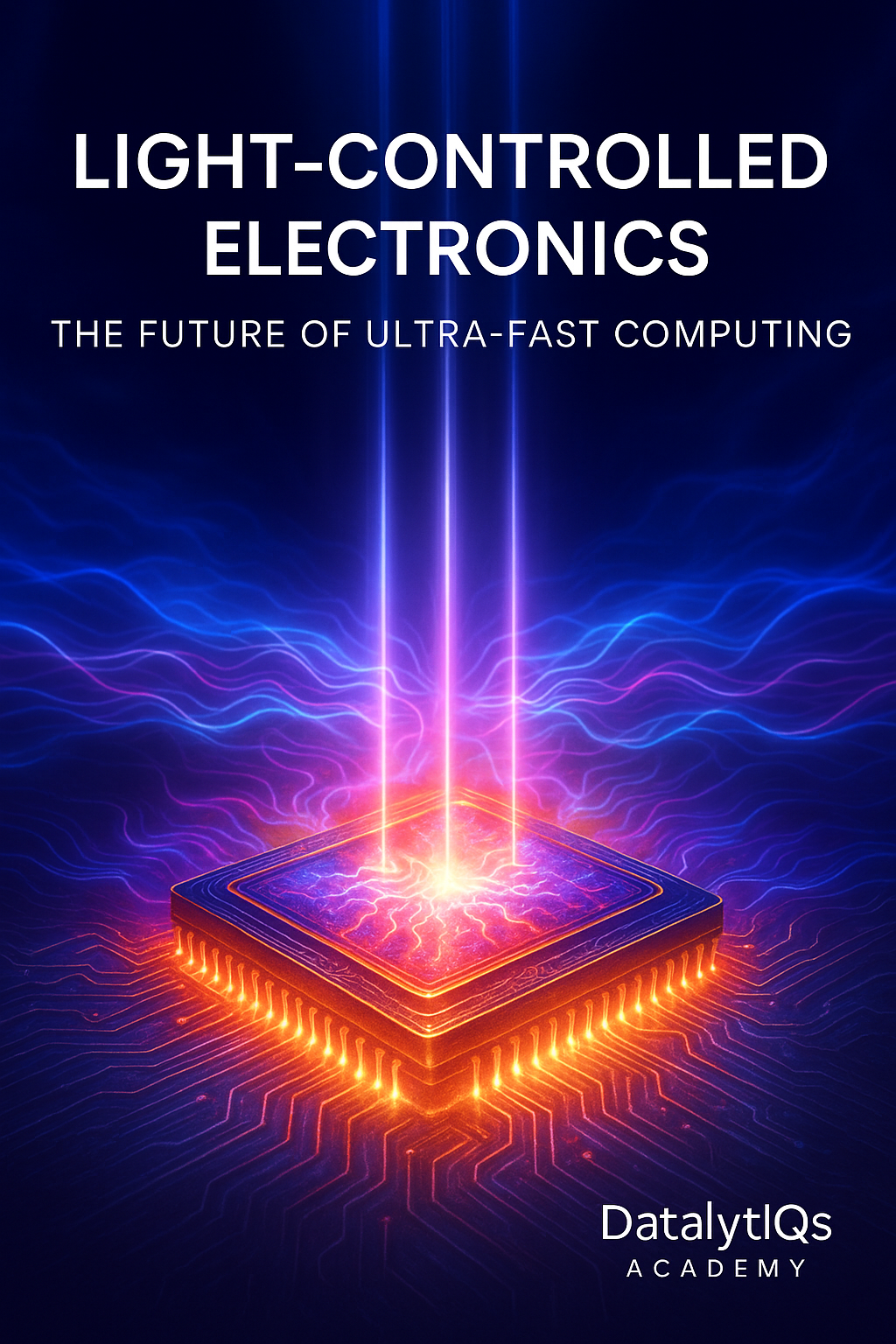
Light-Controlled Electron Gas Points Toward the Future of Ultra-Fast Electronics
By CNRS – French National Center for Scientific Research
Edited by Stephanie Baum • Reviewed by Robert Egan
Educational analysis and commentary by DatalytIQs Academy
A Spark of Light That Could Transform Electronics
Imagine a world where your smartphone, computer, and internet connections operate not through electric currents, but through light itself — achieving speeds and energy efficiencies far beyond today’s silicon-based chips.
That future may have just moved a step closer.
Researchers at the Albert Fert Laboratory (CNRS/Thales) have, for the first time, created and controlled an electron gas using light rather than electricity — a discovery published in Nature Materials.
The Breakthrough
In semiconductor materials, a two-dimensional electron gas (2DEG) is a thin layer where electrons move freely, conducting current with minimal resistance. These quantum gases are what make modern LEDs and some transistors possible.
Until now, however, scientists have been able to generate or manipulate such gases only electrically — by applying voltage.
The CNRS team achieved it optically, simply by shining light on a carefully engineered stack of oxide materials.
When the light was turned off, the gas vanished — proving direct optical control.
Why It Matters
This new phenomenon sits at the frontier of optics, electronics, and quantum physics, opening vast possibilities for future technologies:
-
Ultra-fast transistors: controlled by light instead of electrical signals, eliminating up to one-third of chip contacts — roughly a billion fewer electrical connections in a single processor.
-
Energy-efficient computing: reduced heat and resistance mean lower power consumption.
-
Photonics–electronics fusion: devices that use both light and electrons for communication and computation.
-
Super-sensitive optical detectors: light increases current flow by up to 100,000×, creating a new class of sensors.
How They Did It
The researchers combined atomic-scale imaging, theoretical modeling, and precision material engineering:
-
Two oxide layers were stacked, creating a unique electronic interface at their atomic level.
-
Light exposure triggered a rearrangement of electron positions, generating the gas.
-
Quantum simulations explained how light energy altered electron mobility within the structure.
The project involved scientists from:
-
Institut de Physique et Chimie des Matériaux de Strasbourg (CNRS/Université de Strasbourg)
-
Laboratoire de Physique des Solides (CNRS/Université Paris-Saclay)
DatalytIQ’s Academy Perspective: Education Meets Innovation
At DatalytIQ’s Academy, we view this discovery as a cornerstone for teaching the future of quantum and photonic technologies.
It beautifully illustrates:
-
How quantum mechanics, materials science, and data modeling merge in real-world innovation.
-
The transition from electrical engineering to photonics-driven computation — an evolution students must understand to stay at the forefront of technological change.
-
The importance of simulation and data analytics in decoding atomic and electronic behavior.
We’re integrating such frontier topics into our Advanced Electronics, Quantum Computing, and Data-Driven Materials Analytics courses, preparing learners to navigate — and shape — this rapidly evolving landscape.
A Glimpse of What’s Coming
The discovery of light-controlled electron gases hints at a world where chips communicate at the speed of light, quantum processors run cooler and faster, and data travels with minimal energy loss.
From illuminating atoms to illuminating the future — this is science in motion.
— DatalytIQs Academy
Leave a Reply
You must be logged in to post a comment.