By DatalytIQs Academy
Based on reporting by Jamie Carter, originally published on Live Science (Sept. 29, 2025). Image credit: ESA/Hubble & NASA, A. Filippenko; Acknowledgment: M. H. Özsaraç.
Introduction
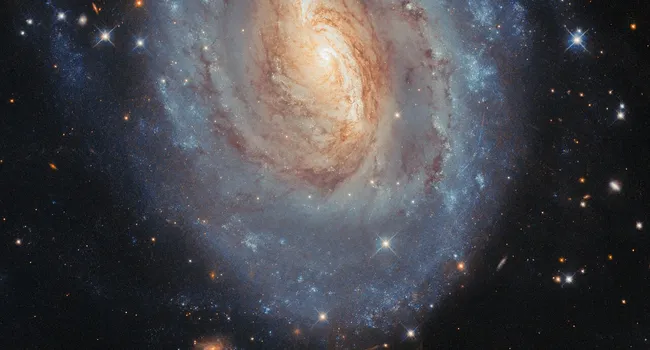
At DatalytIQs Academy, we love when data and discovery intertwine to tell stories written in starlight. The Hubble Space Telescope’s newest image of the barred spiral galaxy NGC 6000 is a vivid example of that cosmic storytelling — a portrait of stellar life cycles, captured through color, with an unexpected visitor streaking across the scene.
The Target: Galaxy NGC 6000
Located about 102 million light-years away in the constellation Scorpius, NGC 6000 is a barred spiral galaxy — a structure defined by bright central stars and extended spiral arms.
Hubble’s new observation bathes the galaxy in golden yellows at its core and shimmering blues on its edges. But these colors are not just beautiful; they reveal the ages and temperatures of the galaxy’s stars.
-
🌕 Yellow Core: Home to old, cooler, and smaller stars that have burned steadily for billions of years.
-
🔵 Blue Arms: Populated by young, hot, massive stars — cosmic newborns blazing briefly but brightly.
Color, in this context, becomes a spectral language, where each hue encodes information about stellar evolution.
The Mission: Supernova Hunting
Hubble’s gaze at NGC 6000 wasn’t simply for aesthetics. Astronomers were on a supernova search, targeting faint remnants from two known stellar explosions — SN 2007ch and SN 2010as.
Supernovas like these mark the violent deaths of massive stars, scattering heavy elements essential for planet formation and life itself.
To detect them, Hubble used red and blue filters, layering multiple long exposures that highlight temperature contrasts and structural detail. But as often happens in science, something unexpected appeared.

The Surprise Guest: A Passing Asteroid
In the corner of Hubble’s deep-space frame, astronomers noticed four faint, broken streaks of red and blue light — not from stars, but from a wandering asteroid crossing the telescope’s view.
Each “broken” segment corresponds to a separate exposure taken through different color filters, producing the dual-toned path of motion across the sky.
This serendipitous sight reminds us that even when Hubble looks deep into the universe, our own solar system occasionally drifts into the picture — a small cosmic coincidence that connects near and far.
The Power of Color in Space Science
Color filters are not mere artistic tools — they are data instruments.
By capturing separate wavelengths and comparing intensity across spectra, astronomers can:
-
Classify stars by temperature and age.
-
Identify chemical compositions within nebulae or galaxies.
-
Track stellar evolution, from hot blue main-sequence stars to cool red giants.
In this way, color imaging transforms astrophotography into a quantitative science — turning pixels into physics.
Where to Find NGC 6000
Though NGC 6000 lies within the Scorpius constellation, it sits south of the celestial equator, making it more visible from the Southern Hemisphere.
Amateur astronomers under dark skies with telescopes 10 inches or larger can glimpse its faint spiral glow — a modest reward for patient observers.
Credits & Acknowledgment
-
Original article: Jamie Carter, Live Science, Sept 29, 2025.
-
Image credit: ESA/Hubble & NASA, A. Filippenko; Acknowledgment: M. H. Özsaraç.
-
Educational adaptation & commentary: DatalytIQs Academy — empowering learners to see the universe through the lens of data, science, and discovery.
Leave a Reply
You must be logged in to post a comment.