Academic performance isn’t just about how much students study — it’s also about how well they rest.
Sleep influences concentration, memory retention, and emotional balance, all of which are crucial for effective learning.
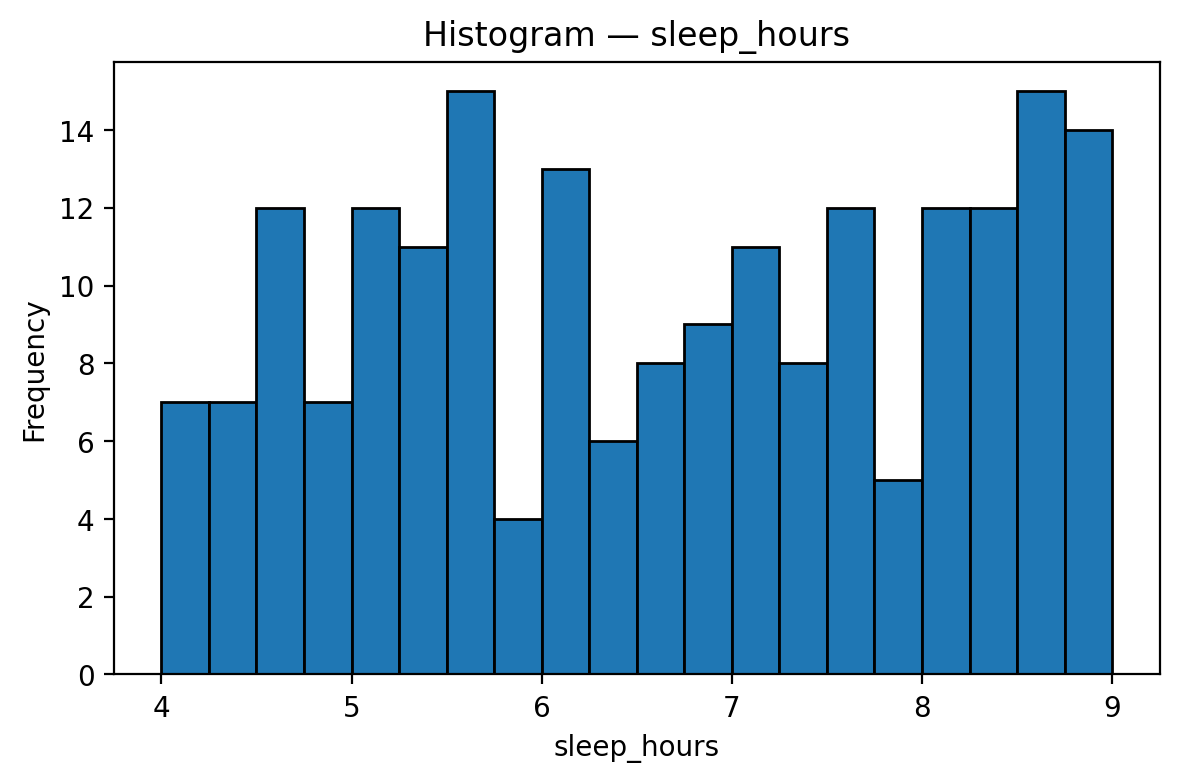
This visualization, drawn from the Kaggle — student_exam_scores.csv dataset, explores how students distribute their sleep hours and what that reveals about their academic routines.
Understanding the Histogram

The histogram plots students’ average sleep duration (in hours), ranging from 4 to 9 hours per night.
The distribution appears relatively uniform, indicating a diverse range of sleep habits among students.
Key observations:
-
Most students sleep between 5 and 8 hours, showing a generally healthy routine.
-
A smaller group sleeps less than 5 hours, possibly sacrificing rest for study or work.
-
A few students average 9 hours or more, which might reflect strong discipline or lighter daily schedules.
Interpretation
-
Moderate Sleepers (5–8 hrs):
Represent the majority. These students likely balance study and rest effectively, supporting consistent focus and productivity. -
Short Sleepers (≤5 hrs):
May experience fatigue, reduced attention, or burnout, signs of possible overextension, or poor time management. -
Long Sleepers (≥9 hrs):
Could be benefiting from improved cognitive recovery, but might also indicate less active study engagement.
Educational Insights
| Observation | Interpretation | Recommendation |
|---|---|---|
| The majority is between 5–8 hrs | Balanced routines | Encourage consistency and regular sleep schedules |
| Few below 5 hrs | Possible overwork | Educate learners on the importance of sleep for academic performance |
| Few above 9 hrs | Ample rest | Monitor engagement — ensure long sleep doesn’t reduce productive hours |
Strategic Takeaways
The results affirm that quality sleep is a hidden driver of academic success.
Institutions can promote:
-
Awareness programs linking rest and performance,
-
Data-based wellness monitoring (using dashboards or surveys), and
-
Balanced schedules that protect both study and rest time.
At DatalytIQs Academy, we emphasize not only how much students learn but also how well they sustain learning through healthy lifestyle habits.
Acknowledgment
Data Source: Kaggle — student_exam_scores.csv
Analysis and Visualization: Education Analytics Unit, DatalytIQs Academy (2025)
Leave a Reply
You must be logged in to post a comment.