Exercise is a cornerstone of heart health, but for some, it can trigger chest discomfort known as exercise-induced angina. This condition serves as a clinical red flag, often revealing underlying coronary artery blockages or poor oxygen supply to the heart.
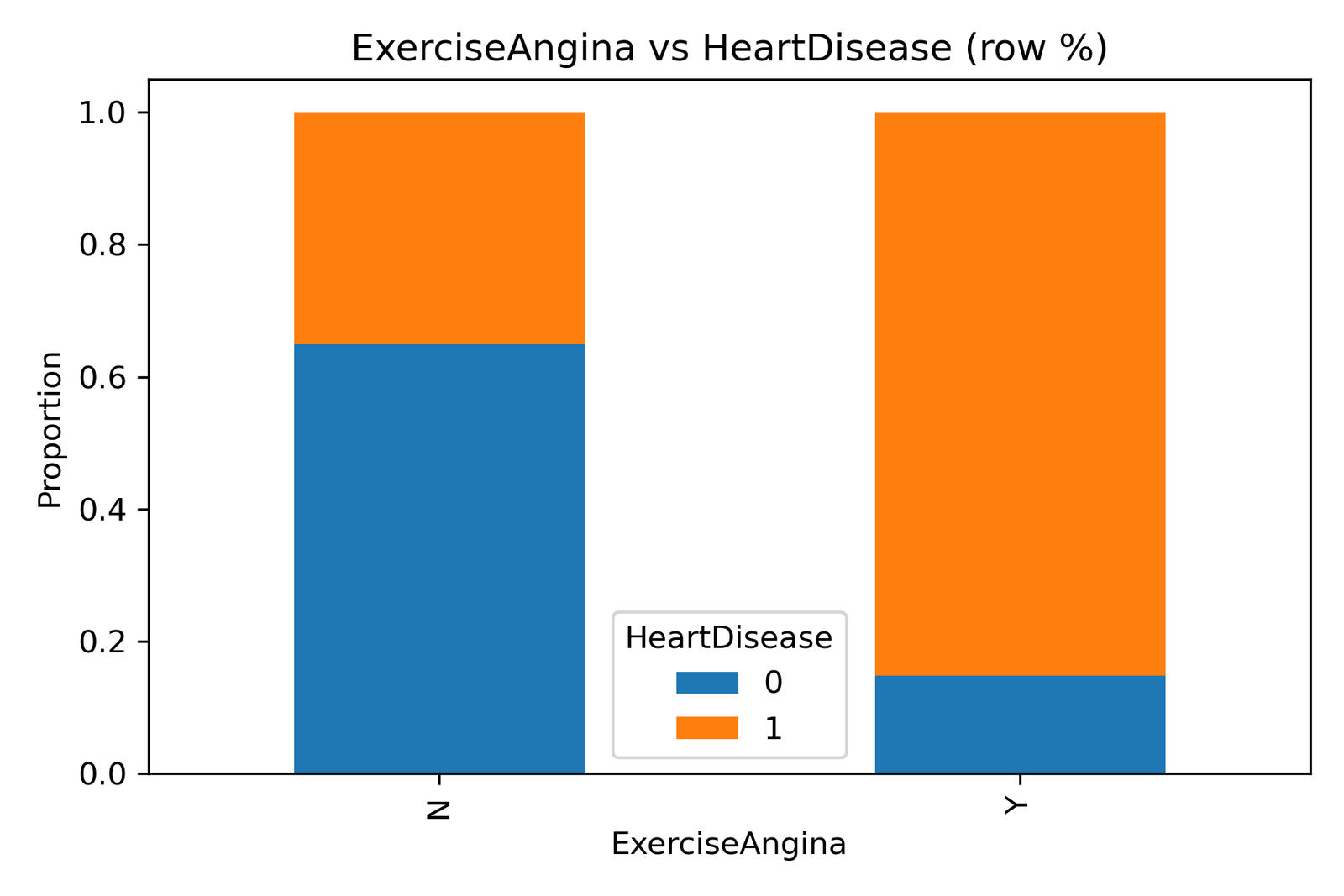
The visualization above explores the relationship between Exercise-Induced Angina (ExerciseAngina) and Heart Disease, using data-driven insights to highlight how physical exertion responses may predict cardiovascular risk.
2. The Visualization Explained
The chart titled “ExerciseAngina vs HeartDisease (row %)” compares two categories of patients:
-
N (No Angina during Exercise)
-
Y (Angina during Exercise)
Each bar shows the proportion of individuals with or without heart disease:
-
Blue (0) – No heart disease
-
Orange (1) – Diagnosed with heart disease
3. Key Insights
-
Patients with exercise-induced angina (Y) show a significantly higher prevalence of heart disease, with nearly 85% testing positive for cardiac conditions.
-
Those without exercise-induced angina (N) have a lower probability of heart disease, with most individuals falling in the healthy category.
-
This stark contrast underscores the predictive power of exercise tests, a simple yet effective diagnostic tool in cardiovascular medicine.
4. Policy and Clinical Implications
From a public health and preventive care perspective:
-
Regular exercise stress testing should be integrated into national screening programs, especially for individuals over 40 or those with risk factors such as diabetes or hypertension.
-
Governments and health ministries can invest in early detection programs that combine physical testing with data analytics to identify hidden cardiac risks.
-
Public awareness campaigns should emphasize that chest discomfort during exercise is not a sign of fitness fatigue; it may be a life-saving signal to seek medical evaluation.
5. Data Source and Analytical Approach
This visualization was generated from open cardiovascular datasets available on Kaggle, analyzed using Python tools such as pandas, matplotlib, and seaborn.
The results reveal a proportional relationship between exercise-induced angina and confirmed cases of heart disease, offering empirical evidence that supports preventive cardiology initiatives.
6. About DatalytIQs Academy
DatalytIQs Academy bridges data analytics and real-world decision-making in Mathematics, Economics, and Finance — extending to health analytics and public policy insights.
Through research-driven education, the Academy empowers learners and professionals to interpret data, influence evidence-based policies, and promote data-literate governance across sectors.
7. Author’s Note
Written by Collins Odhiambo Owino, founder of DatalytIQs Academy, whose mission is to use data-driven insights to shape a healthier, more informed, and equitable society.
Leave a Reply
You must be logged in to post a comment.