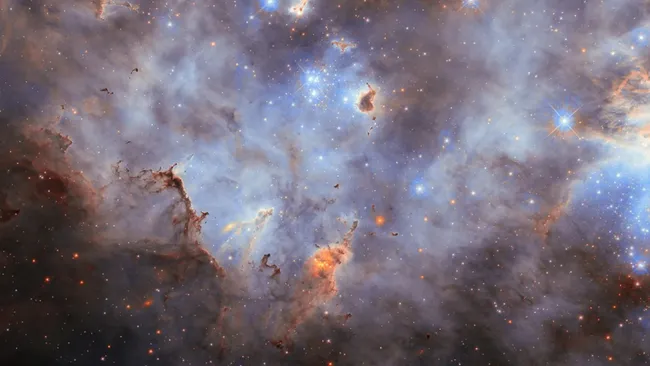
The Hubble Space Telescope has once again revealed the breathtaking beauty of the cosmos—this time capturing a star cluster within the Large Magellanic Cloud (LMC), one of our Milky Way’s nearest galactic neighbors. The image showcases swirling clouds of purple and white gas and dust illuminated by young, bright stars—an exquisite snapshot of the process of stellar birth and evolution.
What Are We Seeing?
This mesmerizing image highlights N11, the second-largest star-forming region in the Large Magellanic Cloud, located about 150,000 light-years from Earth. N11 is a vast cosmic nursery where new stars are born from dense molecular clouds of hydrogen and helium. The region’s energetic young stars emit intense radiation, sculpting the surrounding gas into complex patterns of color and light.
The photo combines data taken roughly 20 years apart:
-
📷 Older observations (2002–2003): Captured using Hubble’s Advanced Camera for Surveys (ACS), which mapped the cluster’s star distribution.
-
📷 Recent observations: Taken with the Wide Field Camera 3 (WFC3), focusing on the swirling dust and gas—the raw material for star formation.
This blend of time-separated images not only enhances visual detail but also allows scientists to track changes in gas motion and stellar evolution over decades.
Why It’s Scientifically Important
The Large Magellanic Cloud is a satellite galaxy of the Milky Way and a living laboratory for studying how stars form in different chemical environments. Because its stars are relatively close and chemically distinct from those in our galaxy, astronomers can compare how metallicity—the abundance of elements heavier than hydrogen and helium—affects the birth, life, and death of stars.
By observing clusters like this one, scientists can:
-
Trace how stellar nurseries evolve.
-
Study how radiation and stellar winds shape surrounding nebulae.
-
Understand the formation of massive stars and their role in galactic chemistry.
What This Means for Us
Beyond its beauty, this cosmic scene offers a glimpse into our own galaxy’s past. The Milky Way once experienced intense star formation episodes like those seen in the LMC today. Observing these regions helps astronomers model the future of our galaxy and understand how stars enrich space with the elements necessary for life.
At DatalytIQs Academy, we highlight such discoveries to bridge astronomy, data analysis, and scientific visualization—inspiring learners to see how long-term observation, advanced imaging, and data modeling come together to deepen humanity’s understanding of the universe.
Credits:
-
Author: Kenna Hughes-Castleberry (Space.com)
-
Image Credit: ESA/Hubble & NASA, C. Murray, J. Maíz Apellániz
-
Adapted and Explained by: DatalytIQs Academy
Educational Insight:
This Hubble observation shows that the universe is a living archive—its galaxies, stars, and nebulae constantly changing, evolving, and teaching us about our cosmic origins. Through patient observation and powerful technology, we’re not just looking at space; we’re witnessing the story of creation itself, written in light.
$$x
=
–
b
±
b
2
–
4
a
c
2
a$$
Leave a Reply
You must be logged in to post a comment.