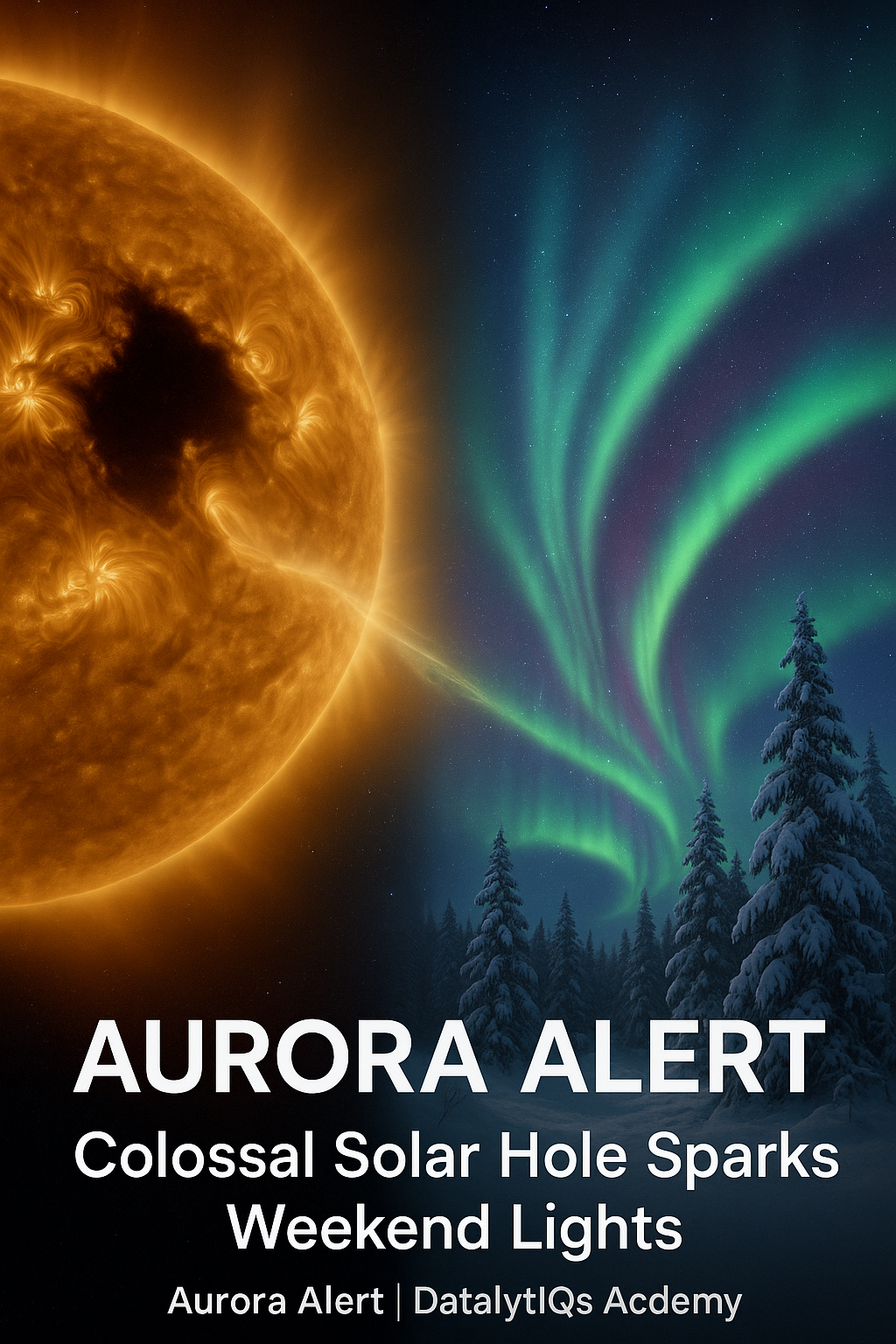
Colossal ‘Hole’ in the Sun Could Spark Dazzling Auroras This Weekend
By Daisy Dobrijevic • Published by Space.com
Educational commentary by DatalytIQs Academy
A Weekend of Cosmic Light Shows
Skywatchers may be in for a treat this weekend as a colossal coronal hole—a vast, magnetically open region on the Sun’s surface—faces Earth once again, unleashing high-speed solar wind that could trigger geomagnetic storms and brilliant auroras under clear, dark skies.
According to NOAA’s Space Weather Prediction Center and the U.K. Met Office, the solar wind stream is expected to reach Earth between Saturday night and Sunday (Oct. 11–12). The strongest activity is forecast between 5 a.m. and 5 p.m. EDT (0900–1700 GMT) on Oct. 12, with a predicted G1 (minor) geomagnetic storm.
If the forecast holds, auroras may stretch as far south as northern Michigan and Maine—and possibly farther due to a seasonal “boost” following the autumn equinox.
What Are Coronal Holes?
Coronal holes are regions where the Sun’s magnetic field lines open into space, allowing charged particles to escape more freely. These streams of solar wind race outward at over 500 km/s, eventually striking Earth’s magnetosphere.
When these particles funnel toward the poles and collide with oxygen and nitrogen atoms in our upper atmosphere, they emit photons of light—painting the night sky with ribbons of green, pink, and violet known as the aurora borealis (northern lights) and aurora australis (southern lights).
A Familiar Feature Returns
This isn’t a new event—it’s the same coronal hole that first appeared last month, previously shaped like a butterfly or bird. Because the Sun rotates roughly every 27 days, these holes can reappear periodically, continuing to influence Earth’s space weather for months.
Each rotation offers a new opportunity for observation and measurement—important for understanding the Sun’s 11-year solar cycle and its effects on satellites, communication systems, and power grids.
Why the Equinox Matters
Around the equinoxes, Earth’s tilt aligns so that the solar wind couples more effectively with Earth’s magnetic field—a phenomenon known as the Russell–McPherron effect.
This alignment makes even modest solar winds more likely to trigger auroras, giving photographers and researchers a seasonal advantage.
NOAA’s forecasted Kp index of 5 confirms the possibility of visible auroras far beyond polar latitudes. (The Kp index runs from 0 – 9; the higher the number, the greater the geomagnetic activity.)
DatalytIQs Academy Perspective: Learning from Space Weather
At DatalytIQs Academy, we view solar events like this as powerful teaching moments that connect astronomy, physics, and data analytics.
Learners in our Space Weather Analytics and Solar Physics modules explore:
-
Modeling geomagnetic storms using real-time NOAA datasets.
-
Visualizing Kp and solar wind data with Python and Power BI.
-
Understanding how Earth’s magnetosphere deflects and channels solar particles.
-
Predicting auroral activity through statistical and machine-learning models.
Our goal is to help students interpret space-weather data not just as numbers, but as the dynamic heartbeat of our Sun-Earth system.
In Summary
As the Sun’s magnetic fields open wide, Earth’s skies may glow once more — a vivid reminder that space weather is both a spectacle and a science.
From solar holes to auroral lights, every flare and filament tells a story — one that DatalytIQs Academy helps decode, data point by data point.
Leave a Reply
You must be logged in to post a comment.