Blog

  • First Step Toward a “Movie of the Universe”

    First Step Toward a “Movie of the Universe”

    Discovery of Binary Stars Marks First Step Toward a “Movie of the Universe”

    By The Australian National University (ANU)
    Edited by Gaby Clark • Reviewed by Robert Egan
    Educational commentary by DatalytIQs Academy

    A Galactic Film in the Making

    Astronomers from The Australian National University (ANU) have made a discovery that could reshape our understanding of how galaxies—and perhaps the universe itself—evolve. Using the Vera C. Rubin Observatory in Chile, researchers detected binary stars within the outer reaches of the globular cluster 47 Tucanae, one of the oldest and brightest star systems in the Milky Way.

    The finding, part of the Legacy Survey of Space and Time (LSST), marks the beginning of an ambitious 10-year quest to create a “movie of the universe” — capturing billions of stars and galaxies as they move and transform across time.

    Binary Stars: Cosmic Duos that Shape the Galaxy

    Binary stars—two stars orbiting a shared center of gravity—are the hidden engines of stellar evolution. Within dense globular clusters, they:

    • Exchange energy with neighboring stars,

    • Influence whether a cluster remains stable over billions of years, and

    • Give rise to exotic celestial objects like blue stragglers — unusually luminous stars that seem younger than their surroundings.

    Using Rubin’s first public dataset (Data Preview 1), ANU scientists detected binaries in 47 Tucanae’s outer regions for the first time. Surprisingly, they found that binary stars are three times more common in the outskirts than in the crowded central zones previously explored by the Hubble Space Telescope.

    This suggests that while dense centers may destroy or disrupt binary systems through frequent stellar interactions, those in the calmer outskirts survive intact — preserving a glimpse into the cluster’s original stellar makeup.

    Unveiling 47 Tucanae: A Stellar Time Capsule

    “47 Tucanae has been studied for over a century,” said Professor Luca Casagrande of ANU,
    “but only now, thanks to Rubin, can we truly map its outskirts and uncover how these ancient clusters assembled.”

    The cluster—visible to the naked eye from the Southern Hemisphere—contains hundreds of thousands of stars tightly packed within a few dozen light-years. These ancient stellar cities serve as natural laboratories for studying the long-term evolution of stars and galaxies.

    The Rubin Observatory’s LSST will allow astronomers to monitor these systems repeatedly, building a frame-by-frame record of cosmic changes.
    The result will be nothing less than a dynamic, evolving portrait of the universe — a scientific “film reel” documenting how matter and motion shape galaxies over time.

    A Transformative Tool for Astronomy

    Even at its early stage, Rubin’s LSST has demonstrated its revolutionary potential.

    “Even in its first test data, LSST is already opening a new window on stellar populations and dynamics,”
    said Professor Helmut Jerjen, co-author of the study.

    Over the next decade, the observatory will map billions of binary systems across the entire southern sky, providing the most complete census of stars ever achieved and testing models of cluster and galaxy formation with unprecedented precision.

    DatalytIQs Academy Perspective: Learning from the Cosmos

    At DatalytIQs Academy, we celebrate discoveries like this as perfect examples of how astronomy, data science, and physics converge.
    This study highlights:

    • The importance of long-term observation and time-series analysis in understanding cosmic evolution.

    • The power of big data in astronomy — Rubin’s LSST will generate tens of petabytes of data, demanding advanced analytics, machine learning, and visualization tools.

    • The value of binary systems as astrophysical “testbeds” for energy transfer, stellar dynamics, and galactic history.

    Our learners explore these same analytical principles in courses on Astrophysical Data Analytics, Simulation Modeling, and Machine Learning for Space Science, connecting classroom theory to frontier discoveries shaping our understanding of the universe.

    The Future: A Universe in Motion

    With Rubin’s global survey underway, astronomy is entering its cinematic era. Soon, scientists won’t just take snapshots of the cosmos—they’ll watch galaxies evolve, clusters breathe, and stars dance in real time.

    From static images to cosmic motion, we are witnessing the birth of a universal story told through data, light, and time.
    DatalytIQs Academy

  • Light-Controlled Electron Gas Points Toward the Future of Ultra-Fast Electronics

    Light-Controlled Electron Gas Points Toward the Future of Ultra-Fast Electronics

    Light-Controlled Electron Gas Points Toward the Future of Ultra-Fast Electronics

    By CNRS – French National Center for Scientific Research
    Edited by Stephanie Baum • Reviewed by Robert Egan
    Educational analysis and commentary by DatalytIQs Academy

    A Spark of Light That Could Transform Electronics

    Imagine a world where your smartphone, computer, and internet connections operate not through electric currents, but through light itself — achieving speeds and energy efficiencies far beyond today’s silicon-based chips.

    That future may have just moved a step closer.
    Researchers at the Albert Fert Laboratory (CNRS/Thales) have, for the first time, created and controlled an electron gas using light rather than electricity — a discovery published in Nature Materials.

    The Breakthrough

    In semiconductor materials, a two-dimensional electron gas (2DEG) is a thin layer where electrons move freely, conducting current with minimal resistance. These quantum gases are what make modern LEDs and some transistors possible.

    Until now, however, scientists have been able to generate or manipulate such gases only electrically — by applying voltage.
    The CNRS team achieved it optically, simply by shining light on a carefully engineered stack of oxide materials.

    When the light was turned off, the gas vanished — proving direct optical control.

    Why It Matters

    This new phenomenon sits at the frontier of optics, electronics, and quantum physics, opening vast possibilities for future technologies:

    • Ultra-fast transistors: controlled by light instead of electrical signals, eliminating up to one-third of chip contacts — roughly a billion fewer electrical connections in a single processor.

    • Energy-efficient computing: reduced heat and resistance mean lower power consumption.

    • Photonics–electronics fusion: devices that use both light and electrons for communication and computation.

    • Super-sensitive optical detectors: light increases current flow by up to 100,000×, creating a new class of sensors.

    How They Did It

    The researchers combined atomic-scale imaging, theoretical modeling, and precision material engineering:

    • Two oxide layers were stacked, creating a unique electronic interface at their atomic level.

    • Light exposure triggered a rearrangement of electron positions, generating the gas.

    • Quantum simulations explained how light energy altered electron mobility within the structure.

    The project involved scientists from:

    • Institut de Physique et Chimie des Matériaux de Strasbourg (CNRS/Université de Strasbourg)

    • Laboratoire de Physique des Solides (CNRS/Université Paris-Saclay)

    DatalytIQ’s Academy Perspective: Education Meets Innovation

    At DatalytIQ’s Academy, we view this discovery as a cornerstone for teaching the future of quantum and photonic technologies.
    It beautifully illustrates:

    • How quantum mechanics, materials science, and data modeling merge in real-world innovation.

    • The transition from electrical engineering to photonics-driven computation — an evolution students must understand to stay at the forefront of technological change.

    • The importance of simulation and data analytics in decoding atomic and electronic behavior.

    We’re integrating such frontier topics into our Advanced Electronics, Quantum Computing, and Data-Driven Materials Analytics courses, preparing learners to navigate — and shape — this rapidly evolving landscape.

    A Glimpse of What’s Coming

    The discovery of light-controlled electron gases hints at a world where chips communicate at the speed of light, quantum processors run cooler and faster, and data travels with minimal energy loss.

    From illuminating atoms to illuminating the future — this is science in motion.
    DatalytIQs Academy

  • A Unified Model Explains Extreme Jet Streams on All Giant Planets

    A Unified Model Explains Extreme Jet Streams on All Giant Planets

    Unified Model Reveals Why Giant Planets Have Opposite Jet Streams

    By the Netherlands Research School for Astronomy (NOVA)
    Edited by Lisa Lock • Reviewed by Robert Egan
    Commentary and educational analysis by DatalytIQs Academy

    A Long-Standing Cosmic Mystery

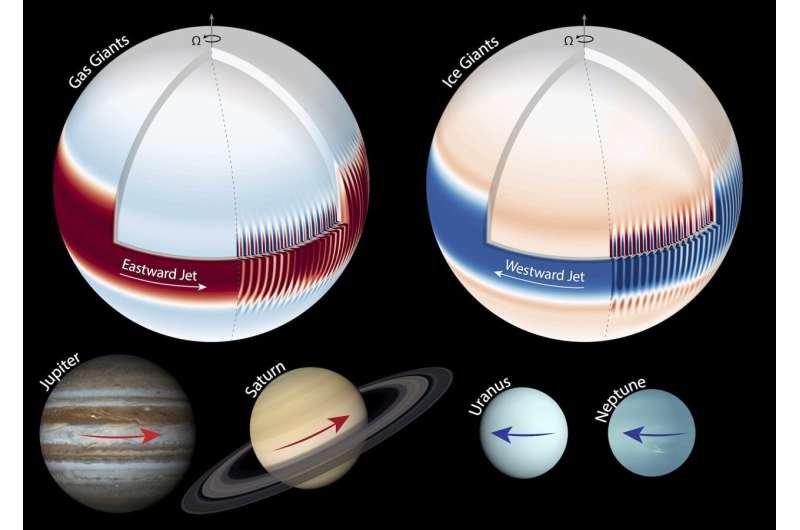
    For decades, astronomers have marveled at the wild jet streams encircling the gas giants — Jupiter, Saturn, Uranus, and Neptune. These atmospheric rivers reach breathtaking speeds between 500 and 2,000 km/h, making them the fastest winds in the solar system.

    Yet there’s always been a puzzle:

    • Jupiter and Saturn have eastward-flowing equatorial jets.

    • Uranus and Neptune have westward-flowing ones.

    How could planets with such similar structures, heat sources, and rotation rates have winds blowing in opposite directions?

    A Unified Theory Emerges

    A team led by Dr. Keren Duer-Milner of Leiden Observatory and SRON (Netherlands Institute for Space Research) has finally cracked the code.
    Using sophisticated global circulation models, they discovered that fast-rotating convection — swirling updrafts that carry heat through a planet’s atmosphere — can produce either eastward or westward jet streams, depending on how deep the atmospheric layer is.

    This system exhibits what scientists call a bifurcation: under nearly identical conditions, the atmosphere can stabilize into two different equilibrium states — one with eastward jets, one with westward jets.

    That means the same physical process explains both behaviors — a single elegant mechanism governing the climate engines of all four giant planets.

    How It Works

    Imagine the atmosphere as a colossal conveyor belt.
    Near the equator, powerful convection cells circulate vertically — rising, cooling, and sinking again. These movements interact with the planet’s rapid rotation to create vast horizontal flows.
    Depending on how thick or thin the convective layer is, the conveyor belt can flip direction — spinning the jet stream eastward or westward.

    It’s the same principle that shapes Jupiter’s colorful bands, Saturn’s golden stripes, and Neptune’s dark storms — all arising from a universal dance between heat, rotation, and depth.

    Beyond Our Solar System

    Dr. Duer-Milner’s team believes this model could also explain atmospheric flows on exoplanets, helping scientists interpret data from the James Webb Space Telescope (JWST) and future missions.
    By linking jet direction to internal heat and depth, researchers can now make more accurate climate predictions for planets light-years away.

    As the study notes, data from NASA’s Juno mission — now orbiting Jupiter — may soon confirm whether these convective “conveyor belts” truly exist.

    🎓 Educational Significance – DatalytIQs Academy Perspective

    At DatalytIQs Academy, we celebrate breakthroughs like this because they bridge theoretical physics, atmospheric science, and planetary modeling — disciplines central to our STEM and data-driven learning philosophy.

    Our educators highlight this unified jet-stream model as a perfect example of:

    • Cross-disciplinary thinking in astronomy and fluid dynamics,

    • Model-based reasoning is used in advanced mathematics and computational physics, and

    • The power of data visualization and simulation in uncovering hidden universal laws.

    Through projects in Climate Modeling, Space Analytics, and Planetary Systems, DatalytIQs Academy encourages learners to explore how such research informs both Earth’s weather prediction systems and exoplanet climatology — proving that science is indeed a language of patterns shared across worlds.

    In Summary

    “We’ve finally found a simple, elegant explanation for a complex phenomenon,”
    Dr. Keren Duer-Milner, Lead Author

    A single model now unites the turbulent atmospheres of the giant planets — from Jupiter’s roaring eastward winds to Neptune’s howling westward gales — illuminating not only our solar system, but potentially thousands of worlds beyond.

    And at DatalytIQs Academy, we continue our mission to make such discoveries accessible, educational, and inspiring for the next generation of data-driven explorers.

  • Redwing: The Autonomous Robot Glider Aiming to Circle the Globe

    Redwing: The Autonomous Robot Glider Aiming to Circle the Globe

    A historic ocean mission has begun.
    Rutgers University, in collaboration with Teledyne Marine, has launched Redwing — an advanced autonomous underwater glider designed to circumnavigate the globe in a five-year scientific mission. If successful, it will be the first underwater robot to achieve this feat, marking a new era in global ocean observation.

    Engineering Marvel of the Deep

    Unlike traditional propeller-driven vehicles, Redwing moves gracefully by adjusting its buoyancy, sinking and rising in a zigzag pattern that saves energy.
    Key innovations include:

    • A carbon fiber hull for endurance and pressure resistance.

    • Advanced navigation and avoidance algorithms to dodge fishing nets and marine hazards.

    • Sensors to measure salinity, temperature, and depth, offering a real-time, 3D view of the ocean.

    • A fish-tracking system capable of detecting tagged marine life, opening new frontiers in behavioral ecology.

    It’s built to stay operational for 1–2 years continuously, sending data to scientists via satellite every 8–12 hours.

    Journey Around the Planet

    Redwing’s global route is as ambitious as its design:

    1. Launch Point: Woods Hole Oceanographic Institution (WHOI), Massachusetts.

    2. Atlantic Leg: Riding the Gulf Stream to Europe, stopping at Gran Canaria.

    3. Southern Crossing: To Cape Town, then across the Indian Ocean to Western Australia and New Zealand.

    4. Antarctic Circuit: Through the Antarctic Circumpolar Current, the planet’s most powerful ocean current.

    5. Final Stretch: Via the Falkland Islands, Brazil, and the Caribbean, back to the Atlantic.

    This full-circle path mirrors the global flow of ocean currents — essentially, Redwing will travel with the heartbeat of the planet.

    Science with Purpose

    Redwing’s mission supports one of the greatest scientific needs of our time — understanding the ocean’s role in Earth’s climate system.
    By measuring how warm, salty, and deep the waters are across various regions, Redwing will help:

    • Refine climate models and hurricane forecasts.

    • Track marine heatwaves and biodiversity shifts.

    • Study how ocean currents influence weather systems worldwide.

    “This is a historic moment for ocean science,” said mission co-leader Prof. Scott Glenn. “We’re deploying a robot that will travel the world’s oceans, gathering data — and we’re doing it with students, educators, and international collaborators every step of the way.”

    A Global Classroom in Motion

    Beyond its scientific goals, Redwing doubles as an educational experiment in global collaboration.
    More than 50 Rutgers undergraduates are currently enrolled in a class that monitors Redwing’s progress and shares updates through a mission blog. Schools and universities around the world will join in — connecting students through virtual sessions, storytelling, and cultural exchanges as Redwing passes near their regions.

    This initiative builds on Rutgers’ earlier success with the Scarlet Knight glider (2009) — the first robot to cross the Atlantic, paving the way for today’s global mission.

    Legacy and Inspiration

    The name Redwing pays tribute to:

    • Rutgers’ scarlet colors, and

    • Doug Webb, the late inventor of the original Slocum glider and founder of the research company that became Teledyne Marine.

    His motto — “Work hard, have fun, and change the world” — lives on through this mission.

    Why It Matters

    Redwing represents the fusion of robotics, climate science, and education — a symbol of how data-driven technology can help humanity adapt to a changing planet.
    By mapping the ocean’s inner workings, Redwing could become a vital tool in forecasting extreme weather, protecting marine ecosystems, and refining global climate predictions for generations to come.

    In essence:

    Redwing isn’t just a robot — it’s a messenger from the deep, carrying the story of Earth’s oceans to classrooms and research labs across the globe.

  • Eyes in the Sky: Turning Earth Observation Data Into Real-World Solutions

    Eyes in the Sky: Turning Earth Observation Data Into Real-World Solutions

    How Europe’s satellites are helping fight disease, predict disasters, and make smarter decisions for people and the planet

    Every day, satellites circling thousands of kilometers above Earth quietly gather hundreds of terabytes of data — mapping forests, oceans, air quality, cities, and even mosquito populations. Yet much of this information remains locked away, unseen and underused.

    Now, a European movement is changing that. Through initiatives like EuroGEO, Copernicus, and Destination Earth, researchers are transforming this deluge of Earth observation (EO) data into actionable insights that protect lives, guide policy, and strengthen resilience to climate change.

    From Space to the Swamp: Stopping Diseases Before They Spread

    One of the most remarkable examples of EO in action is the Early Warning System for Mosquito-Borne Diseases (EYWA).

    Since 2020, EYWA has used high-resolution satellite imagery to pinpoint mosquito breeding grounds — a breakthrough in disease control as climate change expands mosquito habitats into new regions.

    “Millions are affected worldwide, and these diseases are now spreading northward into Europe,”
    explains Dr. Haris Kontoes, research director at Greece’s National Observatory of Athens and coordinator of EYWA.

    By combining satellite data, climate modeling, and local surveillance, EYWA helps authorities act early — spraying or draining sites before mosquitoes multiply. In some regions, this has cut populations by half.

    Today, EYWA safeguards over 30 million people across continents — from farmers in Greece to communities in Cameroon.

    Behind the scenes is a multidisciplinary international team blending expertise in remote sensing, epidemiology, and artificial intelligence — a model for how EO can directly improve public health.

    A Data Revolution for Everyday Problems

    EYWA is part of a wider transformation led by EuroGEO — Europe’s arm of the Global Earth Observation (GEO) alliance.

    EuroGEO links governments, scientists, and private companies to make EO data useful. Its projects tackle everything from flood management and agriculture optimization to climate adaptation and renewable energy planning.

    In 2024, EuroGEO’s rapid flood-monitoring service helped Central European communities track and respond to devastating floods in near real time.

    The potential is enormous: the EO data market is projected to triple by 2030, creating new opportunities for innovation, jobs, and sustainability — provided we can turn data into decisions.

    From Pilots to Permanent Impact

    EYWA was one of 37 pilot applications under the EU’s e-shape project, which tested how scientists and end-users can co-design practical tools — from air-pollution trackers to water-quality prediction systems for divers.

    “Sustainability depends on securing funding and meeting real needs,”
    says Kontoes. “That’s what attracts long-term investment.”

    EYWA’s success has already earned backing from the EU, the Bill & Melinda Gates Foundation, and the Hellenic Foundation for Research and Innovation — proof that public–private collaboration can make EO services both impactful and sustainable.

    The Power of Co-Design

    A key to EuroGEO’s success lies in co-design — developing tools with the people who actually use them.

    “It’s about engaging users directly and building cooperation,”
    says Professor Thierry Ranchin, director of the Center for Observation, Impacts, Energy at Mines Paris—PSL, who led e-shape.

    This approach will define the next stage of EuroGEO, which is moving from experimentation to integration. Through the creation of a EuroGEO Secretariat (EuroGEOSec), Europe aims to link existing projects into one connected ecosystem — the #OneEuroGEO vision.

    These networks share not just data but cloud platforms, AI models, and training programs that empower local users — from municipal planners to farmers — to apply satellite insights directly.

    Bridging the Data Divide

    Despite daily inflows of over 100 terabytes of satellite data, many local governments and agencies still struggle to access or interpret it.

    EuroGEOSec’s mission is to change that — ensuring that a health official in Portugal can use the same insights as a policy analyst in Brussels.

    “There’s fragmentation today in the European landscape,”
    Ranchin explains. “We’re working to reduce it through coordination and shared infrastructure.”

    By 2025, EuroGEOSec plans to publish a roadmap for open, user-friendly access to EO data — connecting Copernicus, national databases, and citizen-driven initiatives into a seamless framework.

    Making Data Work for People

    From monitoring mosquito outbreaks to predicting flood risks, the message is clear: what’s captured in orbit can transform life on Earth.

    But for this revolution to reach everyone, data must be:

    • Accessible — open platforms for agencies, educators, and innovators.

    • Actionable — tools that translate complex satellite signals into simple insights.

    • Collaborative — bridging science, government, and citizens.

    “There will be an explosion of EO data in the coming years,”
    says Ranchin. “The challenge now is ensuring it’s put to good use — for as many people as possible.”

    Reference

    Willmer, G. (2025).
    Eyes in the Sky: Making Earth Observation Data Work for People.
    Horizon: The EU Research & Innovation Magazine.
    Credit: Pixabay / CC0 Public Domain; National Observatory of Athens; EuroGEO.

    From Space Insights to Social Impact

    Earth observation is no longer just about mapping our planet — it’s about understanding it in real time to make it healthier, safer, and more sustainable.

    As Europe connects its satellite networks with local needs, it’s building a blueprint for how data from space can drive change on the ground — for everyone.

  • An Asteroid Just Flew Closer to Earth Than the International Space Station

    An Asteroid Just Flew Closer to Earth Than the International Space Station

    Asteroid 2025 TF zipped just 428 km above Antarctica — the second-closest asteroid flyby ever recorded.

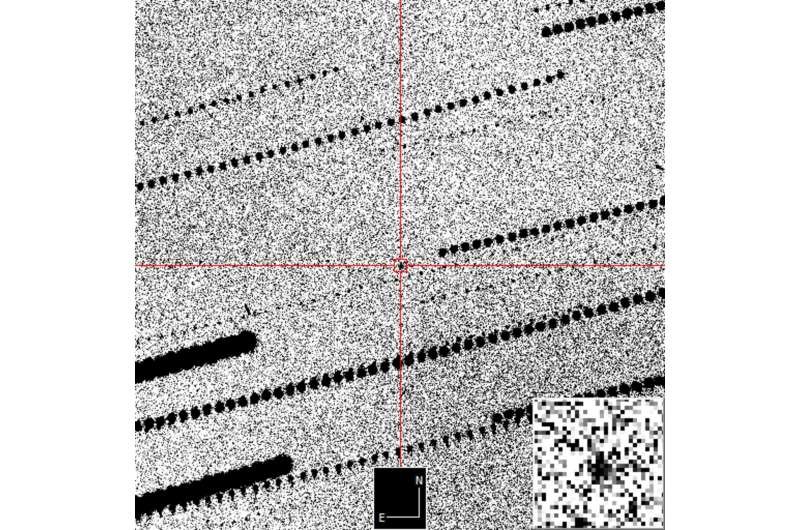
    On October 1, 2025, a small asteroid silently swept past Earth, flying closer than the orbit of the International Space Station (ISS). Designated Asteroid 2025 TF, the rock passed only 428 kilometers (266 miles) above Antarctica — a breathtakingly close shave in cosmic terms.

    Yet, in an ironic twist, astronomers didn’t spot it until hours after it was gone.

    A Near-Miss You Couldn’t See

    The asteroid measured between 1 and 3 meters (3–10 feet) across — small enough that it would have burned up harmlessly if it had entered our atmosphere, likely creating a spectacular fireball over the icy southern continent.

    But this near miss underscores a growing challenge for planetary defense: tiny asteroids are incredibly hard to detect until they’re already upon us.

    “Finding small, fast-moving objects in the vast darkness of space is like searching for a charcoal pebble against a black velvet curtain,”
    explained astronomer Fraser Cain during a Universe Today segment on asteroid detection.

    Discovery After the Flyby

    Astronomers at the Kitt Peak National Observatory in Arizona first spotted 2025 TF just six hours after its closest approach using the Bott Telescope.

    Follow-up observations came from the Catalina Sky Survey and the European Space Agency’s Planetary Defense Office, working with the Las Cumbres Observatory in Siding Spring, Australia.

    These quick collaborations confirmed that 2025 TF had already skimmed past Earth safely — but not by much.

    How Close Was It?

    At 428 km, the asteroid passed through the same orbital neighborhood as the International Space Station, which circles Earth at altitudes between 370 and 460 km.

    Had the two crossed paths, the outcome could have been catastrophic. Fortunately, space is vast even in low Earth orbit, and the ISS was nowhere near the asteroid’s trajectory.

    Still, this proximity highlights an increasing concern: our orbit is crowded, with satellites, space stations, and debris forming a dense shell around the planet.

    A Record-Setting Flyby

    Asteroid 2025 TF now ranks as the second-closest asteroid flyby ever observed, just behind 2020 VT4, a slightly larger 5–10 m rock that passed 386 km above the Pacific Ocean in 2020.

    That earlier asteroid went undetected until 15 hours after its pass, while 2025 TF was found only six hours later — a small but meaningful improvement in detection capability.

    The Hidden Risk: Orbital Collisions

    Though too small to threaten Earth’s surface, these objects pose a serious hazard to satellites and space stations.

    A direct hit could produce a cloud of fragments that might trigger Kessler Syndrome — a chain reaction of collisions that could render low Earth orbit unusable for decades.

    With the number of satellites growing rapidly, particularly from megaconstellations like Starlink, the odds of such an event are slowly rising.

    Why Detection Is So Difficult

    Detecting small asteroids like 2025 TF is challenging because:

    • They’re tiny — often just a few meters wide.

    • They reflect very little light and are nearly invisible against the background sky.

    • Many approach Earth from the direction of the Sun, where telescopes can’t look safely.

    To improve planetary defense, scientists need more dedicated telescopes, both on the ground and in space, linked into global monitoring networks.

    “We need a worldwide, coordinated system to spot these dark, fast-moving objects before they reach our neighborhood,”
    researchers from the ESA’s Planetary Defense Office noted.

    What Comes Next?

    For now, small asteroids like 2025 TF are reminders of the fragile security of our orbital zone.

    Future missions — such as NASA’s NEO Surveyor space telescope and ESA’s Flyeye system — aim to catch such objects before they pass by. But until they’re operational, astronomers remain reliant on existing observatories and a bit of luck.

    Reference

    Tomaswick, A. (2025).
    An Asteroid Recently Flew Closer to Earth Than the ISS.
    Universe Today.
    Credit: ESA / Las Cumbres Observatory.

    A Close Call — and a Wake-Up Call

    Asteroid 2025 TF’s silent flyby reminds us that space is not empty — it’s alive with movement, chance, and risk.
    While this small rock posed no real danger, the next one might not be so forgiving.
    Until our detection systems catch up, we’ll keep relying on cosmic luck to avoid an encounter that could light up our skies — or darken our future.

  • Earth’s Oxygen Boom: How Nickel and Urea Shaped Early Life and Set the Stage for a Living World

    Earth’s Oxygen Boom: How Nickel and Urea Shaped Early Life and Set the Stage for a Living World

    New experiments reveal how chemical balances in ancient oceans delayed and then accelerated the planet’s Great Oxidation Event.

    Roughly 2.4 billion years ago, Earth experienced one of the most transformative moments in its history — the Great Oxidation Event (GOE). This was when the planet’s atmosphere first became rich in oxygen, allowing complex life to eventually evolve.

    But for hundreds of millions of years before that, oxygen-producing microbes known as cyanobacteria already existed. So why did it take so long for oxygen to accumulate in the atmosphere?

    A new study from Okayama University offers a surprising answer: the key may lie in two small but powerful molecules — nickel and urea — that once filled the early oceans.

    The Mystery of Earth’s Delayed Oxygenation

    Scientists have long known that oxygenic photosynthesis — the process by which cyanobacteria split water molecules to release oxygen — evolved well before the GOE. However, despite this biological innovation, the planet’s atmosphere stayed almost oxygen-free for hundreds of millions of years.

    Previous theories blamed volcanic gases, iron oxidation, or methane-dominated atmospheres for absorbing oxygen as fast as it was produced. But a complete explanation remained elusive — until now.

    “We wanted to understand how a tiny microbe was capable of changing an entire planet,”
    said Dr. Dilan M. Ratnayake, the study’s lead author, from the Institute for Planetary Materials, Okayama University (now at the University of Peradeniya, Sri Lanka).
    “Understanding this mechanism could even help us figure out how to generate oxygen on other planets.”

    Recreating the Archean Earth

    To solve the puzzle, Dr. Ratnayake’s team ran a two-stage experimental simulation of Archean Earth, a period between 4 and 2.5 billion years ago, when life was mostly microbial and the atmosphere lacked oxygen.

    Step 1: Could urea form naturally?

    In the first experiment, the researchers mixed ammonium, cyanide, and iron compounds, then exposed them to ultraviolet (UV-C) radiation — the type of light that would have reached the surface before the ozone layer existed.

    The results showed that urea, a vital nitrogen-rich molecule, could form abiotically under these ancient conditions. This finding suggests that urea — long considered a product of life — may have been present before life fully evolved, serving as a nutrient source for primitive organisms.

    Step 2: How did urea and nickel affect cyanobacteria?

    In the second experiment, cultures of Synechococcus sp. PCC 7002, a modern cyanobacterium, was grown under light–dark cycles with varying levels of urea and nickel.

    By tracking optical density and chlorophyll a levels, the researchers measured how these compounds affected microbial growth.

    The Nickel–Urea Bottleneck

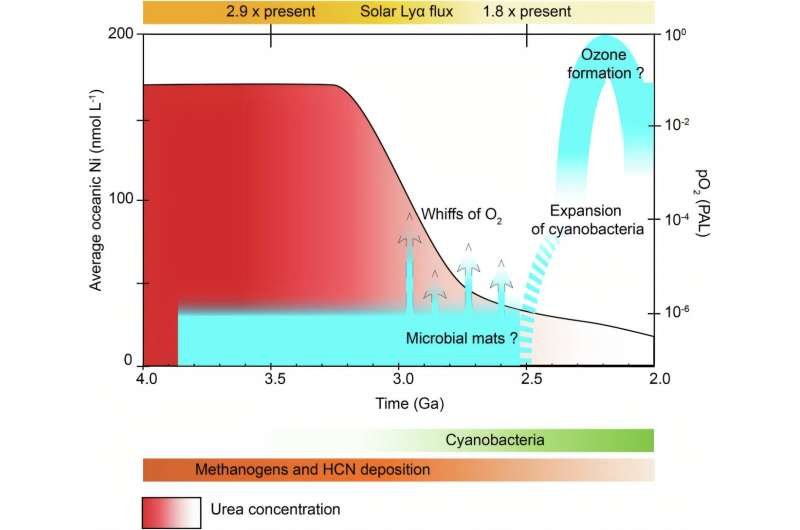
    The findings revealed an elegant chemical interplay. In the early oceans, both nickel and urea were abundant. Nickel, though essential for enzymes that help cyanobacteria process nitrogen, can be toxic in excess. Similarly, while urea provides vital nitrogen, high concentrations inhibit growth.

    This created a metabolic bottleneck — conditions that allowed cyanobacteria to exist but prevented them from thriving enough to alter atmospheric chemistry.

    As time passed, nickel levels declined due to geological changes, and urea concentrations stabilized, creating the perfect balance for massive cyanobacterial blooms. These blooms finally pumped enough oxygen into the atmosphere to trigger the Great Oxidation Event.

    “Nickel and urea had a complex yet fascinating relationship,”
    Dr. Ratnayake explained.
    “At lower concentrations, they promoted the proliferation of cyanobacteria, setting off the chain reaction that ultimately oxygenated Earth.”

    A Blueprint for Life — on Earth and Beyond

    The study’s implications go far beyond early Earth. Understanding how small chemical changes shaped the oxygen balance provides a new framework for detecting life elsewhere in the universe.

    “If we can clearly understand the mechanisms that increase atmospheric oxygen, it will guide how we search for biosignatures on other planets,”
    said Ratnayake.

    Future missions, including Mars Sample Return and exoplanet biosignature studies, could use these insights to identify worlds where trace compounds like nickel and urea may drive — or limit — the emergence of life.

    Rethinking Earth’s Evolutionary Timeline

    By experimentally confirming that urea could form under prebiotic conditions and showing how its interaction with nickel influenced microbial ecosystems, the research provides a new geochemical perspective on how life transformed our planet.

    In essence, Earth’s oxygen boom wasn’t just about biology — it was a delicate chemical balancing act. The gradual decline of nickel and the moderation of urea created the ecological window for cyanobacteria to flourish, reshaping the atmosphere and paving the way for all oxygen-dependent life that followed.

    Reference

    Ratnayake, D. M., Tanaka, R., & Nakamura, E. (2025).
    Nickel and urea controls on cyanobacterial proliferation and the timing of Earth’s oxygenation.
    Communications Earth & Environment (Nature Portfolio).
    DOI: 10.1038/s43247-025-02576-8
    Credit: Okayama University / Communications Earth & Environment (2025).

    A Delicate Chemical Symphony

    This study elegantly connects chemistry, biology, and planetary evolution into one narrative. The interplay of nickel, urea, and sunlight not only determined when Earth became breathable but also offers clues about how to make other worlds livable.

    As we continue searching the cosmos, understanding Earth’s own oxygen story reminds us that life depends not just on the presence of water or light — but on the right balance of elements at the right time.

  • Astronomers Detect Hot Gaseous Outflow in Galaxy NGC 5746

    Astronomers Detect Hot Gaseous Outflow in Galaxy NGC 5746

    XMM-Newton’s deep-space view uncovers a vast X-ray halo and signs of past stellar activity in a massive spiral galaxy.

    Astronomers using the European Space Agency’s XMM-Newton satellite have discovered a hot gaseous outflow extending from the massive spiral galaxy NGC 5746.
    This new observation reveals a vast halo of diffuse, high-temperature plasma and two massive hot bubbles stretching tens of thousands of light-years above and below the galaxy’s plane — a sign of an ancient galactic wind that once blew through the system.

    The findings, posted on October 1, 2025, to the arXiv preprint server (DOI: 10.48550/arxiv.. 2510.00868), promise to deepen our understanding of how galactic outflows regulate star formation and evolution in large spiral galaxies like our own Milky Way.

    A Massive Galaxy on the Edge

    Located about 94.5 million light-years away, NGC 5746 is a barred spiral galaxy seen almost edge-on from Earth — a vantage point that provides an ideal view of its disk and halo.
    With a stellar mass between 110 and 130 billion Suns, NGC 5746 is a true giant, forming part of a galaxy pair with NGC 5740 and serving as the largest member of the NGC 5746 Group.

    For years, scientists have debated whether this galaxy hosts a halo of hot gas — a key feature in understanding how galaxies exchange material with their cosmic environment.
    Earlier X-ray studies using NASA’s Chandra Observatory had hinted at such a halo, but later analyses questioned its existence due to data sensitivity limits.

    Now, new evidence from XMM-Newton brings the debate to a close.

    A Sharper Look with XMM-Newton

    Led by Roman Laktionov of the Dr. Karl Remeis Observatory in Bamberg, Germany, the research team used XMM-Newton’s European Photon Imaging Camera (EPIC) to take deep exposures of NGC 5746 across multiple X-ray bands.

    “EPIC’s larger effective area and superior low-energy response make it far more sensitive to faint, diffuse X-ray emission than Chandra,”
    the researchers wrote in their study.

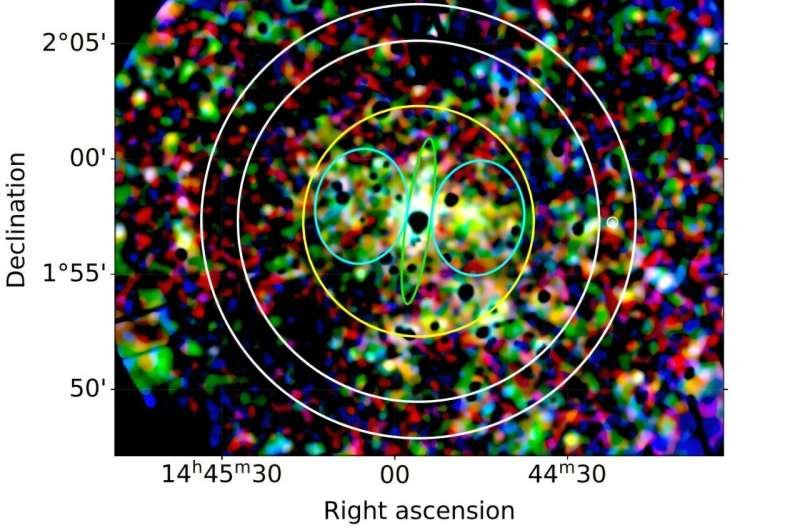
    By merging four separate observations, they produced a three-color composite X-ray image, mapping:

    • 🔴 Soft X-rays (0.3–0.7 keV) in red,

    • 🟢 Medium X-rays (0.7–1.2 keV) in green, and

    • 🔵 Hard X-rays (1.2–5.0 keV) in blue.

    The resulting image revealed a diffuse X-ray halo extending over 100,000 light-years on average — and even up to 130,000 light-years east and west of the galaxy’s disk.

    The halo’s plasma temperature, around 0.56 keV, is notably higher than that of halos around most spiral galaxies — suggesting an energetic and dynamic history.

    The Ghost of a Galactic Wind

    Within this enormous halo, XMM-Newton detected two hot, bubble-like regions rising symmetrically above and below the galactic plane.
    These structures form a biconical outflow, likely remnants of a powerful stellar wind or past starburst episode.

    Unlike the chaotic, clumpy winds seen in more active galaxies, the outflow in NGC 5746 appears smoother and more extended — evidence that the event is no longer active.
    Astronomers believe the gas was heated long ago and has since expanded and cooled into the faint, diffuse halo now observed.

    “The signs of a recent stellar outflow indicate that the star-forming activity in this galaxy is higher than previously thought,”
    the authors reported.

    Revised estimates suggest a star formation rate (SFR) of about 2.9 solar masses per year — nearly three times higher than earlier estimates.

    The Disk: X-ray Binaries at Work

    The study also revealed that NGC 5746’s disk emits strong diffuse X-rays with a plasma temperature of 0.7 keV, dominated by unresolved X-ray binaries — systems where a compact object (like a neutron star or black hole) accretes matter from a companion star.

    This emission, coupled with the halo’s hot gas, provides clues about how energy and matter flow between the disk and the surrounding intergalactic medium.

    What It Means for Galaxy Evolution

    The discovery of this vast, faint X-ray halo offers valuable insights into feedback processes — the mechanisms through which galaxies regulate their own growth.
    Hot gaseous outflows, driven by supernova explosions or bursts of star formation, can expel material into the galactic halo, influencing how future stars and planets form.

    NGC 5746’s halo also reinforces the view that even galaxies with moderate star formation can generate large-scale outflows over cosmic timescales.
    These processes may help explain why some galaxies stop forming stars earlier than others, and how metals and energy are distributed across the universe.

    Reference

    Laktionov, R., Nowakowski, T., et al. (2025).
    Detection of a Hot Gaseous Outflow and X-ray Halo in NGC 5746.
    arXiv preprint DOI: 10.48550/arxiv.2510.00868
    Image Credit: ESA/XMM-Newton/EPIC; Dr. Karl Remeis Observatory.

    A Galaxy That Breathes Fire

    The discovery of a halo glowing with million-degree plasma transforms our picture of NGC 5746 from a quiet spiral to a galaxy that once breathed fire into space.
    Though the outflow has now calmed, its hot remnants remain — a silent record of the energetic forces that shape galaxies across the universe.

  • Astronomers Detect the Smallest Dark Object Ever Found Through Gravitational Lensing

    Astronomers Detect the Smallest Dark Object Ever Found Through Gravitational Lensing

    A new milestone in dark matter research reveals a mysterious, invisible object a million times heavier than our Sun.

    In one of the most remarkable breakthroughs in modern astrophysics, an international team of astronomers has detected the lowest-mass dark object ever measured — using a sophisticated technique known as gravitational lensing.
    This unseen cosmic mass, about one million times the mass of our Sun, lies roughly 10 billion light-years away, from a time when the universe was just 6.5 billion years old.

    The discovery, published in Nature Astronomy by scientists from the Max Planck Institute for Astrophysics, provides a critical piece of evidence about how dark matter is distributed across the universe — whether it is smooth or clumpy, and what that might reveal about its true nature.

    Shedding Light on the Invisible

    Dark matter makes up about 85% of all matter in the universe, yet it doesn’t emit, absorb, or reflect light — making it effectively invisible. Scientists can only infer its presence by observing how it bends and distorts light from background objects — a phenomenon predicted by Einstein’s General Theory of Relativity and known as gravitational lensing.

    “Since we can’t see these dark objects directly, we use very distant galaxies as a backlight to look for their gravitational imprints,”
    explains Devon Powell, lead author of the study at the Max Planck Institute for Astrophysics.

    Using this method, astronomers can detect dark objects that are otherwise completely undetectable by optical or infrared telescopes.

    An Earth-Sized Telescope Network

    The discovery relied on an extraordinary feat of global coordination.
    The team combined data from multiple world-class instruments, including the Green Bank Telescope, the Very Long Baseline Array (VLBA), and the European Very Long Baseline Interferometric Network (EVN).

    By synchronizing these telescopes across the globe, scientists effectively created an Earth-sized super-telescope, powerful enough to capture the minute distortions caused by the dark object’s gravitational pull on light from a distant radio galaxy.

    The data were processed and correlated at the Joint Institute for VLBI ERIC in the Netherlands, producing images of unprecedented sensitivity and resolution.

    A Hidden Mass Revealed

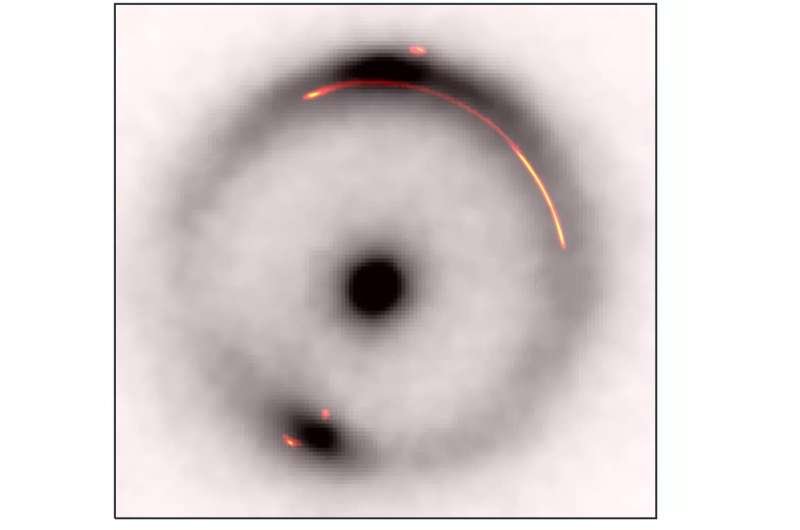
    The key signature of the discovery was a “pinch” or narrowing in the observed radio arc of a distant galaxy — a telltale sign that something massive but invisible was warping spacetime in that region.

    “From the first high-resolution image, we immediately saw a narrowing in the gravitational arc — the unmistakable sign of another mass between us and the galaxy,”
    said John McKean, co-author from the University of Groningen, University of Pretoria, and the South African Radio Astronomy Observatory.

    At the “pinch point” of the arc, sophisticated modeling revealed the presence of a dark clump — shown as a white blob in the team’s composite image.
    Despite searches across optical, infrared, and radio wavelengths, no light emission was detected from the object, confirming that it is truly dark.

    Cracking the Code of Cosmic Shadows

    Detecting such a faint signal required supercomputer-level data processing. The team developed entirely new numerical algorithms capable of modeling billions of data points from the global telescope array.

    “The data were so large and complex that we had to design new modeling approaches,”
    said Simona Vegetti, senior researcher at Max Planck.
    “Finding these dark clumps — and convincing the scientific community they’re real — takes an enormous amount of number-crunching.”

    This dark object’s detection marks a 100-fold improvement in sensitivity compared to previous lensing studies. It provides the first direct evidence for low-mass dark clumps, consistent with predictions of the cold dark matter (CDM) theory — the leading model of cosmic structure formation.

    Implications for the Universe

    According to the CDM model, galaxies — including our own Milky Way — should be embedded within halos of dark matter filled with countless small “clumps” or “subhalos.”
    Detecting these clumps is crucial because it allows scientists to test dark matter theories and distinguish between competing models, such as warm dark matter or self-interacting dark matter.

    “Having found one, the next question is how many more are out there — and whether their abundance still agrees with theoretical models,”
    said Powell.

    If astronomers continue to find more of these invisible, starless objects, some long-standing dark matter hypotheses could be ruled out, potentially reshaping our understanding of cosmic evolution.

    What Comes Next

    The research team is now scanning other regions of the sky using the same gravitational imaging technique to look for additional dark clumps.
    Each new detection will help refine how dark matter behaves at small scales — information vital for future missions like the James Webb Space Telescope, SKA (Square Kilometer Array), and LISA (Laser Interferometer Space Antenna).

    Their ultimate goal?
    To build a 3D dark matter map of the universe — revealing the invisible skeleton that holds galaxies together.

    Reference

    Powell, D., Vegetti, S., McKean, J., Hämmerle, H., et al. (2025).
    Detection of the Lowest-Mass Dark Object via Gravitational Lensing.
    Published in Nature Astronomy (2025).
    Credit: Max Planck Institute for Astrophysics / EVN / GBT / VLBA.

    A Step Closer to Unmasking the Invisible Universe

    This discovery doesn’t just push the limits of observational astronomy — it peels back another layer of the cosmic mystery that defines our existence.
    Hidden in the dark, silent folds of space, these massive, unseen objects may hold the secrets of how the universe was built.

    And now, with gravitational lensing as our cosmic flashlight, we are finally beginning to see the invisible architecture of the cosmos.

  • Two Black Holes Caught Circling Each Other — A Cosmic First

    Two Black Holes Caught Circling Each Other — A Cosmic First

    Astronomers capture the first-ever radio image of two supermassive black holes in orbit, confirming a theory 40 years in the making.

    For the first time in human history, astronomers have captured an image showing two black holes orbiting each other. The extraordinary discovery was made in the quasar OJ287, a celestial object so bright that even amateur astronomers can detect it from Earth.

    This achievement, led by an international team of researchers from the University of Turku (Finland) and collaborators using the RadioAstron satellite, provides the strongest evidence yet that binary black holes — pairs of massive black holes locked in a gravitational dance — really do exist.

    A Quasar with a Mystery

    Quasars are the intensely luminous cores of galaxies, powered by supermassive black holes feeding on surrounding gas and dust.
    OJ287, located about 5 billion light-years away, has long puzzled astronomers. Since the early 1980s, it has exhibited a recurring 12-year cycle of brightness changes, indicating that something extraordinary is occurring at its core.

    In 1982, Finnish astronomer Aimo Sillanpää proposed a daring explanation: OJ287 might not have one black hole, but two, orbiting each other in a 12-year cycle. His idea sparked decades of observation and mathematical modeling.

    From Theory to Image

    Fast forward to the 2020s — after years of calculations and light-curve monitoring, Doctoral Researcher Lankeswar Dey and his team successfully modeled the orbits of OJ287’s suspected black holes. What remained was the most challenging question: Could both black holes actually be seen?

    The answer arrived through radio astronomy. Visible-light telescopes, such as NASA’s TESS satellite, detected light from both black holes, but the images appeared as a single unresolved point. To separate them, scientists needed 100,000 times higher resolution — achievable only through radio telescopes operating in space.

    Enter RadioAstron, a Russian-led satellite observatory with an antenna extending halfway to the Moon. Its immense distance from Earth created a vast virtual telescope, capable of resolving the finest cosmic details. When OJ287 was observed using this system, two distinct bright spots appeared — one for each black hole.

    The Historic Image

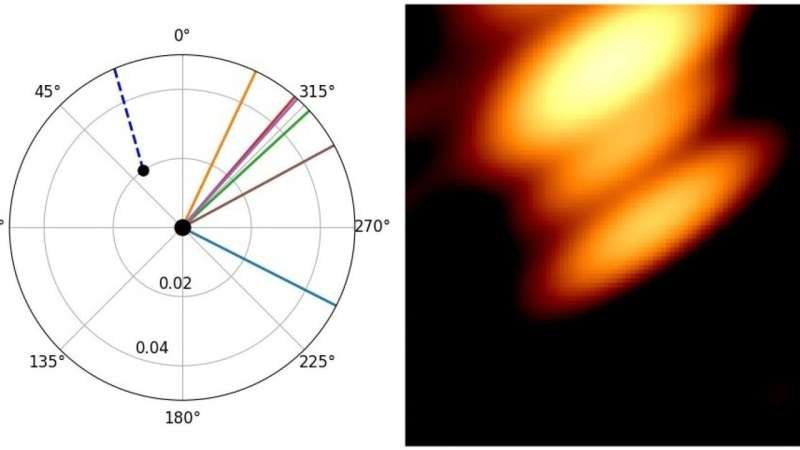
    The final composite shows two key components:

    • Left Panel: A theoretical diagram by Lankeswar Dey, predicting the positions and jet directions of both black holes.

    • Right Panel: The radio image captured by RadioAstron (J.L. Gómez et al., 2022), clearly revealing two bright points corresponding to the two black holes, along with the jet emitted by the smaller one.

    The alignment between theory and observation confirmed what astronomers had hoped for decades: binary black holes are real.

    “For the first time, we managed to get an image of two black holes circling each other,”
    Professor Mauri Valtonen, University of Turku.

    A Twisting Jet — The “Wagging Tail”

    In a surprising twist (literally), researchers also identified a new type of black-hole jet — a twisted stream of particles emanating from the smaller black hole. Because it rapidly orbits its larger companion, the jet appears to wobble and swing like the end of a garden hose.

    This “wagging tail” motion could change direction as the orbit evolves, providing a rare opportunity to observe relativistic effects in real time.

    This image is more than just a cosmic snapshot — it’s a window into the evolution of galaxies and the nature of gravity itself.

    • 🪐 Binary black holes are believed to form during galactic mergers, when two supermassive black holes sink toward the center of the new galaxy and begin orbiting one another.

    • 🔊 Their eventual collision is expected to produce powerful gravitational waves, ripples in space-time first predicted by Einstein.

    • 🔭 Understanding these systems helps astronomers refine models of black-hole growth, galaxy formation, and jet-driven feedback that shapes interstellar environments.

    The work also demonstrates the power of global radio astronomy networks and space-based telescopes working in unison — a model for future missions like the next-generation Event Horizon Telescope and LISA gravitational wave observatory.

    Reference

    Dey, L., Valtonen, M., Sillanpää, A., Gómez, J.L., et al. (2025).
    Imaging Two Orbiting Black Holes in Quasar OJ287.
    Published in The Astrophysical Journal.
    DOI: 10.48550/arxiv.2510.06744

    The Beginning of a New Era

    The image of OJ287’s twin black holes is more than a technical triumph — it’s a glimpse into the violent yet elegant choreography of the universe.
    Two invisible giants, circling each other in the darkness, sending out signals across billions of light-years — and now, for the first time, we can finally see them.