Blog

  • Rare Intersex Spider Among New Species Discovered in Thailand

    Rare Intersex Spider Among New Species Discovered in Thailand

    In the quiet forests of Kanchanaburi, western Thailand, researchers have uncovered something extraordinary — a new species of spider that has stunned arachnologists not only for its striking colors and structure but also for a rare intersex condition found in one of its specimens.

    The discovery, made near Nong Rong in Phanom Thuan District, was recently published in the journal Zootaxa and represents both a new species in the genus Damarchus and the first-ever reported gynandromorph in the spider family Bemmeridae.

    A Hidden Treasure in Thailand’s Forests

    The newly found spiders were first presented to researchers at the Chulalongkorn University Museum of Natural History, where a detailed morphological analysis began. Using a stereomicroscope, the team compared the specimens with known members of the genus Damarchus — a group of mygalomorph spiders known for building distinctive “wishbone”-shaped burrows that open into the ground.

    While molecular data have not yet fully confirmed their taxonomic placement, all evidence so far suggests that this new species belongs to Damarchus, a genus spread across South and Southeast Asia.

    Male and Female Worlds Apart

    One of the most fascinating features of this discovery lies in the dramatic sexual dimorphism — the visible differences between male and female spiders.

    • 🕷️ Males measure around 0.6 inches long, are gray in color, and are coated in a mysterious white substance whose composition remains unknown. When preserved in alcohol, they turn a reddish-brown hue.

    • 🕸️ Females, on the other hand, grow to about 1 inch, display a bright orange coloration, and lack the white coating entirely.

    These contrasts are not merely cosmetic — they hint at different ecological behaviors or mating adaptations yet to be studied.

    The Gynandromorph: Half-Male, Half-Female

    Among the collected specimens was one that stood out as truly exceptional — a gynandromorph, an organism divided between male and female characteristics along a perfect midline.

    Unlike hermaphrodites, which possess both sex organs but retain bilateral symmetry, gynandromorphs are split right down the middle, with one side appearing male and the other female. In this spider, the left side displayed the orange hue of the female, while the right side bore the white coloration of the male — a vivid, living expression of biological duality.

    A Name Inspired by Anime and Biology

    The species has been named Damarchus inazuma sp. nov. — “Inazuma”, after the gender-fluid character from the Japanese manga One Piece. Inazuma’s ability to change between male and female perfectly mirrors the bilateral asymmetry seen in this unique spider.

    “The color arrangement closely mirrors the sexual dimorphism observed in this species,” the authors wrote, noting that the orange and white color split reflects the biological differences between males and females in the species.

    A Rare Genetic Mystery

    This is only the third recorded case of gynandromorphism in mygalomorph spiders — and the first within the Bemmeridae family. Earlier cases were reported in the Theraphosidae (tarantula) family.

    The underlying cause of this condition remains uncertain. The authors suggest, referencing earlier work by arachnologist Benjamin Kaston, that gynandromorphism might result from chromosomal irregularities, such as the loss of one or more X chromosomes in a developing female zygote. Such genetic disruptions could be influenced by environmental stressors or infections — including those caused by nematodes.

    Regardless of the cause, the finding highlights the complexity of biological development and the intricate dance of chromosomes that determine sex in living organisms.


    Why It Matters

    This discovery adds not just a new species to science but a rare biological phenomenon that expands our understanding of sex differentiation, genetic mutation, and biodiversity in Southeast Asia.

    It underscores how much of Earth’s biodiversity remains unexplored — and how even small forest patches can hide species that defy expectations.

    From a scientific standpoint, Damarchus inazuma will help deepen studies on genetic development, arachnid taxonomy, and the evolutionary mechanisms that lead to such unusual conditions.

    And from an artistic perspective — as its name and coloration suggest — it’s a reminder that nature’s creativity rivals even the most imaginative fiction.

    Citation & Acknowledgments

    Source Article:
    Kasal, K. (2025). “Rare intersex spider among new species discovered in Thailand.” Phys.org.
    Edited by: Gaby Clark
    Reviewed by: Robert Egan
    Original Study: Zootaxa (2025). DOI: 10.11646/zootaxa 5696.3.6
    Institution: Chulalongkorn University Museum of Natural History, Thailand


    Author: Collins Odhiambo — DatalytIQs Academy Life Sciences & Biodiversity Blog
    Category: Zoology & Genetics
  • Magnetic “Switchback” Detected Near Earth for the First Time

    Magnetic “Switchback” Detected Near Earth for the First Time

    For decades, scientists believed that magnetic “switchbacks” — sharp bends or kinks in solar magnetic field lines — were phenomena limited to the Sun’s atmosphere. But in a groundbreaking discovery, researchers have now detected such a switchback structure near Earth, providing new insights into how solar and planetary magnetic fields interact.

    The finding, published in the Journal of Geophysical Research: Space Physics by E. O. McDougall and M. R. Argall, marks the first time this phenomenon has been observed so close to home. It offers a fresh perspective on the magnetic dynamics that shape our planet’s near-space environment — and the powerful space weather events that can follow.

    From the Sun’s Corona to Earth’s Magnetosphere

    The story of magnetic switchbacks begins with NASA’s Parker Solar Probe, launched in 2018 to study the Sun up close. The probe’s daring orbits through the solar corona revealed numerous “kinks” in magnetic field lines — regions where the magnetic field suddenly reverses direction in a zigzag pattern.

    These kinks are believed to arise from a process known as magnetic reconnection, in which field lines pointing in opposite directions break and reconnect, snapping into a new configuration and flinging energy outward.

    Until now, scientists thought such structures existed only in the turbulent outer atmosphere of the Sun. The new study, however, shows that Earth’s own magnetic bubble — the magnetosphere — can host similar magnetic twists.

    NASA’s Four-Satellite Mission: The Eyes on the Magnetosphere

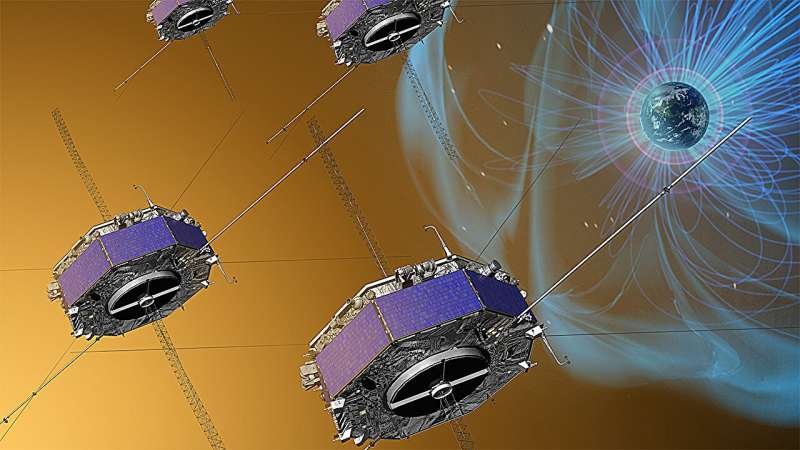
    The discovery came from data gathered by NASA’s Magnetospheric Multiscale (MMS) Mission, a quartet of spacecraft flying in tight formation around Earth. The mission is designed to study magnetic reconnection, the same process responsible for auroras, solar flares, and geomagnetic storms.

    While analyzing MMS data, McDougall and Argall noticed a twisting disturbance in the magnetosphere’s outer region — where Earth’s magnetic field meets the incoming solar wind, a continuous stream of charged particles from the Sun.

    The disturbance contained a blend of two plasmas:

    • Terrestrial plasma trapped within Earth’s magnetic field

    • Solar plasma carried by the solar wind

    This mix of particles rotated, rebounded, and twisted back into place, forming a zigzag pattern — the hallmark of a magnetic switchback.

    Magnetic Reconnection: The Cosmic Snap

    The researchers concluded that this switchback likely formed when solar wind magnetic field lines reconnected with Earth’s magnetic field, creating a temporary structure that flipped direction before relaxing again.

    This observation confirms that magnetic reconnection — a fundamental plasma process — can generate switchbacks not only near the Sun but also wherever magnetic fields interact in space. That includes planetary magnetospheres, comet tails, and possibly even exoplanetary systems.

    “The discovery of a switchback in Earth’s magnetosphere means we can study these events directly—without sending a spacecraft into the Sun,” the authors note. “It opens the door to understanding solar phenomena using near-Earth observations.”

    Why This Matters: Closer to Understanding Space Weather

    Switchbacks are more than just magnetic curiosities. They play a role in how solar energy is transported through space and how geomagnetic storms form when that energy interacts with Earth’s magnetic field.

    Understanding these interactions is critical because geomagnetic storms can:

    • Disrupt satellite communications and GPS systems

    • Overload power grids

    • Pose radiation hazards to astronauts and aircraft

    By studying switchbacks near Earth, scientists can refine models of solar-terrestrial coupling, helping to predict space weather more accurately and safeguard both technology and astronauts.

    The Bigger Picture: A Local Laboratory for Cosmic Physics

    This discovery transforms Earth’s magnetosphere into a natural laboratory for exploring magnetic reconnection and plasma behavior under controlled, observable conditions.

    Instead of relying solely on missions like Parker Solar Probe — which must endure extreme heat and radiation — researchers can now observe similar physics safely from near-Earth orbit.

    As our planet continues to dance with the solar wind, each twist and rebound of magnetic field lines brings us closer to understanding the dynamic magnetic universe we live in.

    Citation & Acknowledgments

    Source Article:
    Stanley, S. (2025). “Magnetic ‘switchback’ detected near Earth for the first time.” Eos.
    Edited by: Lisa Lock
    Reviewed by: Robert Egan
    Image Credit: NASA/GSFC – Magnetospheric Multiscale Mission (MMS)
    Original Study: E. O. McDougall & M. R. Argall, Journal of Geophysical Research: Space Physics (2025).


    Author: Collins Odhiambo — DatalytIQs Academy Space & Physics Blog
    Category: Space Physics & Solar Science

  • The First Device Based on “Optical Thermodynamics” Can Route Light Without Switches

    The First Device Based on “Optical Thermodynamics” Can Route Light Without Switches

    In a leap that could reshape the future of computing and communications, researchers from the University of Southern California (USC) have unveiled the first-ever optical device designed using the principles of “optical thermodynamics.”

    The breakthrough—published in Nature Photonics—marks a revolutionary step in photonics, the science of controlling light. Unlike conventional optical routers that depend on electronic switches or external controls, this new device allows light to route itself naturally, guided by the same fundamental rules that govern heat and energy flow in the physical world.

    When Light Behaves Like Heat

    The research team from USC’s Ming Hsieh Department of Electrical and Computer Engineering discovered that light in complex nonlinear optical systems behaves much like a gas reaching thermal equilibrium.

    In classical thermodynamics, gas molecules move, collide, and distribute energy until a stable balance—an equilibrium—is achieved. Similarly, in nonlinear optical lattices, light waves interact and self-organize until they find a natural pathway through the system.

    This realization led to the creation of a new theoretical and practical framework: optical thermodynamics. It treats light not merely as a wave or particle, but as a thermodynamic medium—capable of expansion, compression, and even phase transitions.

    “What was once viewed as an intractable challenge in optics has been reframed as a natural physical process,” explains Professor Demetrios Christodoulides, the Steven and Kathryn Sample Chair in Engineering at USC Viterbi.
    “This may redefine how engineers approach the control of light and other electromagnetic signals.”

    A Device That Routes Light by Itself

    To appreciate the power of this idea, imagine a marble maze that arranges itself. Normally, you would have to lift barriers and manually guide the marble toward its destination. In the USC device, however, the maze is built so perfectly that no matter where you drop the marble, it rolls on its own toward the right exit.

    That’s exactly what happens to light in the optical thermodynamics system:

    • It begins with an optical expansion, analogous to the Joule–Thomson process in gases.

    • It then naturally redistributes its intensity—like heat spreading evenly through a room—until it reaches optical equilibrium.

    The outcome? Light automatically routes into the correct channel—no external switches, no digital control, no manual adjustment.

    Implications for Computing and Industry

    This new paradigm could transform multiple industries that depend on the manipulation of light. From chip-scale optical interconnects used in high-speed computing to data center communications and quantum information systems, the potential applications are immense.

    Tech giants like NVIDIA and others are already exploring optical data transfer to overcome the speed and power limits of traditional electronics. The USC team’s work provides a simpler, self-organizing foundation for such systems—reducing complexity while increasing efficiency.

    “By allowing light to find its own path,” says Hediyeh M. Dinani, the study’s lead author and a Ph.D. researcher in the Optics and Photonics Group at USC Viterbi, “we’re introducing a new way to design photonic systems that are both self-regulating and scalable.

     Turning Chaos Into Predictability

    Nonlinear optical systems have long been considered chaotic and hard to control. Their unpredictable behavior has limited their use in real-world technology. But optical thermodynamics flips this challenge into an opportunity.

    By treating the apparent randomness as a natural form of equilibrium-seeking behavior, the USC researchers have found a way to turn chaos into order—allowing light to guide itself within devices once thought too complex to manage.

    This discovery is not just a technical feat—it represents a conceptual shift. It shows that nature’s most elegant laws, like thermodynamics, can provide blueprints for designing the next generation of self-organizing technologies.

    A New Frontier in Photonics

    The implications of this research go beyond optical routing. It opens new doors for:

    • Autonomous optical computing systems

    • Energy-efficient communication networks

    • Advanced photonic materials that self-balance and self-heal

    • Exploration of fundamental physics at the intersection of light, heat, and information

    By blending thermodynamic reasoning with modern photonics, the USC team has introduced a framework that could underpin the next era of light-based computation—where devices no longer require complex circuitry, because light itself does the work.

    Citation & Acknowledgments

    Source Article:
    University of Southern California (2025). “First device based on ‘optical thermodynamics’ can route light without switches.”
    Published on Phys.org, written by University of Southern California staff.
    Edited by: Sadie Harley
    Reviewed by: Robert Egan
    Photo Credit: Yunxuan Wei, USC Viterbi School of Engineering.
    Original Research: Nature Photonics (2025) – “Optical Thermodynamics and Self-Routing of Light in Nonlinear Systems” by Hediyeh M. Dinani, Demetrios N. Christodoulides et al.


    Author: Collins Odhiambo — DatalytIQs Academy Science & Emerging Technologies Blog
    Category: Photonics & Applied Physics

  • When Mathematics Meets Aesthetics: Tessellations as a Precise Tool for Solving Complex Problems

    When Mathematics Meets Aesthetics: Tessellations as a Precise Tool for Solving Complex Problems

    Mathematics is often celebrated for its precision, logic, and rigor—but beneath its formal symbols lies a world of breathtaking beauty and design. In a recent study, mathematicians from Freie Universität Berlin have shown that the geometric elegance of tessellations—the art of tiling a surface with perfectly fitting shapes—can do far more than please the eye. It can solve some of the most challenging mathematical problems in analysis, physics, and engineering.

    Published in the journal Applicable Analysis, the study “Beauty in/of Mathematics: Tessellations and Their Formulas” by Professor Heinrich Begehr and Dajiang Wang merges artistry with mathematical precision. It reveals how intricate geometric patterns can serve as analytical frameworks for solving boundary value problems, such as the Dirichlet and Neumann problems—cornerstones of mathematical physics.

    The Parqueting-Reflection Principle: Beauty with Structure

    At the heart of this research lies the parqueting-reflection principle—a mathematical technique that uses repeated reflections of geometric shapes across their edges to fill a plane seamlessly, with no gaps or overlaps. The resulting symmetry mirrors the enchanting works of M.C. Escher, but with an added layer of analytical depth.

    “Beauty in mathematics is not only an aesthetic notion,” explains Professor Begehr, “but something with structural depth and efficiency.”

    By reflecting geometric figures—such as circular polygons or Schweikart triangles—mathematicians can develop explicit integral representations of functions within those tiled regions. These representations are then used to construct kernel functions (such as Green, Neumann, and Schwarz kernels) that provide elegant, computable solutions to otherwise complex differential equations in physics and engineering.

    A Legacy of Berlin’s Mirror Tilings

    This study continues a two-decade research tradition at Freie Universität Berlin’s Institute of Mathematics, where Begehr’s group has been exploring what they call the “Berlin mirror tilings.”

    This approach stems from the unified reflection principle first proposed by Hermann Amandus Schwarz (1843–1921)—a Berlin mathematician whose work laid the foundation for modern complex analysis. By reflecting circular polygons (shapes bounded by straight lines and circular arcs) repeatedly, mathematicians can tile entire planes or disks, forming patterns that are both visually captivating and mathematically exact.

    “Mathematicians once used a three-part vanity mirror to produce endless reflections,” Begehr notes humorously. “Today, we achieve the same result using iterative computer programs—enhanced by precise formulas from complex analysis.”

    Schweikart Triangles: Hyperbolic Beauty

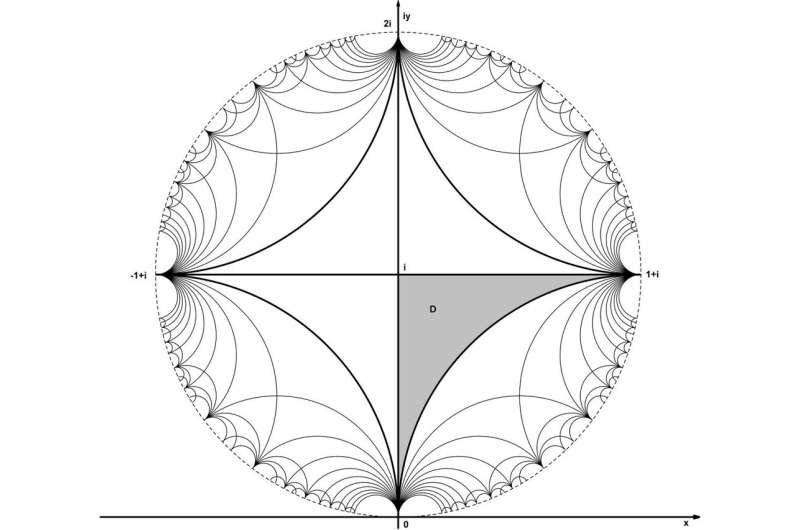
    The research also explores tessellations in hyperbolic geometries, where traditional Euclidean rules no longer apply. In this curved mathematical space, used in theoretical physics and models of spacetime, the team works with Schweikart triangles, named after the 19th-century scholar Ferdinand Kurt Schweikart.

    These unique triangles, defined by one right angle and two zero angles, can be reflected infinitely within a circular disk to produce intricate hyperbolic tessellations. The patterns are mesmerizing, resembling stained-glass windows or fractal spirals—but they also have analytical value.

    In 2024, Begehr demonstrated this principle’s power by constructing a harmonic Green function for a Schweikart triangle in hyperbolic space, published in Complex Variables and Elliptic Equations. His findings revealed that even in the warped realms of hyperbolic geometry, mathematical beauty maintains its precision and purpose.

    Where Art, Mathematics, and Technology Intersect

    What makes this work so compelling is its reach beyond pure mathematics. The parqueting-reflection principle offers inspiration for architecture, design, and computer graphics, where symmetry and form play key roles. As co-author Dajiang Wang notes:

    “We hope our results resonate not only in pure mathematics and physics, but also inspire ideas in fields like architecture and digital visualization.”

    By merging analytical formulas with geometric creativity, this research bridges two worlds often seen as opposites: mathematics as logic and art as expression. In truth, the two share the same heartbeat—pattern, proportion, and precision.

    Mathematics as a Visual Science

    This study reminds us that mathematics is more than abstraction; it’s a visual science. Its symbols are not just tools for calculation, but expressions of symmetry, motion, and infinite beauty. With modern computational graphics, these visual insights can now be rendered with stunning clarity—transforming equations into art and geometry into algorithms.

    At DatalytIQs Academy, such discoveries exemplify our philosophy: that learning mathematics is not only about solving problems but about seeing the patterns that structure reality itself.

    Citation & Acknowledgments

    Source Article:
    Freie Universität Berlin (2025). “When mathematics meets aesthetics: Tessellations as a precise tool for solving complex problems.”
    Published on Phys.org, written by Krystal Kasal.
    Edited by: Lisa Lock
    Reviewed by: Robert Egan
    Original Study: Heinrich Begehr & Dajiang Wang, “Beauty in/of Mathematics: Tessellations and Their Formulas,” Applicable Analysis (DOI: 10.1080/00036811.2025.2510472).

    Author: Collins Odhiambo — DatalytIQs Academy Mathematics & Innovation Blog
    Category: Mathematical Physics & Geometry

  • Astronomers Discover the Most ‘Pristine’ Star in the Known Universe

    Astronomers Discover the Most ‘Pristine’ Star in the Known Universe

    In a stunning breakthrough for astrophysics, astronomers have identified what may be the most pristine star ever observed — a rare cosmic relic that offers a direct glimpse into the universe’s earliest moments after the Big Bang.

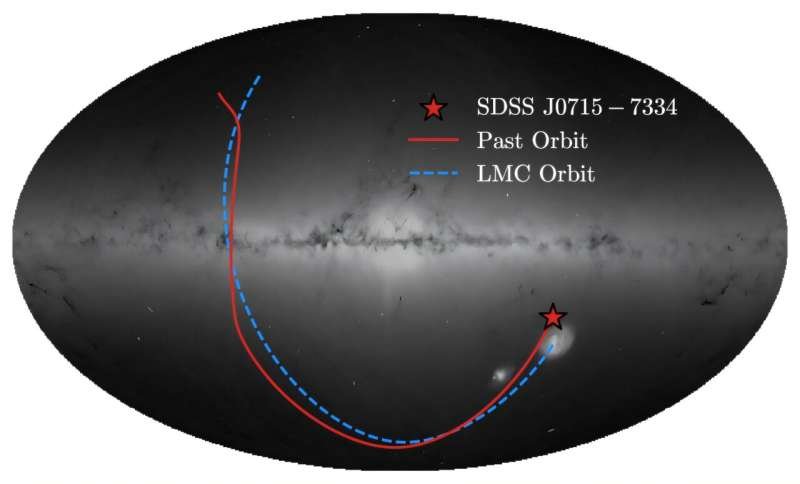
    The discovery, led by Dr. Alexander Ji and his team at the University of Chicago, focuses on a red giant known as SDSS J0715−7334. This ancient star, found in the outskirts of the Milky Way, is believed to have formed from nearly untouched cosmic material — hydrogen, helium, and just trace amounts of lithium — before heavier elements ever dominated the universe.

    A Window into the First Generation of Stars

    To understand why this discovery is so significant, it helps to recall how stars evolve. The first stars, often called Population III stars, were born from the primordial gases that filled the universe soon after the Big Bang. Inside their blazing cores, these stars fused lighter elements into heavier ones — a process known as stellar nucleosynthesis. When they exploded as supernovae, they scattered these newly forged elements, seeding future generations of stars with heavier materials like iron, carbon, and oxygen.

    Over cosmic time, this process enriched the interstellar medium, meaning every new generation of stars contained more heavy elements — what astronomers refer to as higher metallicity. But SDSS J0715−7334 stands out because it seems to have escaped this enrichment.

    The Most Metal-Poor Star Ever Found

    The research team’s spectroscopic analysis revealed that SDSS J0715−7334’s total metallicity — symbolized as Z — is less than 7.8 × 10⁻⁷, making it the most metal-poor star known. For comparison, the previous record-holder, J1029+1729, had a metallicity of about 1.4 × 10⁻⁶, while another famous low-iron star, SMSS J0313−6708, still contained over ten times more heavy elements than this newly discovered relic.

    What’s even more astonishing is that SDSS J0715−7334 also shows extremely low carbon content. This combination of low iron and low carbon makes it a truly exceptional find, potentially marking it as a direct descendant of a single massive Population III supernova — likely one from a star around 30 times the mass of our Sun.

    A Journey from the Large Magellanic Cloud

    Using Gaia spacecraft data and advanced orbital modeling, the team traced SDSS J0715−7334’s movement and found that it most likely originated in the Large Magellanic Cloud (LMC) — a small satellite galaxy orbiting the Milky Way. At some point in its long journey, gravitational interactions appear to have pulled it into our galaxy’s outer halo.

    This finding adds an intriguing twist to the story: not only is this the most pristine star known, but it may have migrated across galaxies, carrying with it an untouched record of early cosmic chemistry.

    Cooling the Early Universe: Dust, Not Metals

    Another remarkable insight from this discovery involves how such ancient stars formed in the first place. Normally, gas clouds cool and condense more efficiently when heavy elements are present because they help radiate away energy. Yet SDSS J0715−7334 exists below the “fine structure cooling threshold” — a critical point where traditional cooling via heavy elements becomes impossible.

    This means that dust particles may have played a key role instead, enabling early gas clouds to lose heat and collapse into stars even in environments nearly devoid of metals. This supports the idea that “dust cooling” was crucial for the formation of low-metallicity stars in the early universe — and that similar processes might occur in other galaxies beyond the Milky Way.

    A Living Fossil from the Dawn of Time

    SDSS J0715−7334 is more than just a star — it’s a cosmic time capsule. Its composition preserves evidence of how the very first stars lived, died, and gave birth to the complex, element-rich universe we inhabit today. Each observation of such pristine stars brings us closer to understanding the conditions that shaped the first galaxies, first elements, and ultimately, the origin of life itself.

    As Dr. Ji’s team notes, “J0715−7334 is an especially clean probe of Population III, as its distant halo orbit completely precludes significant surface contamination from the interstellar medium.” In other words, it is as close as astronomers have ever come to studying pure, unpolluted starlight from the dawn of creation.

    Citation & Acknowledgments

    Source Article:
    Kasal, K. (2025). “Astronomers discover the most ‘pristine’ star in the known universe.” Phys.org.
    Edited by Gaby Clark, reviewed by Robert Egan.
    Research by Alexander Ji et al., University of Chicago.
    Data: Gaia Mission, arXiv Preprint Server (2025).


    Author: Collins Odhiambo – DatalytIQs Academy Science & Space Blog
    Category: Astronomy & Cosmology

  • Hubble Went Supernova Hunting — and Found Something Unexpected

    Hubble Went Supernova Hunting — and Found Something Unexpected

    By DatalytIQs Academy

    Based on reporting by Jamie Carter, originally published on Live Science (Sept. 29, 2025). Image credit: ESA/Hubble & NASA, A. Filippenko; Acknowledgment: M. H. Özsaraç.

    Introduction

    At DatalytIQs Academy, we love when data and discovery intertwine to tell stories written in starlight. The Hubble Space Telescope’s newest image of the barred spiral galaxy NGC 6000 is a vivid example of that cosmic storytelling — a portrait of stellar life cycles, captured through color, with an unexpected visitor streaking across the scene.

    The Target: Galaxy NGC 6000

    Located about 102 million light-years away in the constellation Scorpius, NGC 6000 is a barred spiral galaxy — a structure defined by bright central stars and extended spiral arms.
    Hubble’s new observation bathes the galaxy in golden yellows at its core and shimmering blues on its edges. But these colors are not just beautiful; they reveal the ages and temperatures of the galaxy’s stars.

    • 🌕 Yellow Core: Home to old, cooler, and smaller stars that have burned steadily for billions of years.

    • 🔵 Blue Arms: Populated by young, hot, massive stars — cosmic newborns blazing briefly but brightly.

    Color, in this context, becomes a spectral language, where each hue encodes information about stellar evolution.

    The Mission: Supernova Hunting

    Hubble’s gaze at NGC 6000 wasn’t simply for aesthetics. Astronomers were on a supernova search, targeting faint remnants from two known stellar explosions — SN 2007ch and SN 2010as.
    Supernovas like these mark the violent deaths of massive stars, scattering heavy elements essential for planet formation and life itself.

    To detect them, Hubble used red and blue filters, layering multiple long exposures that highlight temperature contrasts and structural detail. But as often happens in science, something unexpected appeared.

    The Surprise Guest: A Passing Asteroid

    In the corner of Hubble’s deep-space frame, astronomers noticed four faint, broken streaks of red and blue light — not from stars, but from a wandering asteroid crossing the telescope’s view.
    Each “broken” segment corresponds to a separate exposure taken through different color filters, producing the dual-toned path of motion across the sky.

    This serendipitous sight reminds us that even when Hubble looks deep into the universe, our own solar system occasionally drifts into the picture — a small cosmic coincidence that connects near and far.

    The Power of Color in Space Science

    Color filters are not mere artistic tools — they are data instruments.
    By capturing separate wavelengths and comparing intensity across spectra, astronomers can:

    • Classify stars by temperature and age.

    • Identify chemical compositions within nebulae or galaxies.

    • Track stellar evolution, from hot blue main-sequence stars to cool red giants.

    In this way, color imaging transforms astrophotography into a quantitative science — turning pixels into physics.

    Where to Find NGC 6000

    Though NGC 6000 lies within the Scorpius constellation, it sits south of the celestial equator, making it more visible from the Southern Hemisphere.
    Amateur astronomers under dark skies with telescopes 10 inches or larger can glimpse its faint spiral glow — a modest reward for patient observers.

    Credits & Acknowledgment

    • Original article: Jamie Carter, Live Science, Sept 29, 2025.

    • Image credit: ESA/Hubble & NASA, A. Filippenko; Acknowledgment: M. H. Özsaraç.

    • Educational adaptation & commentary: DatalytIQs Academy — empowering learners to see the universe through the lens of data, science, and discovery.

  • The James Webb Telescope Proves Einstein Right — Eight Times Over

    The James Webb Telescope Proves Einstein Right — Eight Times Over

    By DatalytIQs Academy

    Based on reporting by Jamie Carter, originally published on Live Science (Oct. 5, 2025). Image credit: ESA/Webb, NASA & CSA, G. Gozaliasl, A. Koekemoer, M. Franco.

    Introduction

    At DatalytIQs Academy, we celebrate the union of data, discovery, and imagination — and few scientific achievements embody that spirit better than the James Webb Space Telescope (JWST).
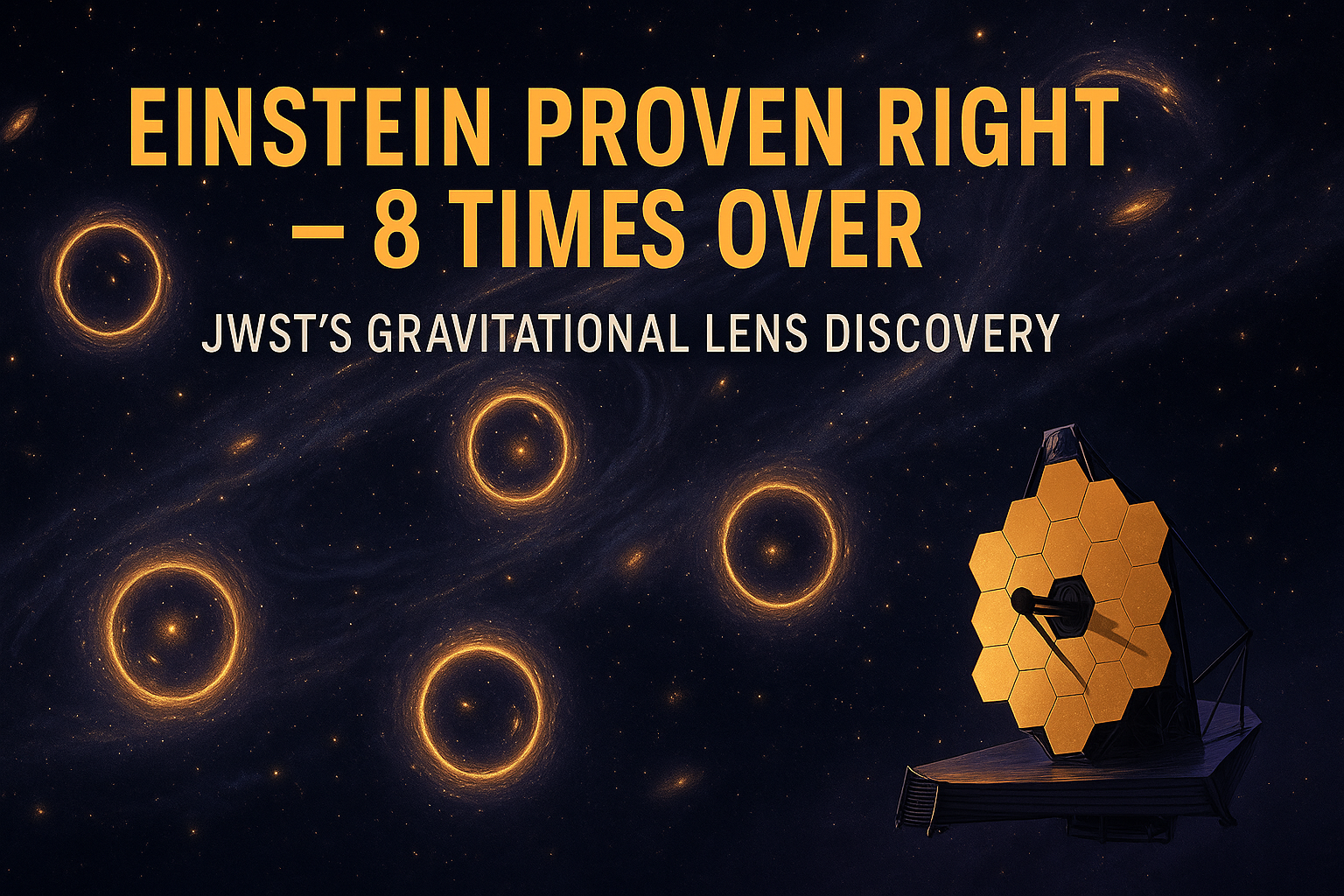
    In its latest triumph, JWST has captured eight dazzling examples of Einstein rings, visually confirming the century-old predictions of Albert Einstein’s general theory of relativity.

    What Exactly Are Einstein Rings?

    Think of space as an elastic fabric. When a massive object — such as a galaxy — rests on that fabric, it curves space around it. Light from a more distant galaxy passing through this warped region bends along curved paths, sometimes forming a perfect ring of light known as an Einstein ring.

    This striking optical illusion is no trick of the camera — it’s a natural result of gravitational lensing, a phenomenon Einstein mathematically predicted in 1915. These rings are the cosmos’ own magnifying glasses, allowing us to see galaxies so remote they would otherwise remain invisible.

    JWST’s Proof of Einstein’s Prediction

    The COSMOS-Web project, one of JWST’s largest observing programs, spent 255 hours scanning over 42,000 galaxies, identifying more than 400 gravitational lenses.
    Eight of them stand out as textbook demonstrations of Einstein’s equations, each forming a near-perfect ring or arc of light.

    One breathtaking image, COSJ100024+015334, reveals a galaxy seen as it existed just one billion years after the Big Bang — when the universe was in its infancy. It’s a direct window into cosmic history, magnified through the curvature of space itself.

    Why Gravitational Lensing Matters

    Einstein’s theory doesn’t just describe beauty — it drives modern astrophysics.
    Gravitational lensing helps astronomers:

    • 🔍 Magnify distant galaxies to study the universe’s earliest structures.

    • 💫 Map dark matter, the invisible mass that bends light but emits none.

    • 🧭 Measure galactic mass and understand cosmic evolution across billions of years.

    Each Einstein ring is both a scientific instrument and a cosmic artwork, demonstrating that the universe adheres to the elegant geometry of relativity.

    Beyond Hubble: JWST’s Infrared Vision

    While the Hubble Space Telescope first hinted at these effects, JWST’s infrared sensitivity pierces cosmic dust and distance to uncover details Hubble could never resolve.
    This leap in clarity allows scientists to see the reddened, dust-obscured galaxies that populate the deep universe — and to test Einstein’s theory under conditions never before observed.

    COSMOS-Web Project at a Glance

    Parameter Detail
    Observing time 255 hours
    Galaxies surveyed 42,000 +
    Einstein rings found 400 + candidates
    Perfect rings showcased 8 spectacular examples

    The Legacy of Einstein’s Curved Universe

    “Space tells matter how to move; matter tells space how to curve.” — Albert Einstein

    Each of JWST’s eight Einstein rings is a glowing testament to that principle — proof that Einstein’s century-old mathematics still describes the living architecture of our universe.

    At DatalytIQs Academy, we view these discoveries as more than distant wonders; they are lessons in data, geometry, and observation — the very foundations of analytical thinking we teach every day.

    Credits & Acknowledgment

    • Primary source: Jamie Carter, Live Science, Oct 5, 2025.

    • Image credits: ESA/Webb, NASA & CSA, G. Gozaliasl, A. Koekemoer, M. Franco.

    • Educational commentary and adaptation: DatalytIQs Academy — advancing knowledge in Mathematics, Economics, and Science through data and discovery.

  • Young Sunlike Star Reveals Rapid Two-Year Magnetic Cycle

    Young Sunlike Star Reveals Rapid Two-Year Magnetic Cycle

    By Janine Fohlmeister, Leibniz Institute for Astrophysics Potsdam (AIP)
    Edited by Sadie Harley • Reviewed by Robert Egan
    Educational commentary by DatalytIQs Academy


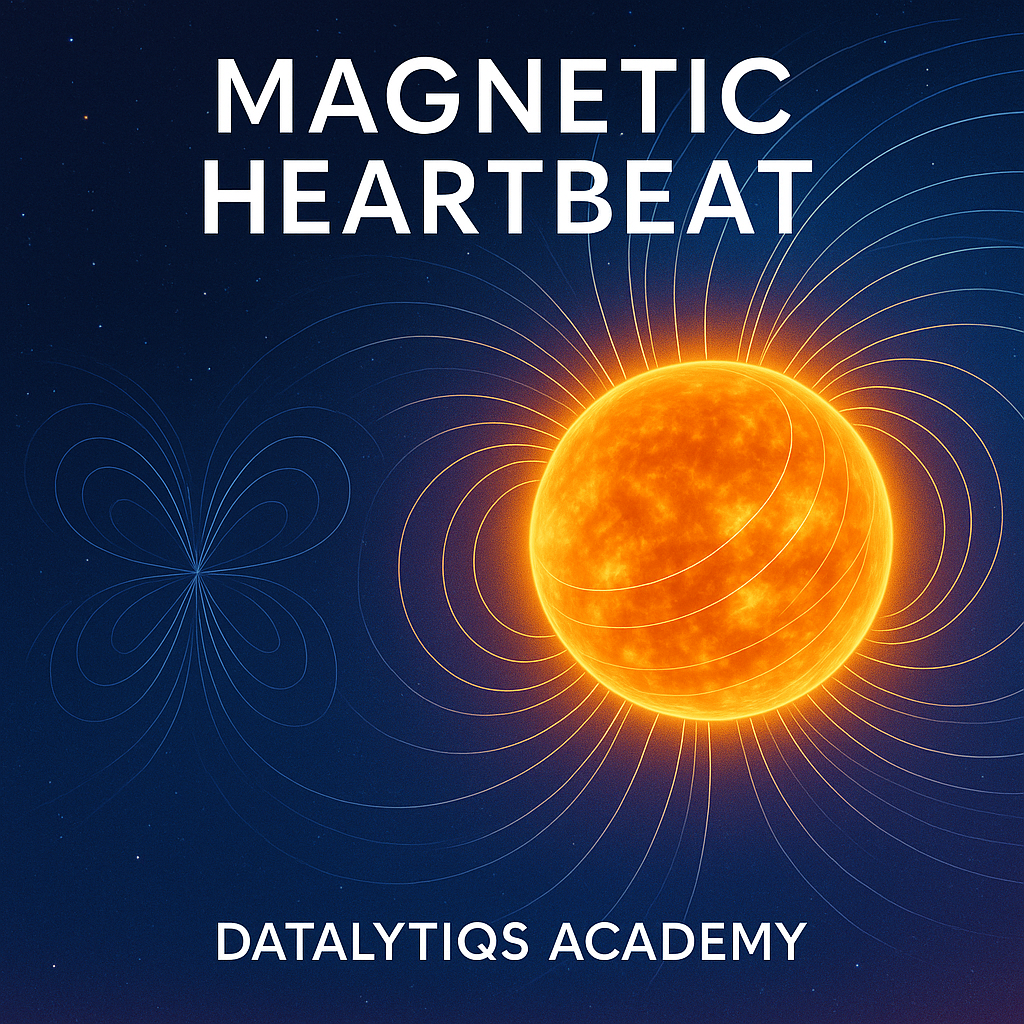
    A Star’s Magnetic Heartbeat

    Astronomers at the Leibniz Institute for Astrophysics Potsdam (AIP) have observed a star astonishingly similar to our Sun—but much younger and more energetic—completing a full magnetic cycle in just two years.

    The star, known as Iota Horologii (ι Hor), lies 56 light-years away in the southern constellation Horologium, the “pendulum clock.” At 600 million years old, it offers a vivid glimpse into the early magnetic life of stars like our Sun.

    This discovery is part of AIP’s “Far Beyond the Sun” campaign and is published as “Far Beyond the Sun III: The Magnetic Cycle of ι Horologii” on the arXiv preprint server.

    Mapping a Magnetic Dynamo

    Using the HARPS polarimeter on the 3.6-meter telescope at La Silla Observatory in Chile, researchers collected nearly 200 nights of spectropolarimetric observations across six observing seasons.

    By applying Zeeman Doppler Imaging (ZDI), they reconstructed 18 magnetic field maps spanning roughly 140 full rotations of the star. These maps charted the emergence, disappearance, and reversal of magnetic regions — a dynamic portrait of the stellar dynamo at work.

    The team discovered that ι Hor’s magnetic poles flip every 773 days, completing a full 22-year solar equivalent in just two years — a breathtakingly rapid rhythm compared to our Sun’s slow magnetic heartbeat.

    Magnetic Butterfly Diagrams Beyond the Sun

    For the first time, scientists have created “magnetic butterfly diagrams” for a star other than our own.

    On the Sun, these diagrams track sunspot migration from mid-latitudes toward the equator as magnetic polarity reverses.
    For ι Hor, the team averaged magnetic field strengths by latitude, revealing that:

    • Poleward flows of the radial field reached speeds of 15–78 m/s,

    • Equatorward drifts of the toroidal field moved at 9–19 m/s
      Both are significantly faster than on the Sun.

    These measurements mark the first-ever detection of meridional (poleward) and equatorward flows on any star besides our own.

    Why This Matters

    According to Dr. Julian Alvarado Gómez, lead investigator at AIP:

    “These results offer a critical benchmark for understanding magnetic dynamos — the engines that drive stellar and solar activity.”

    By comparing ι Hor’s rapid cycle and intense activity to the Sun’s slower 22-year cycle, scientists can infer how rotation rate and stellar age shape the evolution of magnetic fields.

    Magnetic activity also dictates the intensity of stellar winds, flares, and high-energy radiation — factors that determine planetary habitability. Since ι Hor hosts at least one known exoplanet, its magnetic behavior provides clues about how young sunlike stars influence their planetary environments.

    DatalytIQs Academy Perspective: Stellar Dynamos and Data Modeling

    At DatalytIQs Academy, this discovery serves as a rich teaching case for students in Stellar Physics, Space Data Analytics, and Exoplanetary Environments.

    Learners explore:

    • Magnetohydrodynamic (MHD) modeling of stellar interiors,

    • Spectropolarimetric data processing for detecting magnetic fields,

    • Comparative analyses between solar and stellar cycles, and

    • Statistical modeling of activity patterns using time-series data.

    This case also reinforces the interdisciplinary nature of modern astronomy — where data science, physics, and machine learning converge to reveal the unseen engines powering the stars.

    In Summary

    Iota Horologii’s rapid magnetic cycle is more than a stellar curiosity — it’s a window into our Sun’s past and a key to understanding the magnetic lives of stars across the galaxy.

    From solar flares to stellar dynamos, the pulse of the cosmos beats faster than we once imagined — and DatalytIQs Academy is here to decode every rhythm.

  • Cornell Study Warns: Delaying Emissions Cuts Could Lock in Rapid Sea-Level Rise

    Cornell Study Warns: Delaying Emissions Cuts Could Lock in Rapid Sea-Level Rise

    Cornell Study Warns: Delaying Emissions Cuts Could Lock in Rapid Sea-Level Rise

    By Caitlin Hayes, Cornell University
    Edited by Gaby Clark • Reviewed by Robert Egan
    Educational commentary by DatalytIQs Academy

    Timing Is Everything in the Fight Against Sea-Level Rise

    A new study from Cornell University, published in Nature Climate Change (Oct. 10, 2025), reveals that when the world reduces emissions may be even more important than how fast those reductions occur.

    According to the research, delaying action by just a decade could push Earth past critical tipping points, triggering irreversible melting of ice sheets and accelerated sea-level rise through the year 2200.

    “Around 2065, emissions become the dominant factor,” says Dr. Vivek Srikrishnan, lead author and assistant professor of biological and environmental engineering at Cornell. “The mitigation we do today will start to materially impact the range of sea-level rise outcomes by then.”

    The Model Behind the Warning

    Srikrishnan and his team—including first author Chloe Darnell (M.S. ’23)—developed a sophisticated model that integrates emissions scenarios, ocean heat uptake, and ice-sheet dynamics.

    Their simulations show that:

    • A delay in emissions cuts until 2050 results in a >50% chance of exceeding a 0.4 m rise by 2200,

    • Sea levels could exceed 0.5 m depending on how the oceans absorb heat,

    • Such increases would multiply global flood risks by up to 10× at most tidal gauges, and 100× at over half of them.

    Even a modest sea-level rise could dramatically reshape coastal infrastructure, ecosystems, and economic stability.

    Antarctica and Greenland: The Uncertain Giants

    The study highlights that Antarctic Ice Sheet dynamics account for most 21st-century uncertainty in projections.
    However, Greenland’s ice could play a far greater role in the 22nd century, especially under prolonged warming.

    These two ice masses, combined with complex ocean feedbacks, define the nonlinear nature of future sea-level change — where small shifts in temperature or emissions can trigger large, abrupt consequences.

    No Time for “Silver Bullets”

    Srikrishnan warns that waiting for perfect solutions is risky:

    “It’s not worth waiting for a silver bullet. The faster we reduce emissions, the better—but any reduction helps.”

    The research reinforces that emissions peaking before 2050 gives humanity its best chance to avoid irreversible thresholds and preserve flexibility in adaptation planning.

    A New Tool for Climate Risk Assessment

    Beyond projections, the team’s approach provides a framework for policymakers. By linking policy-driven emission pathways to probabilistic climate outcomes, the model helps identify “signposts” — observable early indicators of impending instability.

    This kind of forward-looking analysis allows governments, cities, and industries to allocate resources proactively, instead of reacting to disasters after they occur.

    DatalytIQs Academy Perspective: Climate Analytics for Decision-Making

    At DatalytIQs Academy, we see this research as a benchmark in climate risk modeling and sustainability policy analysis.
    It embodies the principles we teach across our programs in:

    • Climate Data Science – simulating emission trajectories and sea-level models using Python and R,

    • Environmental Economics – quantifying adaptation costs and policy trade-offs,

    • Geospatial Analytics – mapping vulnerable coastlines and urban flood risks.

    Learners engage with real climate datasets to analyze uncertainty, model tipping points, and design adaptive policy frameworks—equipping them to translate research like Cornell’s into actionable insights for communities and governments.

    In Summary

    “Trying to refine our understanding of uncertainties—and recognizing what we can observe as early warning signs—is key,” says Srikrishnan.

    The message is clear: cut emissions now, not later. The coming decades will decide whether our coastlines slowly adapt or rapidly retreat.
    At DatalytIQs Academy, we stand committed to turning this data into knowledge, strategy, and impact—training the minds who will manage the planet’s most critical transition.

  • Colossal ‘Hole’ in the Sun Could Spark Dazzling Auroras This Weekend

    Colossal ‘Hole’ in the Sun Could Spark Dazzling Auroras This Weekend

    Colossal ‘Hole’ in the Sun Could Spark Dazzling Auroras This Weekend

    By Daisy Dobrijevic • Published by Space.com
    Educational commentary by DatalytIQs Academy

    A Weekend of Cosmic Light Shows

    Skywatchers may be in for a treat this weekend as a colossal coronal hole—a vast, magnetically open region on the Sun’s surface—faces Earth once again, unleashing high-speed solar wind that could trigger geomagnetic storms and brilliant auroras under clear, dark skies.

    According to NOAA’s Space Weather Prediction Center and the U.K. Met Office, the solar wind stream is expected to reach Earth between Saturday night and Sunday (Oct. 11–12). The strongest activity is forecast between 5 a.m. and 5 p.m. EDT (0900–1700 GMT) on Oct. 12, with a predicted G1 (minor) geomagnetic storm.

    If the forecast holds, auroras may stretch as far south as northern Michigan and Maine—and possibly farther due to a seasonal “boost” following the autumn equinox.

    What Are Coronal Holes?

    Coronal holes are regions where the Sun’s magnetic field lines open into space, allowing charged particles to escape more freely. These streams of solar wind race outward at over 500 km/s, eventually striking Earth’s magnetosphere.

    When these particles funnel toward the poles and collide with oxygen and nitrogen atoms in our upper atmosphere, they emit photons of light—painting the night sky with ribbons of green, pink, and violet known as the aurora borealis (northern lights) and aurora australis (southern lights).

    A Familiar Feature Returns

    This isn’t a new event—it’s the same coronal hole that first appeared last month, previously shaped like a butterfly or bird. Because the Sun rotates roughly every 27 days, these holes can reappear periodically, continuing to influence Earth’s space weather for months.

    Each rotation offers a new opportunity for observation and measurement—important for understanding the Sun’s 11-year solar cycle and its effects on satellites, communication systems, and power grids.

    Why the Equinox Matters

    Around the equinoxes, Earth’s tilt aligns so that the solar wind couples more effectively with Earth’s magnetic field—a phenomenon known as the Russell–McPherron effect.
    This alignment makes even modest solar winds more likely to trigger auroras, giving photographers and researchers a seasonal advantage.

    NOAA’s forecasted Kp index of 5 confirms the possibility of visible auroras far beyond polar latitudes. (The Kp index runs from 0 – 9; the higher the number, the greater the geomagnetic activity.)

    DatalytIQs Academy Perspective: Learning from Space Weather

    At DatalytIQs Academy, we view solar events like this as powerful teaching moments that connect astronomy, physics, and data analytics.
    Learners in our Space Weather Analytics and Solar Physics modules explore:

    • Modeling geomagnetic storms using real-time NOAA datasets.

    • Visualizing Kp and solar wind data with Python and Power BI.

    • Understanding how Earth’s magnetosphere deflects and channels solar particles.

    • Predicting auroral activity through statistical and machine-learning models.

    Our goal is to help students interpret space-weather data not just as numbers, but as the dynamic heartbeat of our Sun-Earth system.

    In Summary

    As the Sun’s magnetic fields open wide, Earth’s skies may glow once more — a vivid reminder that space weather is both a spectacle and a science.

    From solar holes to auroral lights, every flare and filament tells a story — one that DatalytIQs Academy helps decode, data point by data point.