The Diurnal Meteorological Cycle: Understanding Daily Rhythms of Temperature, Humidity, and Wind Speed
By Collins Odhiambo | DatalytIQs Academy
1. Introduction: A Day in the Life of the Atmosphere
Every 24 hours, the atmosphere performs a silent symphony.
As the sun rises and sets, temperature, humidity, and wind speed rise and fall in a rhythmic cycle — shaping weather, comfort, and even air quality.
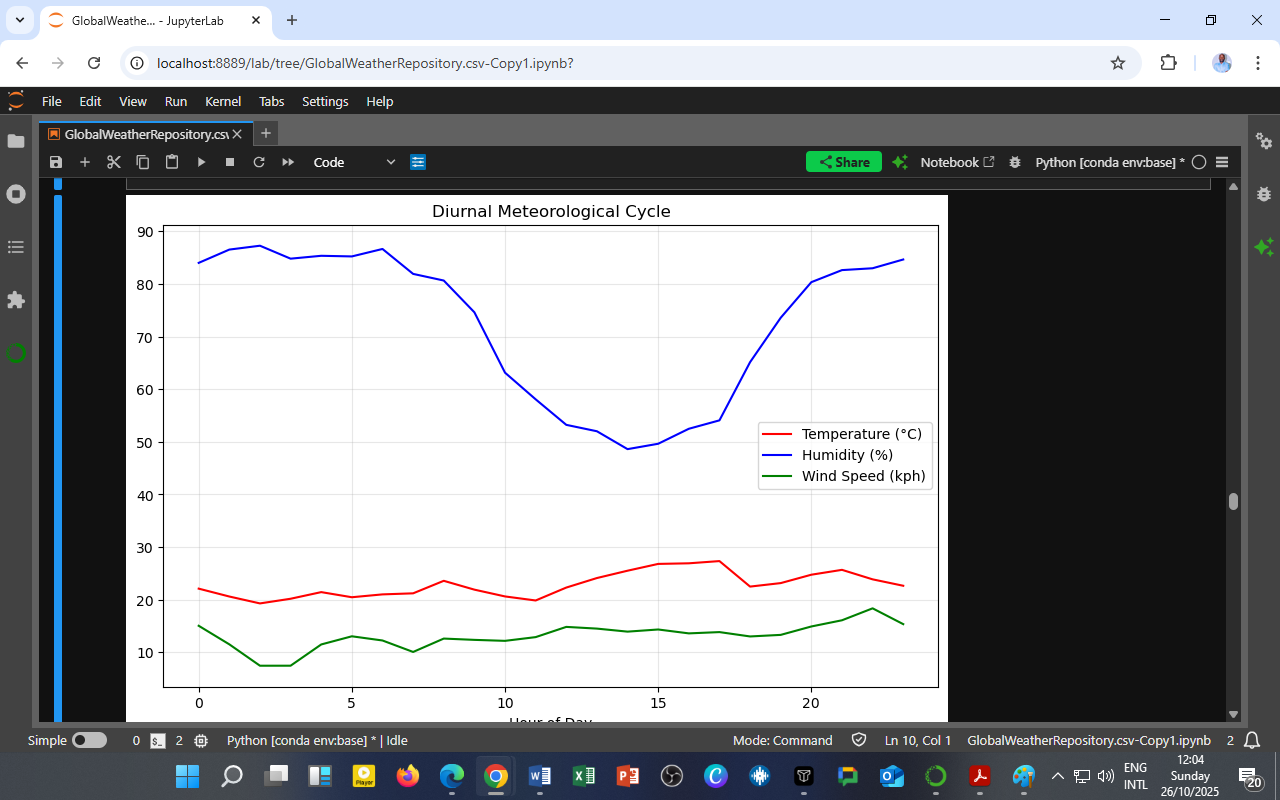
This post visualizes the diurnal meteorological cycle, using real environmental data processed in Python (JupyterLab).
📊 Chart: Diurnal Meteorological Cycle
🟥 Temperature (°C) — red line
🟦 Humidity (%) — blue line
🟩 Wind Speed (kph) — green line

2. Temperature: The Solar Pulse of the Day
Morning (0–6 hours)
-
Cooler temperatures dominate the early hours before sunrise.
-
Limited solar radiation results in radiative cooling of the surface.
Midday (10–16 hours)
-
Temperature rises gradually, reaching its peak in the afternoon, around 14:00–16:00.
-
This corresponds to the maximum solar intensity and minimum relative humidity.
Evening (18–23 hours)
-
As the sun sets, the surface cools, and temperature decreases again — completing the daily loop.
The diurnal temperature pattern follows the balance between incoming solar radiation and outgoing longwave radiation, influencing all other meteorological variables.
3. Humidity: The Inverse Mirror of Temperature
High at Night, Low by Day
-
Humidity is highest during the night and early morning (00:00–06:00) — reaching up to 85–90%.
-
As the temperature rises through the morning, humidity drops sharply, hitting its lowest point around noon.
-
In the evening, as the air cools, moisture condenses, and humidity rises again.
Explanation:
Humidity is inversely related to temperature because warm air holds more water vapor, but relative humidity measures how saturated the air is.
When the air warms, its capacity increases faster than the moisture input, reducing relative humidity.
4. Wind Speed: The Daytime Mixer
Pattern Overview
-
Wind speeds are lowest at night (below 10 kph) when surface air layers are stable and calm.
-
After sunrise, as the surface warms, convection strengthens, mixing the air and increasing wind speeds (10–15 kph) by mid-afternoon.
-
In the evening, cooling stabilizes the atmosphere again, and winds weaken.
Wind speed follows thermal convection cycles — higher turbulence during the day, lower at night.
These variations control pollutant dispersion, heat distribution, and evaporation rates.
5. Atmospheric Interactions: The Diurnal Triangle
| Variable | Morning | Midday | Evening | Key Relationship |
|---|---|---|---|---|
| 🌡️ Temperature | Rising | Peak | Falling | Drives humidity and wind changes |
| 💧 Humidity | High | Low | Rising | Inversely tied to temperature |
| 🌬️ Wind Speed | Calm | Moderate | Calm | Controlled by thermal mixing |
The triangle of temperature, humidity, and wind defines the daily stability or instability of the atmosphere.
This determines how heat, moisture, and pollutants are distributed near the surface — vital for both weather forecasting and air-quality management.
6. Implications for Environment and Policy
1. Air Quality Forecasting
-
Morning calm and high humidity can trap pollutants near the ground (e.g., PM₂.₅, NO₂).
-
Afternoon wind and heat disperse them — hence, daily exposure risk varies by hour.
2. Urban Planning and Cooling Design
-
Knowledge of peak heat hours supports better building ventilation, shade design, and green infrastructure planning.
3. Renewable Energy and Efficiency
-
Wind and solar energy output depend on these daily cycles.
-
Predicting diurnal variations helps in energy scheduling and grid optimization.
4. Public Health and Comfort
-
High daytime temperatures with low humidity increase heat stress.
-
Nighttime humidity affects sleep quality and respiratory conditions.
7. Educational Takeaway for DatalytIQs Learners
This diurnal cycle graph provides a perfect case study in meteorology and environmental analytics, showing:
-
How solar radiation drives atmospheric processes,
-
Why meteorological data visualization matters, and
-
How Python-based analytics can reveal insights hidden in raw datasets.
Through consistent data practice, learners can analyze similar cycles to explore:
-
Pollution dispersion,
-
Microclimate variations, and
-
Renewable energy optimization.
8. Conclusion: The Breath of a Day
The diurnal meteorological cycle is nature’s 24-hour heartbeat.
Each sunrise ignites a chain reaction — warming air, drying moisture, and stirring wind.
By understanding these daily rhythms, we gain the power to predict, plan, and protect our environment more intelligently.
Author
Written by Collins Odhiambo
Educator & Data Analyst
DatalytIQs Academy – Where Data Meets Discovery.
Data: Global Weather Repository.




You must be logged in to post a comment.