By DatalytIQs Academy
Based on reporting by Jamie Carter, originally published on Live Science (Oct. 5, 2025). Image credit: ESA/Webb, NASA & CSA, G. Gozaliasl, A. Koekemoer, M. Franco.
Introduction
At DatalytIQs Academy, we celebrate the union of data, discovery, and imagination — and few scientific achievements embody that spirit better than the James Webb Space Telescope (JWST).
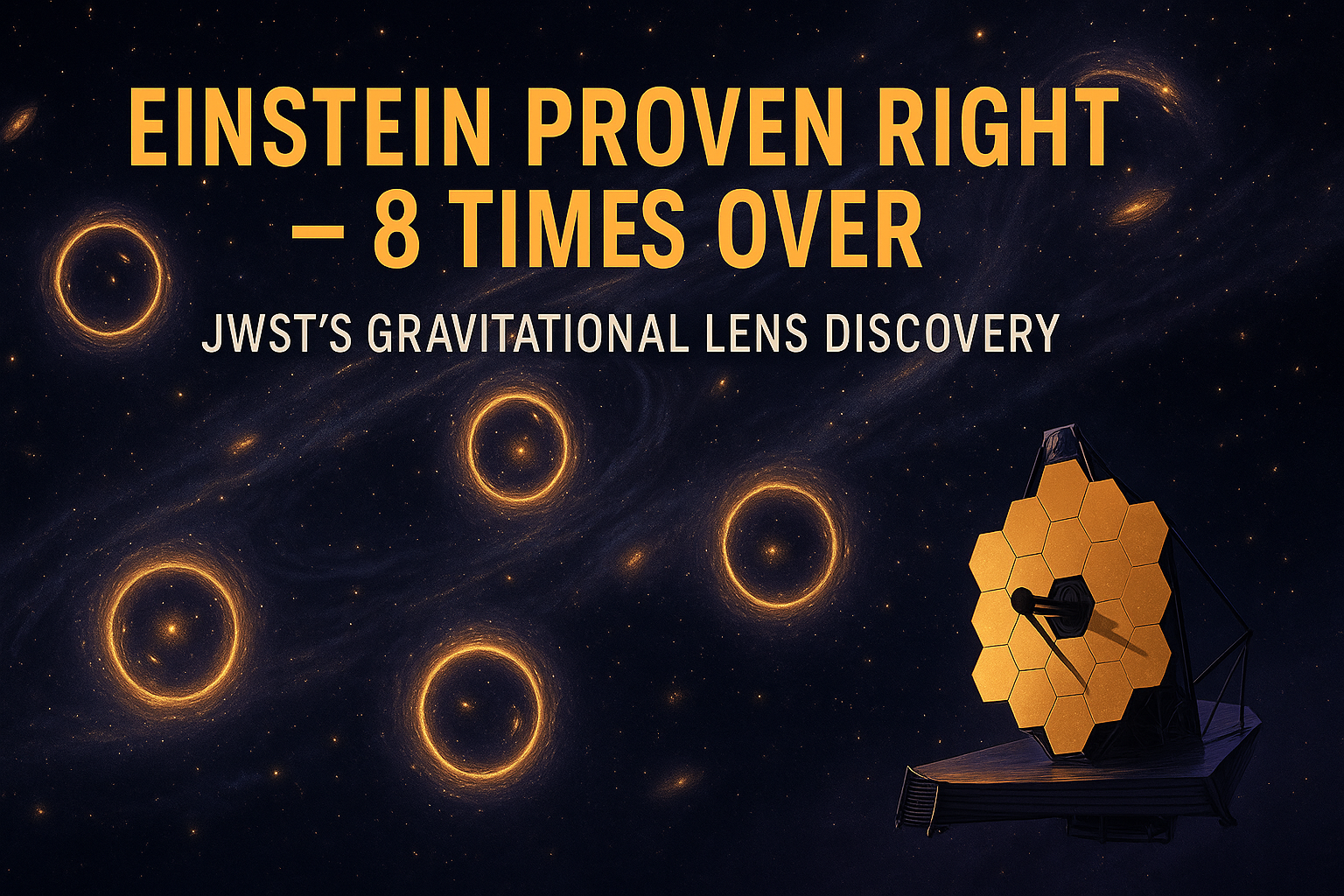
In its latest triumph, JWST has captured eight dazzling examples of Einstein rings, visually confirming the century-old predictions of Albert Einstein’s general theory of relativity.
What Exactly Are Einstein Rings?
Think of space as an elastic fabric. When a massive object — such as a galaxy — rests on that fabric, it curves space around it. Light from a more distant galaxy passing through this warped region bends along curved paths, sometimes forming a perfect ring of light known as an Einstein ring.
This striking optical illusion is no trick of the camera — it’s a natural result of gravitational lensing, a phenomenon Einstein mathematically predicted in 1915. These rings are the cosmos’ own magnifying glasses, allowing us to see galaxies so remote they would otherwise remain invisible.

JWST’s Proof of Einstein’s Prediction
The COSMOS-Web project, one of JWST’s largest observing programs, spent 255 hours scanning over 42,000 galaxies, identifying more than 400 gravitational lenses.
Eight of them stand out as textbook demonstrations of Einstein’s equations, each forming a near-perfect ring or arc of light.
One breathtaking image, COSJ100024+015334, reveals a galaxy seen as it existed just one billion years after the Big Bang — when the universe was in its infancy. It’s a direct window into cosmic history, magnified through the curvature of space itself.
Why Gravitational Lensing Matters
Einstein’s theory doesn’t just describe beauty — it drives modern astrophysics.
Gravitational lensing helps astronomers:
-
🔍 Magnify distant galaxies to study the universe’s earliest structures.
-
💫 Map dark matter, the invisible mass that bends light but emits none.
-
🧭 Measure galactic mass and understand cosmic evolution across billions of years.
Each Einstein ring is both a scientific instrument and a cosmic artwork, demonstrating that the universe adheres to the elegant geometry of relativity.
Beyond Hubble: JWST’s Infrared Vision
While the Hubble Space Telescope first hinted at these effects, JWST’s infrared sensitivity pierces cosmic dust and distance to uncover details Hubble could never resolve.
This leap in clarity allows scientists to see the reddened, dust-obscured galaxies that populate the deep universe — and to test Einstein’s theory under conditions never before observed.
COSMOS-Web Project at a Glance
| Parameter | Detail |
|---|---|
| Observing time | 255 hours |
| Galaxies surveyed | 42,000 + |
| Einstein rings found | 400 + candidates |
| Perfect rings showcased | 8 spectacular examples |
The Legacy of Einstein’s Curved Universe
“Space tells matter how to move; matter tells space how to curve.” — Albert Einstein
Each of JWST’s eight Einstein rings is a glowing testament to that principle — proof that Einstein’s century-old mathematics still describes the living architecture of our universe.
At DatalytIQs Academy, we view these discoveries as more than distant wonders; they are lessons in data, geometry, and observation — the very foundations of analytical thinking we teach every day.
Credits & Acknowledgment
-
Primary source: Jamie Carter, Live Science, Oct 5, 2025.
-
Image credits: ESA/Webb, NASA & CSA, G. Gozaliasl, A. Koekemoer, M. Franco.
-
Educational commentary and adaptation: DatalytIQs Academy — advancing knowledge in Mathematics, Economics, and Science through data and discovery.
Leave a Reply
You must be logged in to post a comment.