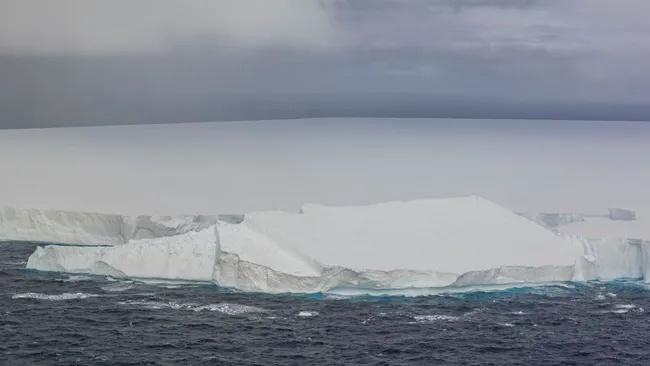
The Fall of a Frozen Giant
For nearly four decades, iceberg A23a ruled Antarctica’s frozen seas — the “queen of icebergs” — a colossal white fortress the size of Rhode Island.
But now, after losing over 80% of its mass since May 2025, A23a is rapidly disintegrating in the South Atlantic Ocean near South Georgia Island, scientists at the British Antarctic Survey (BAS) report.
What was once 1.1 trillion tons of ancient ice now measures only 1,700 square kilometers (656 sq miles), and the breakup is accelerating.
“The iceberg is rapidly breaking up and shedding very large chunks,” said Dr. Andrew Meijers, polar oceanographer at BAS. “These fragments are now large enough to be tracked as separate icebergs.”
From Antarctica to the Atlantic: A 40-Year Odyssey
-
1986 – Birth: A23a calved from Antarctica’s Filchner-Ronne Ice Shelf in the Weddell Sea.
-
1986–2020 – Grounded: It remained stuck to the seabed for > 30 years, slowly weathering polar winds.
-
2020 – Freed: The berg finally lifted off as its anchor ice melted.
-
2024 – Trapped again: It spun inside a Taylor column — a swirling ocean vortex created by an undersea mountain.
-
2025 – Breakaway and Breakdown: Freed in December 2024, it drifted toward South Georgia, entered the Southern Antarctic Circumpolar Current Front (SACCF), and began collapsing into hundreds of smaller icebergs.
Now, thousands of fragments drift eastward, glittering like glass in satellite imagery from NASA’s Aqua and ESA’s Sentinel-1 missions.
Anatomy of a Breakup
The SACCF, a powerful current looping counterclockwise around South Georgia, appears to be the iceberg’s undoing.
This same current shredded previous giants — A68 (2017–2020) and A76 (2021) — as they approached the island.
The combination of:
-
Warm sub-surface waters,
-
Constant shear stress from rotating currents, and
-
Tidal flexing near underwater ridges,
is causing A23a to fracture along structural weaknesses formed decades earlier.
“A23a remained intact longer than its predecessors, but the SACCF is relentless,” Meijers explained. “It’s only a matter of weeks before it breaks beyond trackable size.”

The End of a Reign — and the Rise of D15a
A23a has now relinquished its title as the world’s largest iceberg to D15a, a 3,000 km² (1,160 sq mi) mass drifting peacefully near Australia’s Davis Station.
Soon, A23a’s remnants will melt into mini-bergs, feeding the cold, nutrient-rich waters that sustain krill, fish, and whales — a reminder that even in decay, ice feeds life.
Climate Context: A Warning Written in Ice
Antarctica’s ice systems are changing fast. The number of large calving events is increasing, driven by rising ocean temperatures and thinning ice shelves.
Each megaberg that breaks away reveals two stories:
-
The natural pulse of glacial cycles, and
-
The accelerating fingerprint of climate change.
Scientists caution that if warming continues, iceberg calving could become more frequent, altering ocean circulation, ecosystems, and global sea-level dynamics.
Quick Facts
| Attribute | A23a (Before May 2025) | A23a (Sept 2025) |
|---|---|---|
| Mass | ~1.1 trillion tons | ~0.22 trillion tons |
| Area | 3,672 km² (1,418 sq mi) | 1,700 km² (656 sq mi) |
| Origin | Filchner-Ronne Ice Shelf | — |
| Location | South Georgia Island region | — |
| Current Tracking Agency | BAS / U.S. National Ice Center | — |
Scientific Importance
The demise of A23a provides a rare natural laboratory for studying:
-
Ice–ocean interactions under extreme stress,
-
The role of ocean currents in iceberg decay, and
-
Carbon and nutrient cycling as melting freshwater enters marine systems.
High-resolution data from satellites like Sentinel-3, ICESat-2, and MODIS are already being used to map its disintegration in near-real time — a feat impossible in the 1980s when the iceberg was born.
Reflection: The Queen’s Legacy
A23a’s journey mirrors the broader story of our warming world — a world where even ice that outlasted generations can crumble within months.
As southern spring approaches, her remaining shards drift northward, dissolving into the Atlantic. What began as a monument to endurance now ends as a warning of impermanence.
Acknowledgments
This article is based on reporting by Sascha Pare (Live Science, 2025) and data from the British Antarctic Survey (BAS), U.S. National Ice Center, and NASA Earth Science Division.
Gratitude to:
-
Dr. Andrew Meijers, BAS Polar Oceanographer.
-
NASA Aqua and MODIS mission teams for open-access imagery.
-
European Space Agency (ESA) for Sentinel satellite data.
-
Cryosphere research partners are studying iceberg dynamics under climate change.
Curated and interpreted by Collins Odhiambo Owino for DatalytIQs Academy – Cryosphere Watch Series, exploring the intersection of satellite science, climate analytics, and environmental storytelling.
Leave a Reply
You must be logged in to post a comment.