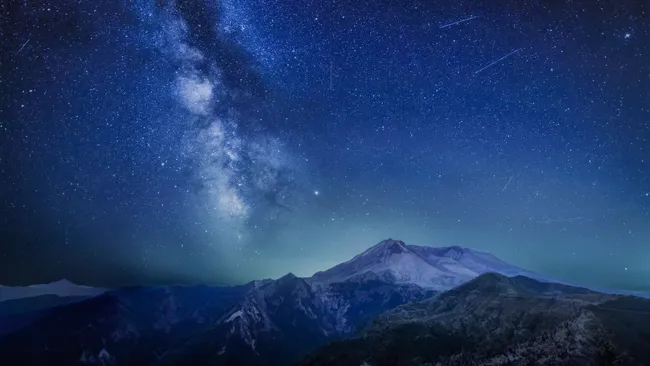
Two Cosmic Streams, One Night of Wonder
As July draws to a close, the night sky will host a celestial duet — two meteor showers, the Southern Delta Aquariids and the Alpha Capricornids, peaking together overnight on July 29–30, 2025.
With the moon conveniently out of view, skywatchers across both hemispheres can expect up to 25 meteors per hour, glowing across dark skies in graceful streaks of cosmic dust.
“It’s one of those rare nights when two showers blend into a single, mesmerizing display,” notes the American Meteor Society (AMS).
The Southern Delta Aquariids: Trails from Comet 96P/Machholz
The Southern Delta Aquariids (SDA) are the stronger of the two showers, originating from Comet 96P/Machholz, a 6-kilometer-wide comet discovered in 1986 that takes 5.3 years to orbit the Sun.
-
Active Period: July 18 – August 12
-
Peak Night: July 29–30
-
Meteor Rate: Up to 20 meteors per hour
-
Best Viewing: Pre-dawn hours, when Aquarius sits highest in the southern sky
-
Characteristic: Faint but lingering trails, often bluish-white
Because their radiant — the apparent origin point — lies in the constellation Aquarius, observers in the Southern Hemisphere will have the best view. Those in the Northern Hemisphere should look low toward the southern horizon in the early morning hours.
The Alpha Capricornids: Slow, Bright, and Colorful
Complementing the Aquariids, the Alpha Capricornids (CAP) are fewer but often spectacular, producing bright, slow-moving meteors and occasional fireballs.
-
Active Period: July 7 – August 15
-
Peak: July 29–30
-
Meteor Rate: 5–10 per hour
-
Parent Body: Comet 169P/NEAT, discovered in 2002
-
Orbit Period: 4.2 years
-
Radiant: Constellation Capricornus, next to Aquarius
Because their radiance is close together, meteors from both showers appear to emanate from the same area of sky, blending into one continuous celestial performance.
“The Alpha Capricornids tend to be especially bright and colorful,” notes AMS, “so even if they’re fewer, they’re often more memorable.”
How to Watch the 2025 Meteor Duo
| Meteor Shower | Parent Comet | Peak Dates | Best Time | Where to Look | Meteors/hr | Notes |
|---|---|---|---|---|---|---|
| Southern Delta Aquariids | 96P/Machholz | July 29–30 | Pre-dawn | Southern sky (Aquarius) | ~20 | Faint, persistent trails |
| Alpha Capricornids | 169P/NEAT | July 29–30 | After midnight | South-southeast (Capricornus) | 5–10 | Bright, colorful fireballs |
Viewing Tips:
-
Best Hours: Midnight to dawn (local time)
-
Moon Phase: Waning crescent — minimal interference
-
Optimal Locations: Southern Hemisphere or tropical latitudes
-
Equipment: None needed — use naked eyes for the widest field of view
-
Eye Adjustment: Allow 20 minutes in darkness for optimal sensitivity
The Science of Shooting Stars
Meteor showers occur when Earth passes through debris trails left behind by comets. As these particles collide with the atmosphere, they ignite from friction, creating glowing streaks visible for fractions of a second.
Both the Machholz and NEAT comets are short-period comets, returning regularly and continually refreshing their debris fields. By studying these meteor streams, astronomers refine:
-
Orbital models of small-body dynamics,
-
Chemical composition of cometary dust, and
-
Interactions between Earth’s magnetosphere and meteoroid influx.
Why It Matters
This double meteor peak demonstrates how cosmic cycles intersect with predictable mathematical precision.
At DatalytIQs Academy, it offers learners an opportunity to connect:
-
Orbital mechanics with observable sky events,
-
Data modeling (meteoroid flux per hour) with real-world observation, and
-
Astronomical storytelling with scientific understanding.
It’s the perfect classroom moment to merge data, dynamics, and awe.
Acknowledgments
This analysis draws from Jamie Carter’s 2025 Live Science report, with data sourced from:
-
American Meteor Society (AMS) meteor stream database
-
NASA’s Center for Near-Earth Object Studies (CNEOS)
-
International Meteor Organization (IMO) observational data
-
ESA’s Space Situational Awareness (SSA) program
Curated and interpreted by Collins Odhiambo Owino for DatalytIQs Academy – Astronomy & Space Analytics Series, connecting celestial events to scientific literacy.
Leave a Reply
You must be logged in to post a comment.