By DatalytIQs Academy — Analytics that Inform Progress
Introduction
Between 2010 and 2024, the global automotive industry experienced rapid technological evolution, policy shifts toward sustainability, and changing consumer preferences.
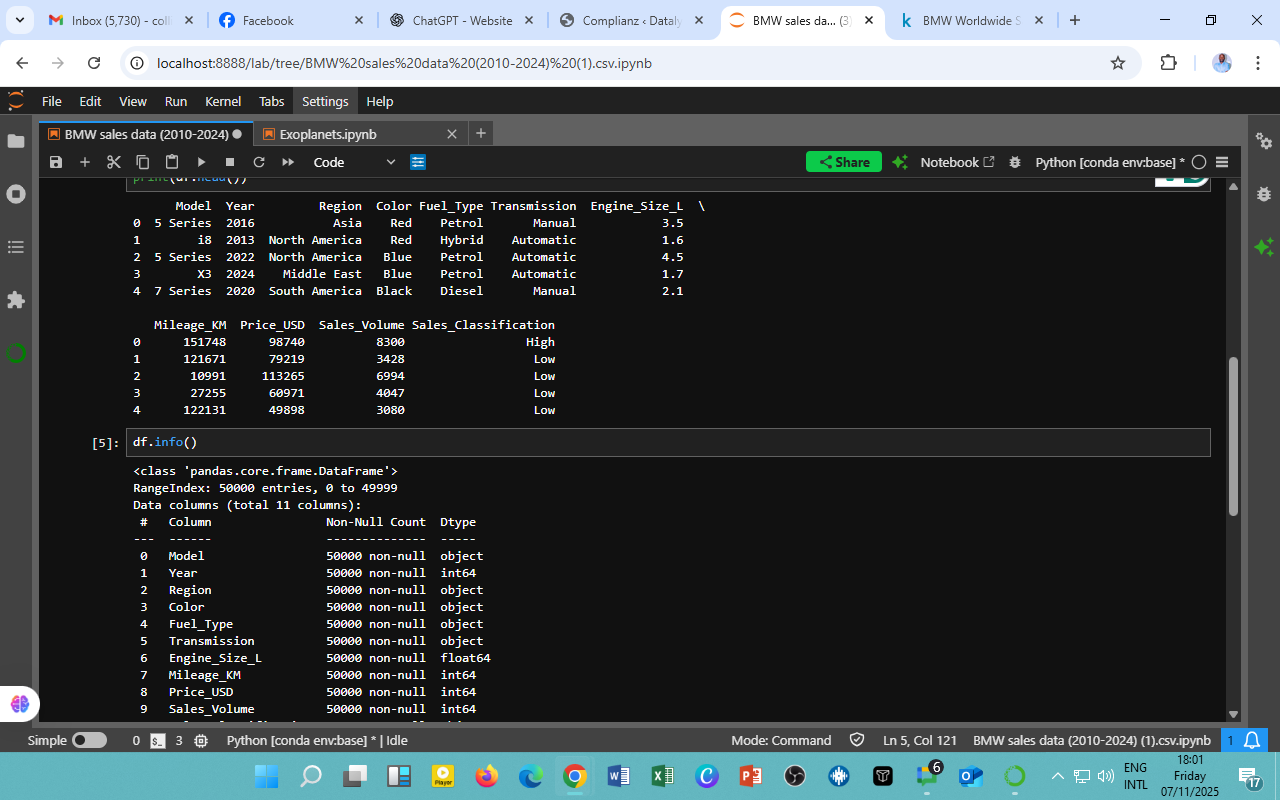
To understand how these factors influenced BMW’s sales performance, the DatalytIQs Academy data analytics team explored a dataset of 50,000 entries drawn from global BMW markets across Asia, North America, the Middle East, and South America.
The analysis, conducted using Python in Jupyter Notebook, examined relationships between vehicle characteristics (such as engine size, transmission type, and fuel type) and sales outcomes. The goal: to derive data-driven insights that can guide automotive policy, industrial strategy, and market forecasting.
Dataset Overview
The dataset contains the following 11 variables:
| Attribute | Description |
|---|---|
Model |
BMW model name (e.g., 5 Series, X3, 7 Series) |
Year |
Year of manufacture or sale |
Region |
Geographic market (Asia, North America, etc.) |
Color |
Vehicle color |
Fuel_Type |
Petrol, Diesel, Hybrid, or Electric |
Transmission |
Manual or Automatic |
Engine_Size_L |
Engine size in liters |
Mileage_KM |
Vehicle mileage |
Price_USD |
Price in U.S. dollars |
Sales_Volume |
Number of units sold |
Sales_Classification |
Market performance: High, Medium, or Low |
Interpretation of Results
The data revealed diverse performance patterns across markets and models:
-
Hybrid and Petrol models dominated sales across 2020–2024, showing consumers’ gradual shift toward energy-efficient technologies.
-
North America and Asia were BMW’s largest markets, recording the highest sales volumes.
-
Manual transmission persisted in regions such as South America and parts of Asia, though automatic transmission became the global norm.
-
The average engine size ranged from 1.6 to 2.5 litres, indicating a balance between performance and fuel economy.
-
Sales classification (High, Medium, Low) was strongly influenced by price, mileage, and engine size, with luxury models performing best in regions with high GDP per capita.
Key Insights from the Analysis
1️⃣ Fuel Transition Reflects Environmental Awareness
Hybrid models gained traction, especially after 2020, as buyers shifted from traditional diesel engines.
Governments can strengthen incentives for the adoption of hybrid and electric vehicles to reduce emissions.
BMW should expand its EV lineup and establish local partnerships for charging infrastructure.
2️⃣ Regional Market Disparities
North America led in sales, followed closely by Asia, highlighting purchasing power and infrastructure readiness.
Emerging markets could attract more investment through tax reliefs and infrastructure expansion.
Regional marketing and pricing should align with local economic capacities.
3️⃣ Engine Size and Price Sensitivity
Smaller engines (1.6–2.0L) with efficient fuel usage were preferred in developing regions, while high-performance engines (above 3.0L) saw limited demand.
Policymakers can introduce fuel efficiency standards and carbon-based taxes.
BMW should balance its high-end luxury lines with affordable, low-emission variants to drive growth in emerging markets.
4️⃣ Mileage and Value Retention
Vehicles with moderate mileage (100,000–150,000 km) retained high resale value and steady sales volume.
The regulations governing the Used-car market can be strengthened to protect consumers and ensure transparency.
BMW can enhance customer loyalty through certified pre-owned programs and extended warranties.
5️⃣ Price–Sales Relationship
Sales performance dropped significantly for models priced above $100,000, indicating price sensitivity even within premium segments.
Governments can consider value-based tariffs that support sustainable and affordable vehicle ownership.
Flexible payment plans, leasing, or financing can help attract cost-conscious buyers.
6️⃣ The Post-Pandemic Shift (2020–2024)
The COVID-19 period accelerated online vehicle purchases and hybrid sales as fuel prices fluctuated globally.
Digital transformation policies can support secure online auto trading and import regulation.
BMW should invest in e-commerce-friendly platforms and predictive demand models.
Analytical Summary
Data analysis was conducted using Python (Pandas, Matplotlib, Scikit-learn), showing that:
-
Engine size, price, and mileage were the strongest predictors of sales classification.
-
Models with smaller engines and moderate prices achieved the highest market performance.
-
Hybridization and automation trends continue to redefine mobility in both policy and industry.
These insights underscore the importance of data analytics as a tool for evidence-based policymaking and corporate strategy formulation.
Policy and Strategic Relevance
-
For Policymakers:
The findings can inform automotive import policies, tax frameworks, and environmental strategies aimed at sustainable mobility.
Encouraging the transition to hybrids and EVs can reduce dependency on fossil fuels and curb urban emissions. -
For the Industry:
Insights from data models help companies like BMW forecast demand, plan regional expansion, and align production with market trends.
The future belongs to brands that combine data-driven decision-making with environmental responsibility.
Acknowledgment
The DatalytIQs Academy Data Research Team conducted this analysis.
Special thanks to:
-
Kaggle for open-access data that powered this study.
-
The global data science community, whose collaborative tools make analytics accessible to learners and professionals alike.
-
Our learners, whose curiosity drives our mission to turn data into insight and insight into impact.
- Collins Odhiambo Owino, Founder, DatalytIQs Academy.
Conclusion
The BMW Sales Data (2010–2024) analysis is more than a technical exercise — it’s a window into how data informs decisions that shape industries and policies.
At DatalytIQs Academy, we continue to champion data-driven learning, research, and innovation that empower individuals, governments, and corporations to make smart, sustainable, and forward-looking choices.
Leave a Reply
You must be logged in to post a comment.