Blog

  • 🌍 Kenya Weather Overview – Saturday, October 4, 2025(6:41 p.m. local time)

    🌍 Kenya Weather Overview – Saturday, October 4, 2025

    🇰🇪 National Summary

    • Country High: 🌡️ 33°C in Garissa (Northeastern Kenya)

    • Country Low: 🌡️ 17°C in Kericho (Western highlands)

    • Max Wind: 💨 46 km/h in Garissa

    • General Pattern:
      Broken clouds and mild evening temperatures dominate much of Kenya. Interior regions remain warm and dry, while western and coastal areas experience higher humidity and scattered showers.


    🏙️ City-by-City Snapshot (6:41 p.m. local time)

    City Condition Temperature Notes
    Nairobi (Capital) 🌤 Broken clouds 20°C Calm evening, light southerly winds (9 km/h). Feels pleasant with moderate humidity.
    Eldoret ☁️ Cloudy 20°C Cool and stable, typical highland weather. Possible mist later at night.
    Garissa ☀️ Hot, partly sunny 33°C The country’s hottest region today, strong winds (46 km/h). Dry conditions persist.
    Kisumu 🌦️ Overcast with rain 26°C Scattered thunderstorms around the Lake Victoria region; high humidity (~85%).
    Nakuru ☁️ Cloudy 24°C Mild, partly overcast. Stable conditions for the central Rift Valley.
    Mombasa 🌴 Warm, humid 28°C Typical coastal humidity; light sea breeze moderates the heat.
    Kericho 🌫 Cool and damp 17°C The country’s coolest region due to elevation; fog likely overnight.

    🌦 Regional Trends

    1. Western Kenya (Kisumu, Kericho, Eldoret):
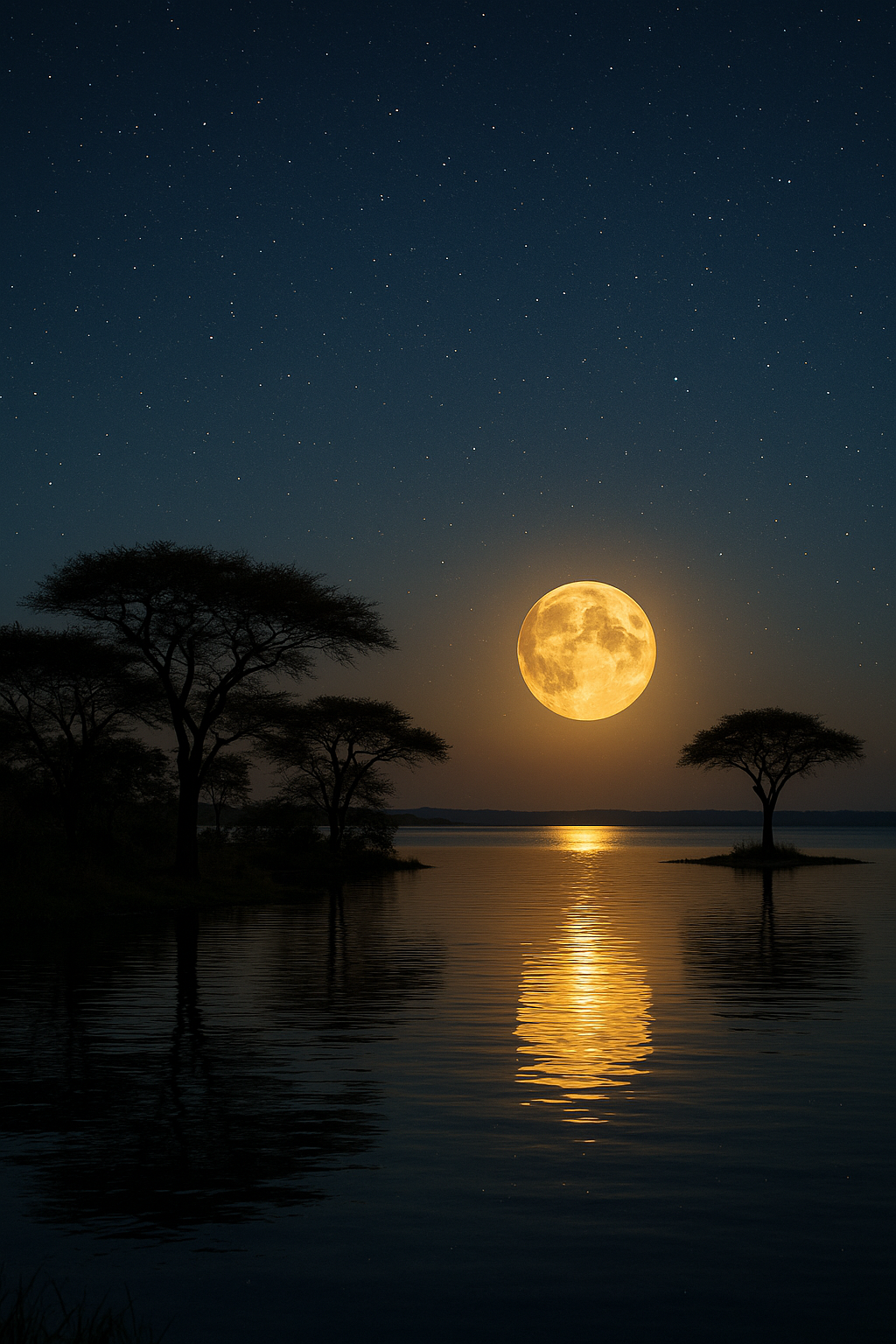
      Intermittent rainfall and high humidity due to the Lake Victoria basin and orographic effects. Ideal for observing Harvest Moon reflections when skies clear between showers.

    2. Central Highlands (Nakuru, Nairobi):
      Mild and partly cloudy. The capital region enjoys a comfortable evening climate (20–24°C) with good visibility.

    3. Coastal Belt (Mombasa):
      Humid and breezy. No significant rain expected, but clouds will persist overnight.

    4. Northeastern Kenya (Garissa):
      Hottest and driest — clear skies, high winds, and low humidity make it favorable for night-sky observation.


    🌕 Astronomical Outlook

    With International Observe the Moon Night (Oct 4) and the Harvest Supermoon approaching (Oct 6–7):

    • Best visibility: Garissa, Nairobi, Nakuru, and Mombasa (less cloud cover).

    • Partial visibility: Kisumu, Kericho, and Eldoret (occasional thunderstorms).


    🌡️ Summary

    Kenya’s weather this evening is a blend of:

    • Cool, humid skies in the west

    • Warm, partly cloudy in the central and coastal regions

    • Hot and windy in the northeast

    Despite scattered showers, moonwatchers across Kenya should expect short cloud breaks suitable for glimpsing the waxing gibbous Moon, especially after 8:00 p.m..
  • Weather Overview — Kisumu, Kenya (October 4, 2025)

    Weather Overview — Kisumu, Kenya (October 4, 2025)

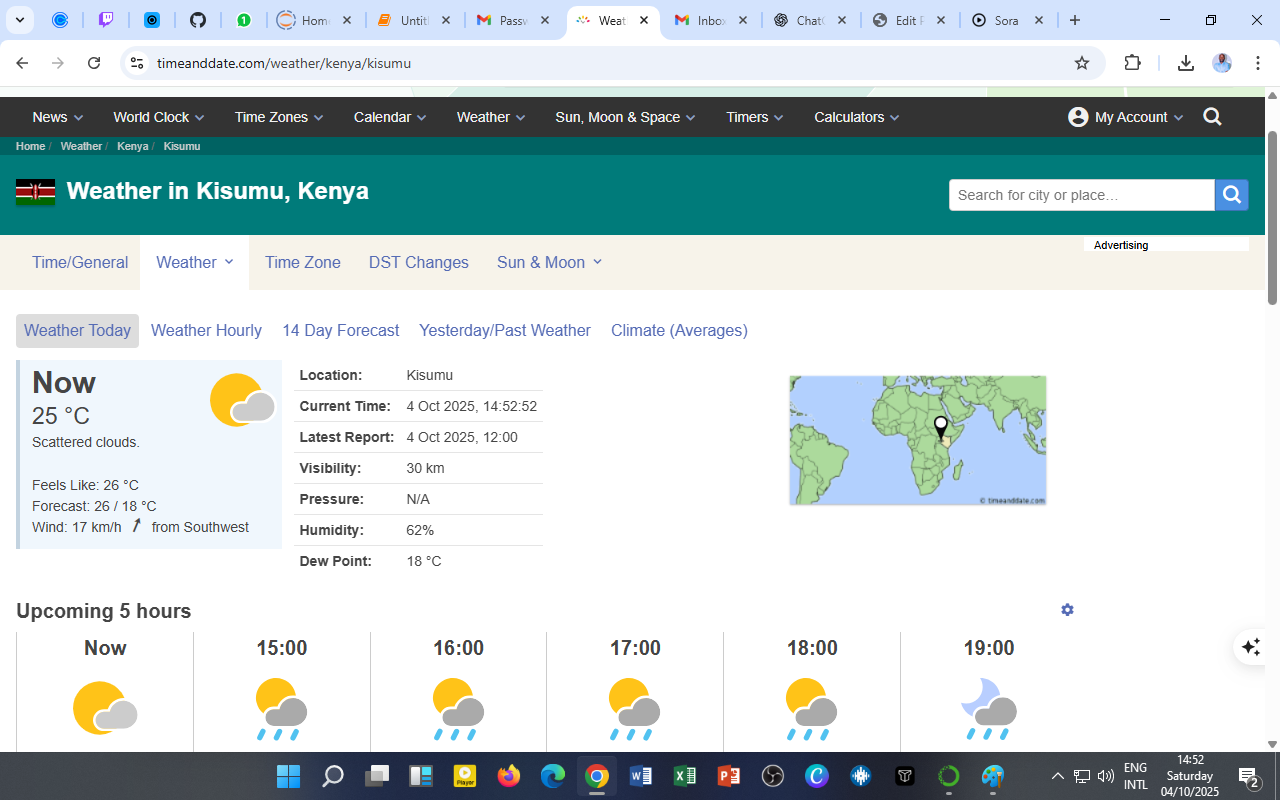
    Time of Report: 14:52 local time (EAT)
    Location: Kisumu, Western Kenya
    Temperature: 25°C
    Feels Like: 26°C
    Forecast Range: 26°C (day) / 18°C (night)
    Weather Condition: Scattered clouds
    Wind: 17 km/h from the Southwest (SW)
    Humidity: 62%
    Visibility: 30 km
    Dew Point: 18°C

    • General Conditions:
      The afternoon weather in Kisumu is warm and slightly humid with scattered cloud cover — typical of early October when the region transitions between dry and short-rain seasons.

    • Wind & Humidity:
      Winds from the southwest often carry moist air from Lake Victoria, leading to localized evening showers, as the forecast suggests.

    • Visibility:
      At 30 km, visibility is excellent — meaning there’s no haze or heavy precipitation currently affecting the air clarity.


    🌙 Evening Forecast (15:00–19:00)

    Time Condition Note
    15:00 🌤 Partly cloudy Warm, breezy afternoon
    16:00 🌧 Light rain expected Possible short drizzle
    17:00 🌧 Light showers Scattered clouds persist
    18:00 🌦 Cloudy with rain Brief showers before sunset
    19:00 🌙🌧 Clearing sky with light rain Likely to improve after dusk

    There may be intermittent light rain between 4:00–7:00 p.m., but skies are expected to partially clear by nightfall — meaning observers might still get a good view of the waxing gibbous moon (weather permitting).


    🌕 Observation Outlook for Moonwatchers

    • The Moon rises at 16:22 (ESE direction), likely behind thin evening clouds.

    • If showers subside around 7:00–8:00 p.m., the Harvest Supermoon buildup will be visible — glowing softly through broken clouds.

    • Best viewing window: Between 8:00 p.m. and 9:30 p.m., when the atmosphere stabilizes and the moonlight reflects off moist air for a beautiful golden hue.


    🌍 Summary

    Kisumu’s weather on October 4, 2025, presents a mild, tropical evening with scattered clouds and light rain, typical of equatorial lakeside climates. Despite brief showers, conditions are favorable for moon observation later in the night, making it a fitting prelude to the International Observe the Moon Night event.

  • Kisumu Sky watch: Waxing Gibbous Moon Heralds the Harvest Supermoon

    Kisumu Sky watch: Waxing Gibbous Moon Heralds the Harvest Supermoon

    Date: October 4, 2025
    Location: Kisumu, Kenya
    Source: TimeandDate.com – Kisumu Moon Data

    Tonight, skywatchers in Kisumu will enjoy a 90.5% waxing gibbous Moon, glowing bright in the east-southeast (101.6°) sky. At this phase, the Moon is just days away from reaching its peak as the Harvest Supermoon on October 7 — the first of three supermoons in 2025.

    At 14:41 local time, the Moon is still below the horizon (altitude = -24.6°), but it will rise at 16:22 (4:22 p.m.), casting a golden hue across the evening sky. Tonight’s Moon sits 372,875 km away from Earth — slightly closer than average — making it appear larger and brighter as it climbs above the horizon.

    The Harvest Supermoon derives its name from centuries-old farming tradition, when its extra light allowed farmers to work late into the night during harvest season. This year, it will reach full illumination at 06:47 a.m. EAT on October 7.


    🔭 What to Watch For

    • Moonrise: Around 4:22 p.m. (ESE direction).

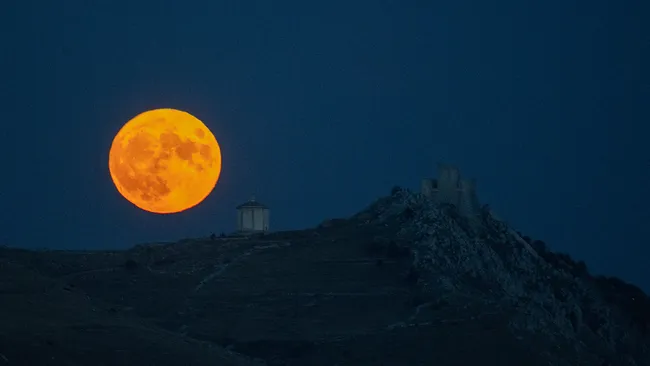
    • Best viewing window: 6:30 – 8:00 p.m., when the Moon glows deep orange near the horizon.

    • Pairings: Look for Saturn close to the Moon on October 5, followed by Jupiter later in the month.

    • Next major lunar event: New Moon on October 21 (3:25 p.m. EAT) — perfect for dark-sky stargazing.


    🌍 Why It Matters

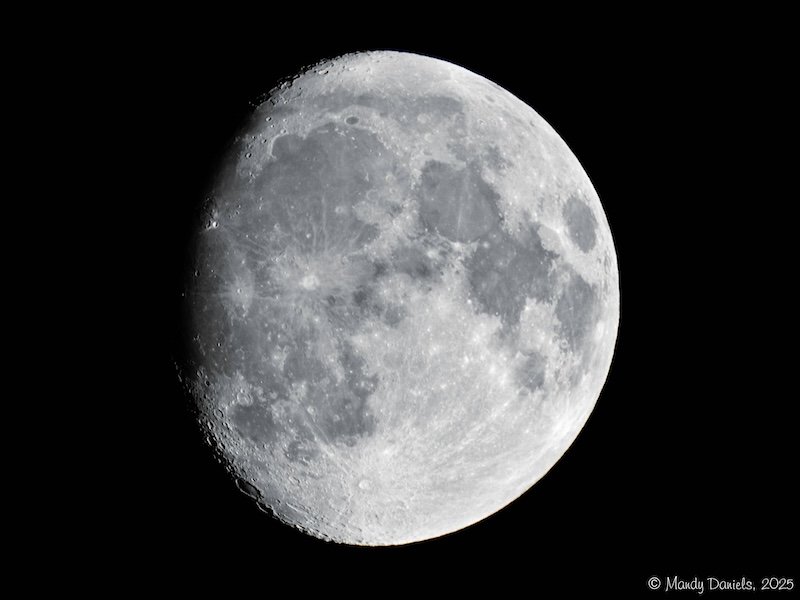
    This period marks the transition into the Harvest Moon season, symbolizing abundance and renewal. The Moon’s low arc across the Kenyan sky gives observers a vivid view of its craters and maria — especially along the terminator, the dividing line between lunar day and night.

    So, step outside this weekend and witness the Moon’s majestic rise over Lake Victoria — a preview of the breathtaking Harvest Supermoon to come.

  • When to Watch the Harvest Supermoon and Planetary Pairings

    When to Watch the Harvest Supermoon and Planetary Pairings

    Your Moon Guide for October 2025: When to Watch the Harvest Supermoon and Planetary Pairings

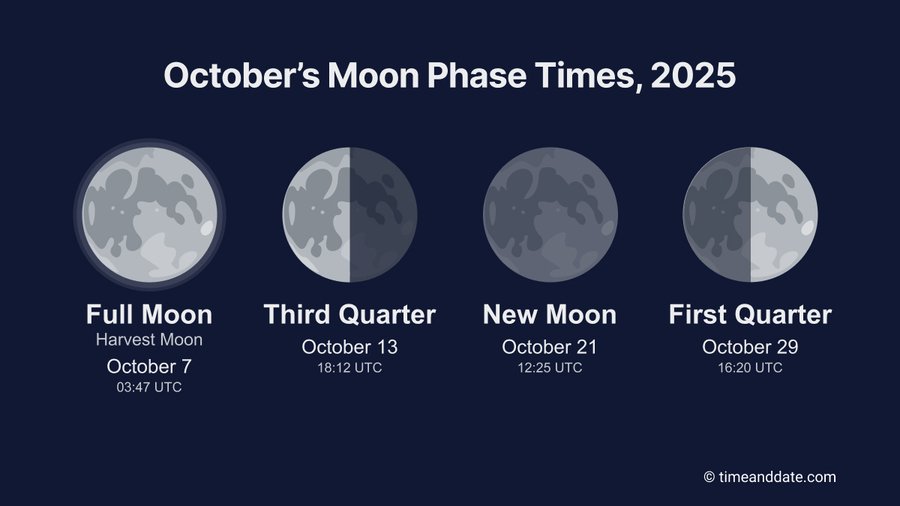
    October brings one of the most dazzling lunar shows of the year. The Full Harvest Moon will reach peak brightness at 03:47 UTC on October 7, marking the first supermoon of 2025. This year, the Harvest Moon falls in October (instead of September) because it’s the full moon closest to the autumn equinox, which occurred on September 22.

    Throughout the month, the Moon will pair beautifully with Saturn, Jupiter, and Venus, offering several nights of brilliant skywatching. The nearly full Moon rises around sunset and sets near sunrise, casting a golden glow over autumn nights.

    📅 Key Moon Phases – October 2025

    • 🌑 New Moon: October 21

    • 🌓 First Quarter: October 29

    • 🌕 Full Moon (Harvest Supermoon): October 7 (03:47 UTC)

    • 🌗 Last Quarter: October 14

    🔭 Sky Highlights:

    • Early October: Moon passes near Saturn

    • Mid-October: Moon meets Jupiter in the east

    • Late October: Crescent Moon joins Venus before dawn

    Whether you’re a casual observer or an astrophotography enthusiast, October 2025 is an ideal month to reconnect with the night sky.

  • International Observe the Moon Night 2025: On October 4, 2025

    International Observe the Moon Night 2025: On October 4, 2025

    International Observe the Moon Night 2025: Celebrate Our Celestial Neighbor

    On October 4, 2025, skywatchers around the world will come together for International Observe the Moon Night (InOMN) — a global celebration of lunar wonder hosted annually since 2010.

    This year’s event coincides with a waxing gibbous moon, 90% illuminated, offering excellent views of craters, ridges, and mountain shadows along the lunar terminator — the line between lunar day and night. Observing through binoculars or a small telescope reveals the Moon’s texture in stunning detail.

    Whether you join a local astronomy club, stream a virtual event, or step outside with friends, InOMN is about reconnecting with the night sky and rediscovering the Moon as both a scientific and cultural icon.

    🗓️ Date: Saturday, October 4, 2025
    📍 Best Time: Evening, just after sunset
    🔭 Tip: Focus near the terminator for the most dramatic shadows and detail

  • Harvest Moon 2025: On October 6–7, 2025

    Harvest Moon 2025: On October 6–7, 2025

    On October 6–7, 2025, skywatchers will witness the first full moon of autumn, known as the Harvest Moon — and this year, it doubles as a supermoon. Appearing larger and brighter than usual, it will rise in the eastern sky just after sunset, glowing with a golden-orange hue that once guided farmers through late-night harvests.

    The moon turns full at 11:47 p.m. EST (3:47 p.m. UTC on Oct. 7), shining brightly for several nights. For the most striking view, look east about 15–20 minutes after moonrise from a clear, elevated spot.

    Adding to the celestial show, the Draconid meteor shower will peak around Oct. 8, offering occasional shooting stars despite the bright moonlight. The Harvest Moon will be 224,599 miles (361,457 km) from Earth — about 10% closer than average — making it the first of three supermoons in 2025.

  • How Stars die

    Every star eventually runs out of fuel. At the heart of a star, the steady conversion of hydrogen into helium through nuclear fusion produces the energy that balances gravity’s inward pull. But once the hydrogen in the core is exhausted, gravity begins to win. The core collapses, its pressure and temperature rise, and the star swells outward. What happens next depends largely on the star’s mass.

    The Fate of Low-Mass Stars

    For smaller stars like our Sun, the outer atmosphere continues to expand, transforming the star into a subgiant and later a giant. In its core, helium fuses into carbon, while the star’s outer layers grow unstable. Some of these giants pulsate—expanding and contracting—before eventually shedding their atmospheres into space.

    This process creates a glowing shell of gas and dust known as a planetary nebula. One of the most striking examples is the Helix Nebula (NGC 7293), located 650 light-years away in Aquarius, imaged here in bluish-purple hues by NASA’s telescopes.

    At the center of the nebula lies the star’s former core, now a white dwarf—a dense, Earth-sized ember that slowly cools and fades over billions of years. This is the destiny that awaits our Sun in several billion years.

    The Fate of Massive Stars

    High-mass stars follow a more violent path. After burning hydrogen into helium and helium into carbon, they continue fusing heavier elements: oxygen, neon, magnesium, and beyond. For the most massive stars, the process marches all the way to silicon fusion, which produces iron in the core.

    But here lies the limit. Unlike lighter elements, fusing iron does not release energy—it consumes it. With no fuel left to support the star against gravity, the iron core collapses in seconds. Forces inside the nuclei briefly halt the collapse, triggering a rebound that sends a shock wave racing outward. The result is one of the most dramatic events in the universe: a supernova explosion.

    One famous remnant of such an event is Tycho’s Supernova, first observed in 1572 in the constellation Cassiopeia. In this composite image, NASA’s Chandra X-ray Observatory reveals the glowing debris left behind from that stellar death.

    Cosmic Recycling

    The supernova’s aftermath leaves behind an incredibly dense remnant: either a neutron star—a city-sized core of collapsed matter—or a black hole, where gravity is so intense that not even light can escape. Meanwhile, the explosion blasts heavy elements like carbon, oxygen, and iron into space.

    This ejected material enriches the galaxy, seeding new molecular clouds with the raw ingredients for future stars, planets, and even life itself. In this way, the death of one generation of stars becomes the foundation for the next—a cosmic cycle of creation and destruction that has shaped the universe for billions of years.

  • The Life of a Star

    When a star is first born, most of its energy comes from the heat generated by the collapse of gas and dust into a dense core. Over millions of years, the temperature and pressure at the center of this young star rise so high that the nuclei of hydrogen atoms begin to fuse, forming helium. This process, known as nuclear fusion, releases tremendous amounts of energy.

    That energy not only makes the star shine but also pushes outward, balancing the inward pull of gravity. With this balance achieved, the star enters the main sequence—the longest and most stable phase of its life.

    Our own Sun, captured here in an image from NASA’s Solar Dynamics Observatory, is a classic example of a main-sequence star. It glows with a tannish-orange light, while powerful magnetic activity can unleash dramatic solar flares, as shown by the pinkish eruptions visible across its surface. The Sun is currently about halfway through its main-sequence lifetime.

    During this phase, a star’s brightness, size, and temperature gradually evolve, but it remains relatively stable for millions—or even billions—of years. The pace of this life cycle depends largely on a star’s mass:

    • Low-mass stars burn their fuel slowly, glowing cooler and dimmer but lasting for trillions of years—far longer than the universe has even existed so far.

    • Massive stars, on the other hand, live fast and die young. They burn through their fuel at an extraordinary rate, often exhausting themselves in only a few million years.

    In the grand tapestry of the cosmos, the main sequence is the stage where stars spend most of their lifetimes, steadily burning hydrogen, illuminating galaxies, and providing the light and warmth that make life possible on worlds like our own.

  • Birthplaces of Stars: Inside the Cosmic Nurseries

    Stars are born within vast, cold clouds of gas and dust known as molecular clouds. These enormous structures can range in mass from 1,000 to as much as 10 million times that of our Sun, stretching across hundreds of light-years.

    Because molecular clouds are extremely cold, their gas begins to clump together, forming pockets of higher density. Over time, some of these clumps collide or gather more material, increasing their mass and strengthening their gravitational pull. Eventually, gravity wins, pulling the clump inward. As the material collapses, friction generates heat—giving rise to a protostar, the earliest stage of a star’s life.

    Often, stars do not form in isolation. Instead, they are born in groups, creating what astronomers call stellar clusters. When a molecular cloud contains many of these clusters, it becomes a true stellar nursery—a region where star formation is actively underway.

    One such nursery is NGC 3324, located at the northwest edge of the Carina Nebula. In breathtaking images captured by the James Webb Space Telescope, the nursery’s edge appears like a landscape of “mountains” and “valleys” sculpted by cosmic forces. In reality, these shapes are towering walls of gas and dust, lit up by the newborn stars within.

    These stellar nurseries remind us that even the mightiest stars in the universe begin life quietly, hidden within cold clouds, before blazing into brilliance and shaping the galaxies around them.

  • Could Alien Life Exist Within Our Solar System-Mars, Europa, Enceladus?

    The solar system is home to eight planets and hundreds of moons — but could any of them host extraterrestrial life? It’s a question that has fascinated humanity for centuries, and scientists are beginning to zero in on a few intriguing possibilities.

    While Earth remains the only confirmed world with life, researchers have identified several “hotspots” in our solar system where life may have once existed — or may still survive today in hidden environments.

    Life on Mars?

    Mars, our neighboring planet, may not have “little green men,” but evidence suggests it could have supported microbial life in the past. Today, Mars is a cold, desert world. However, rover missions have revealed that billions of years ago, Mars had flowing liquid water, lakes, and rivers — all essential ingredients for life. Scientists continue searching for fossilized microbes or chemical signatures that could confirm life once thrived there.

    And Mars isn’t the only candidate. Moons like Europa (Jupiter) and Enceladus (Saturn), with their vast underground oceans, and even Titan, Saturn’s moon with methane lakes, remain at the center of the search for alien life close to home.

    The big question remains: Is life limited to Earth, or is our solar system hiding secrets beneath its frozen surfaces and rocky terrains?