Blog

  • 🌕 The Harvest Moon Will Light Up the Night Sky on October 6, 2025

    🌕 The Harvest Moon Will Light Up the Night Sky on October 6, 2025

    A Celestial Beacon of Autumn

    On the evening of Monday, October 6, 2025, skywatchers around the world will be treated to one of the year’s most captivating lunar events — the Harvest Moon.
    This full moon will reach peak illumination at 11:48 p.m. EDT (8:48 p.m. PDT, or 03:48 GMT on Oct. 7), casting its golden light across fields, forests, and seas alike.

    Because it occurs closest to the autumnal equinox, this particular full moon is known as the Harvest Moon — a celestial companion that for centuries guided farmers through their late-season harvests.

    Names Across Cultures and Seasons

    Different cultures have long celebrated this moon, weaving it into their seasonal calendars and storytelling traditions:

    • 🌾 Anishinaabe (Great Lakes)Binaakwe-giizis, the Falling Leaves Moon, and Mshkawji-giizis, the Freezing Moon, marking the changing of seasons.

    • 🕊 Cree Nation (Central Canada)Opimuhumowipesim, the Migrating Moon, when birds begin their long journeys southward.

    • 🌽 Haudenosaunee (Iroquois / Mohawk)Kentenha, the Time of Poverty Moon, signaling a period of preparation before winter.

    These ancestral names remind us that astronomy and agriculture have always been deeply intertwined — the moon’s rhythm guiding both nature’s cycles and human survival.

    Why It’s a Supermoon

    This October’s full moon will occur just 1.5 days before perigee, when the Moon is closest to Earth in its orbit. That makes it the first and smallest of three consecutive supermoons in 2025.

    During this event:

    • The moon will appear about 4% larger and 13% brighter than a typical full moon.

    • Its enhanced brightness will create stronger ocean tides and glowing nightscapes ideal for photography.

    • It will travel through the constellations Cetus and Pisces, visible all night long from sunset to sunrise.

    The Magic of the Harvest Moonrise

    Normally, the moon rises about 50 minutes later each evening.
    But near the equinox, the shallow angle of the ecliptic — the moon’s orbital path — causes the full moon to rise at nearly the same time each night, sometimes only 10 minutes apart depending on your latitude.

    For ancient farmers, this was nothing short of a miracle: it meant several consecutive evenings of extended twilight, bathed in silver-gold light, long after sunset.

    That extra hour of brightness could mean the difference between finishing a harvest before frost or losing it to the cold — hence the enduring name, Harvest Moon.

    When and How to Watch

    • Date: Monday, October 6, 2025

    • Peak Illumination: 11:48 p.m. EDT (03:48 GMT, Oct. 7)

    • Best Viewing: Look toward the eastern horizon just after sunset to watch the moon’s golden disk rise.

    • Tip: If you’re near water or open fields, you’ll see its reflection stretch across the landscape — a scene of breathtaking calm.

    A Moment of Reflection

    Every full moon invites a pause — a moment to look up and reconnect with nature’s cycles. The Harvest Moon, especially, symbolizes gratitude, abundance, and transition. It reminds us that even as daylight shortens and leaves begin to fall, the sky offers its own light to guide us forward.

    “The moon is a friend for the lonesome to talk to.”
    Carl Sandburg

    Key Takeaway

    The Harvest Moon of October 2025 will not only illuminate the night — it will also reconnect us with the ancient rhythm of Earth and sky.
    Watch it rise, breathe in the stillness, and remember that even in changing seasons, the universe keeps its quiet, reliable pulse.

    By Starry Night / Chris Vaughan
    Edited and adapted for DatalytIQs Academy Astronomy Blog

    Credits:
    Starry Night / Chris Vaughan – Image and data visualization
    Adapted from NASA and Phys.org reports (2025
  • 🌍 Earth’s Crust Is Tearing Apart off the Pacific Northwest — and That’s Not Necessarily Bad News

    🌍 Earth’s Crust Is Tearing Apart off the Pacific Northwest — and That’s Not Necessarily Bad News

    A Rare Glimpse into Earth’s Changing Face

    For the first time, scientists have directly observed a subduction zone — one of Earth’s most powerful tectonic engines — breaking apart in real time.
    This extraordinary finding, published in Science Advances (2025), offers new insight into how Earth’s surface reshapes itself and what that means for the future of seismic activity in the Pacific Northwest.

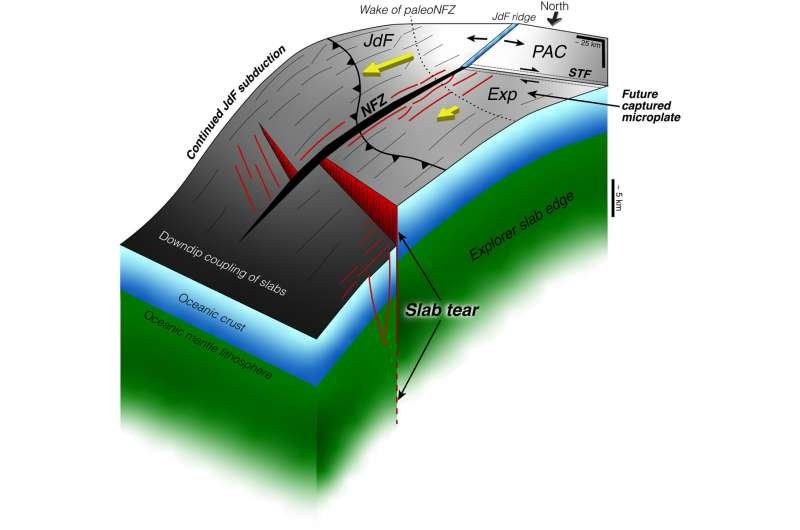
    Using cutting-edge seismic imaging and earthquake data, researchers have captured the Juan de Fuca plate, off the coast of Vancouver Island, in the process of tearing itself to pieces.

    It’s a geologic drama unfolding deep beneath the ocean floor — and while it sounds ominous, it’s actually part of Earth’s natural renewal cycle.

    Subduction Zones: Earth’s Hidden Powerhouses

    Subduction zones are the collision points between tectonic plates, where one slab of crust dives beneath another and sinks into the mantle. These zones:

    • Drive continental drift,

    • Generate massive earthquakes and tsunamis, and

    • Fuel volcanic arcs that recycle crustal material.

    But like all things geological, subduction zones have lifespans. They don’t last forever.
    When they finally die, they leave behind mountain ranges, volcanic chains, and fragments of ancient oceanic plates — Earth’s geological fingerprints through time.

    Cascadia’s Slow-Motion Breakup

    The research, led by Dr. Brandon Shuck (Louisiana State University, formerly at Columbia University’s Lamont-Doherty Earth Observatory), used seismic reflection imaging — essentially an “ultrasound” of the planet’s crust — to peer beneath the Pacific seafloor.

    Data from the 2021 Cascadia Seismic Imaging Experiment (CASIE21) aboard the Marcus G. Langseth research vessel revealed something never seen so clearly before:
    The Juan de Fuca plate is actively fracturing and breaking off in segments.

    “It’s like watching a train derail — one car at a time,” said Dr. Shuck.
    “Instead of shutting down all at once, the plate is ripping apart piece by piece, creating new boundaries and smaller microplates.”

    The Mechanics of a Dying Subduction Zone

    • Slab Fragmentation: The Juan de Fuca plate is tearing along multiple fractures, including one massive 75-kilometer-long tear where the plate has dropped nearly 5 kilometers.

    • Piecewise Detachment: The breakup isn’t sudden — it happens episodically, with one portion detaching while others remain active.

    • Microplate Formation: These fragments slowly become independent mini-plates, like the fossilized remains of the ancient Farallon Plate off Baja California.

    • Seismic Signature: Detached segments stop producing earthquakes, leaving “quiet gaps” in seismic activity — a telltale sign of subduction shutdown in progress.

    “Once a piece has completely broken off, it no longer produces earthquakes because the rocks aren’t stuck together anymore,” Shuck explained.

    Why It’s Not All Bad News

    At first glance, Earth’s crust tearing apart sounds alarming. But this natural process may actually reduce long-term tectonic strain by breaking down the massive energy of subduction into smaller, manageable pieces.

    Co-author Dr. Suzanne Carbotte from Lamont-Doherty notes:

    “We’ve known that subduction can stall when buoyant regions of oceanic crust reach a subduction zone, but we’ve never had such a clear picture of the process in action.”

    In essence, the Juan de Fuca plate’s gradual disintegration could help release geological stress more gently, rather than through one catastrophic rupture.

    A Window into Earth’s Past—and Future

    The Cascadia findings also solve a long-standing geological puzzle:
    How did the Farallon Plate, which once dominated the eastern Pacific, disintegrate into a patchwork of smaller plates millions of years ago?

    Cascadia now offers the missing link — showing that subduction zones don’t die in one massive collapse, but instead unravel step by step over millions of years.

    This model helps explain:

    • Fossilized microplates across ancient ocean floors,

    • Abrupt shifts in volcanic activity, and

    • The uneven distribution of earthquake zones in modern subduction systems.

    What About Earthquake Risks?

    For now, these findings don’t dramatically alter the hazard outlook for the Pacific Northwest.
    The Cascadia subduction zone remains capable of generating massive earthquakes and tsunamis, much like the event that struck Japan in 2011.

    However, this new understanding will refine models of how fault complexity and plate fragmentation influence rupture propagation — crucial for improving seismic hazard forecasts in the region.

    “This is the first time we’ve caught a subduction zone in the act of dying,” Shuck said.
    “Understanding how it unravels helps us better predict what might happen next — not just here, but in subduction zones worldwide.”

    Key Takeaway

    The Earth beneath the Pacific Northwest is not collapsing — it’s evolving.
    The Juan de Fuca plate’s slow disintegration is part of the natural rhythm of plate tectonics, helping scientists piece together the life and death cycles of oceans, mountains, and continents themselves.

    By Bianca Scolaro, State of the Planet
    Edited by Lisa Lock, reviewed by Robert Egan
    Published in: Science Advances (2025)
    DOI: 10.1126/sciadv.ady8347

    References:
    Scolaro, B. (2025). Earth’s crust is tearing apart in the Pacific Northwest—and that’s not necessarily bad news. State of the Planet.
    Published in Science Advances (2025). DOI: 10.1126/sciadv.ady8347

  • 🌌 Infrared Data from the James Webb Telescope Reveals New Structural Details of M87’s Black Hole Jet

    🌌 Infrared Data from the James Webb Telescope Reveals New Structural Details of M87’s Black Hole Jet

    A Deeper Look into a Cosmic Powerhouse

    The galaxy M87, located about 53 million light-years away in the Virgo Cluster, has fascinated astronomers for decades. It hosts one of the most massive black holes ever discovered—the same one that produced the first-ever black hole image from the Event Horizon Telescope (EHT) in 2019.

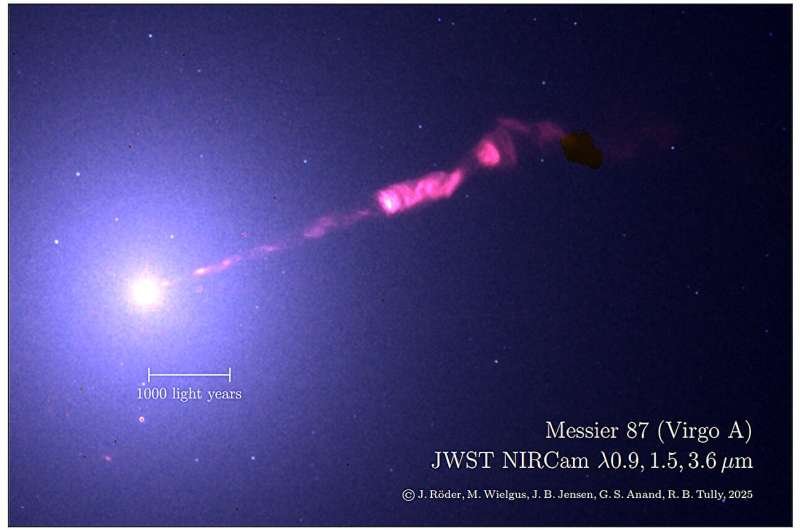
    Now, thanks to the James Webb Space Telescope (JWST), scientists have captured the most detailed infrared view yet of M87’s iconic black hole jet — a stream of high-energy particles traveling nearly at the speed of light.

    This groundbreaking study, published in Astronomy & Astrophysics (2025), unveils new substructures, knots, and counter-jet features that deepen our understanding of how black holes release energy across the cosmos.

    A Jet that Defies Imagination

    First cataloged by Charles Messier in the 18th century, M87 appeared at first glance as just a fuzzy nebula. Modern telescopes later revealed it as a giant elliptical galaxy with an extraordinary feature:
    a relativistic jet shooting out from its central supermassive black hole — a structure extending thousands of light-years into space.

    This jet is famous for its synchrotron emission, radiation produced as charged particles spiral along magnetic field lines at near-light speeds. Previous studies using radio, X-ray, and optical observations have traced its general shape and energy, but infrared details were missing — until now.

    How JWST’s Infrared Eyes Transformed the View

    Using JWST’s Near Infrared Camera (NIRCam), astronomers observed M87’s jet in four infrared bands (0.90, 1.50, 2.77, and 3.56 µm).
    Through advanced data processing — including galaxy modeling, background subtraction, and stellar light removal — they isolated the jet’s own glow from the galaxy’s overwhelming brightness.

    What emerged was a highly detailed image of both the main jet and the elusive counter-jet, revealing features invisible in optical light.

    Key Findings: The Anatomy of M87’s Jet

    1. Helical Jet Structure:
      The main jet shows a twisting, helical shape, suggesting the influence of strong magnetic fields and relativistic rotation.

    2. Bright Knot “L” and HST-1:

      • Knot L: A slowly moving, luminous region close to the nucleus.

      • HST-1: A famous, fast-moving “superluminal” component discovered by the Hubble Telescope — now resolved into two substructures with distinct spectral indices, offering clues about particle acceleration.

    3. Counter-Jet Revealed:
      For the first time in this wavelength, JWST captured a clearer image of the counter-jet, located about 24 arcseconds from the galaxy’s nucleus.
      It forms a C-shaped filament structure connected by a bright hotspot — consistent with radio observations, but far sharper in detail.

    Why This Discovery Matters

    The ability to trace both the main jet and counter-jet in infrared allows researchers to probe:

    • The magnetic field geometry shapes the jet’s spiral motion,

    • The energy distribution of relativistic particles, and

    • How material is accelerated outward from the black hole’s accretion disk.

    This data also bridges observational gaps between radio, optical, and X-ray studies — giving scientists a complete multi-wavelength picture of jet physics in active galactic nuclei (AGN).

    A Glimpse into the Future of Black Hole Science

    Infrared astronomy, powered by JWST, has opened a new frontier in studying the invisible forces sculpting galaxies.
    Future missions combining JWST data with polarimetric and high-resolution radio observations could reveal:

    • The exact magnetic field orientations,

    • How energy is transported along jets, and

    • How these colossal outflows shape their host galaxies.

    As the lead authors note:

    “The residual jet images are consistent with the radio to optical spectrum… We identified all distinct jet components up to 24 arcseconds from the nucleus, including HST-1 and the upstream knot L.”

    Key Takeaway

    The James Webb Telescope is not just looking farther into the universe — it’s looking deeper into its hidden structures.
    With these infrared insights, we now see M87’s black hole jet not as a distant cosmic flare, but as a finely sculpted engine of energy and motion, powered by one of nature’s most extreme objects.

    By Krystal Kasal, Phys.org
    Edited by Lisa Lock, reviewed by Robert Egan
    Published in: Astronomy & Astrophysics (2025)
    DOI: 10.1051/0004-6361/202556577

    References:
    Kasal, K. (2025). Infrared data from the James Webb Telescope reveal more structural details of M87’s black hole jet. Phys.org.
    Published in Astronomy & Astrophysics (2025). DOI: 10.1051/0004-6361/202556577

  • 🌱 Study Identifies Key Agricultural Practices That Threaten Soil Health and Global Food Supply

    🌱 Study Identifies Key Agricultural Practices That Threaten Soil Health and Global Food Supply

    The Foundation Beneath Our Feet Is Failing

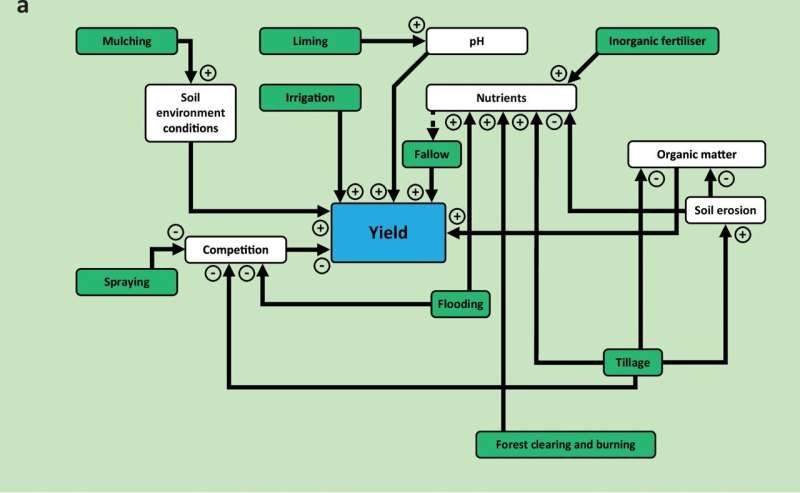
    Modern agriculture has given the world record food yields — but at a growing hidden cost. A major global study by Rothamsted Research warns that intensive farming methods are eroding the very soil systems that sustain human life, threatening long-term food security and environmental stability.

    Soil resilience — the capacity of soil to withstand, adapt to, and recover from stress — is collapsing under mounting pressure from plowing, fertilizer overuse, irrigation, and chemical pollution. These practices, while boosting short-term productivity, are silently degrading the earth’s most vital natural resource.

    Key Findings: The Erosion of Soil Resilience

    The review synthesized decades of global data and identified the biggest threats to soil health:

    1. Erosion — Accelerated by overplowing, overgrazing, and deforestation. Fertile topsoil that took centuries to form can vanish within years.

    2. Salinization — Caused by excessive irrigation and poor drainage, leaving salt residues that choke plant growth.

    3. Chemical contamination — Pesticides and plastic residues disrupt the microbial ecosystems essential for nutrient cycling.

    4. Soil compaction — Heavy machinery and livestock trampling compress the soil, reducing its aeration, water infiltration, and root penetration.

    Over time, these pressures lead to declining yields, pest outbreaks, loss of biodiversity, and increased vulnerability to drought and flooding — a cycle that threatens both livelihoods and the global food supply.

    Healthy Soil: The Hidden Engine of Life

    Soils support 95% of all food production and store more carbon than the world’s forests combined. When healthy, they act as carbon sinks, water filters, and biodiversity reservoirs. But when damaged, they release carbon dioxide, intensify floods, and contribute to climate change.

    Lead author Dr. Alison Carswell emphasizes:

    “Healthy, resilient soils are not just the foundation of food security — they are central to biodiversity and climate stability. Yet many practices we rely on today risk undermining that foundation for the future.”

    The Way Forward: Balancing Yield and Resilience

    The study acknowledges that not all intensive practices are harmful. Some — like liming acidic soils or flooding rice paddies — can sustain soil function if properly managed.

    Moreover, sustainable approaches can reverse damage:

    • 🌾 Conservation tillage to reduce erosion.

    • 🐞 Integrated pest management (IPM) to minimize chemical load.

    • 🌿 Crop rotation and cover cropping to rebuild organic matter.

    • 💧 Precision irrigation to manage salinity and conserve water.

    However, these solutions require trade-offs — balancing short-term profit with long-term ecological stability.

    The message is clear: soil must be managed as a living system, not a disposable input.

    A Global Warning

    The UN estimates that one-third of the world’s soils are already degraded, and the loss continues at rates that could jeopardize future food supplies — particularly in vulnerable regions of sub-Saharan Africa, South America, and Southeast Asia.

    If soil degradation continues unchecked, scientists warn of potential tipping points — moments when soil productivity collapses beyond recovery, leading to cascading effects on global trade, migration, and food prices.

    Breaking the Cycle

    Dr. Carswell concludes with urgency and hope:

    “Breaking the cycle of soil degradation is possible — but it requires rethinking how we manage land, not just for yields next season, but for resilience in the decades to come.”

    Key Takeaway

    The world’s food future depends not only on innovation above the ground but on restoring the life beneath it.
    Sustainable soil management is not optional — it’s the foundation of climate resilience, food security, and planetary health.

    References:
    Carswell, A., et al. (2025). Impacts of agricultural management practices in cropping systems in the short-term and in the long-term. npj Sustainable Agriculture. DOI: 10.1038/s44264-025-00098-6

  • Scientists Finally Prove Quantum Computers Can Unconditionally Outperform Classical Machines

    Scientists Finally Prove Quantum Computers Can Unconditionally Outperform Classical Machines

    A Landmark in Quantum Computing

    For decades, scientists have been chasing one elusive goal: unquestionable proof that quantum computers can outperform classical computers — not just in theory, but in real, measurable experiments.

    Now, a team led by researchers from The University of Texas at Austin (UT Austin) has achieved exactly that. Their new study, published on arXiv (2025), demonstrates a clear and unconditional quantum advantage, proving that no classical computer, regardless of future optimizations, can match the efficiency of their quantum setup.

    This result sets a new benchmark called quantum information supremacy, representing a profound leap forward in computing science.

    How the Quantum Challenge Was Designed

    To test quantum supremacy rigorously, the team created a communication game between two quantum “players”:

    • Alice, who prepares a quantum state (a message), and

    • Bob, who must measure it and predict its contents before Alice is done.

    This setup forces the system to rely on quantum memory — the ability of qubits to exist in superpositions, simultaneously holding multiple pieces of information.

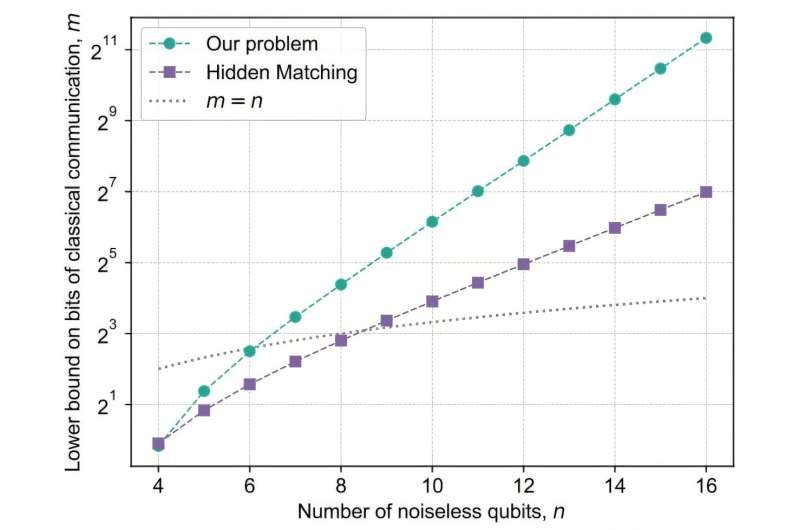
    Over 10,000 trials, the quantum processor demonstrated that it could perform the task with only 12 qubits, while a classical system would require at least 62 bits of memory to achieve the same result.

    That’s not just a difference in scale — it’s an exponential gap.

    Why This Matters: The Quantum Memory Breakthrough

    Previous claims of “quantum advantage” often depended on assumptions or computational conjectures — leaving open the possibility that faster classical algorithms might someday close the gap.

    This study, however, provides an unconditional mathematical proof. The researchers confirmed that the quantum device accessed parts of the Hilbert space (the vast multidimensional space where quantum states exist) that classical computers fundamentally cannot reach.

    In their own words:

    “Our result provides the most direct evidence yet that currently existing quantum processors can generate and manipulate entangled states of sufficient complexity to access the exponentiality of Hilbert space.”

    In essence, quantum computers have now demonstrated they can do things classical computers simply cannot — ever.

    What Does This Mean for the Future?

    This proof of true quantum superiority isn’t just theoretical — it paves the way for revolutionary real-world applications:

    • 🔐 Next-generation cryptography: Ultra-secure communication protocols based on quantum keys.

    • 💊 Drug discovery: Modeling molecular interactions far too complex for classical simulations.

    • ⚙️ Materials science: Designing superconductors, catalysts, and nanostructures faster than ever before.

    • 🧮 Optimization problems: Solving logistics, finance, and data-mining challenges exponentially faster.

    By fully unlocking quantum memory, researchers have opened a door to computing beyond human imagination — and perhaps, beyond classical physics as we know it.


    A New Era: From Quantum Promise to Quantum Proof

    This experiment confirms what quantum theorists have long anticipated: quantum information is a fundamentally different resource — one that grows exponentially, not linearly.

    The distinction between classical and quantum computation is now no longer philosophical or potential — it is proven.

    As researchers continue to refine qubit stability, reduce noise, and expand system size, this demonstration will stand as the moment when quantum computing truly stepped out of theory and into verified reality.


    Key Takeaway

    Quantum supremacy has now crossed from speculation to certainty — marking a turning point in the history of computation. The age of unconditional quantum advantage has begun.


    References
    Arnold, P. (2025). Scientists have finally proven that a quantum computer can unconditionally outperform classical computers. Phys.org.
    arXiv preprint: 10.48550/arxiv.2509.07255

  • 🌊 How the Red Sea Went Completely Dry — and Was Later Reborn by a Catastrophic Flood

    🌊 How the Red Sea Went Completely Dry — and Was Later Reborn by a Catastrophic Flood

    A Sea that Vanished—and Then Returned

    More than 6 million years ago, the Red Sea — one of the world’s youngest and most unique marine environments — completely dried up. What today is a deep, vibrant sea bordered by coral reefs was once a vast salt desert, barren and lifeless.

    Now, scientists from King Abdullah University of Science and Technology (KAUST) have confirmed that around 6.2 million years ago, a catastrophic flood from the Indian Ocean breached a volcanic ridge near the Bab el-Mandab Strait, refilling the empty basin in a geological instant — roughly within 100,000 years.

    Uncovering a Geological Catastrophe

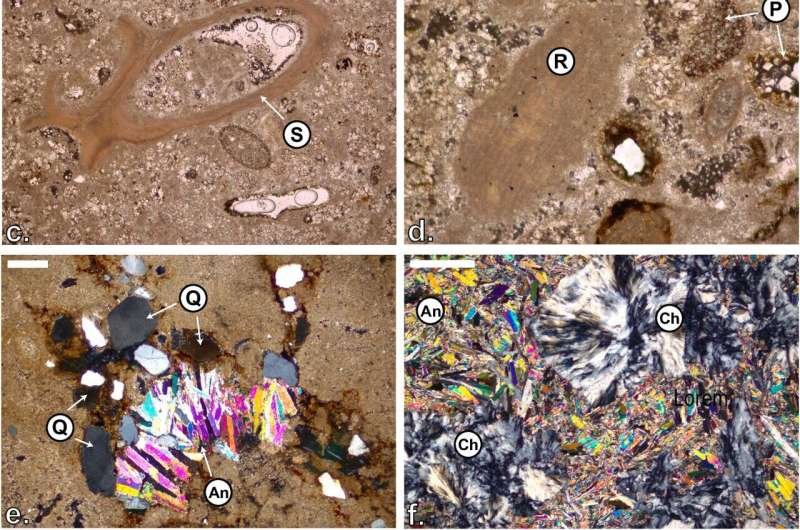
    The research team used seismic imaging, microfossil records, and geochemical dating to trace the dramatic transformation.

    Before the flood, the Red Sea had been isolated from the Mediterranean Sea and slowly evaporated under intense heat, leaving behind thick layers of salt, gypsum, and anhydrite. Then, a sudden breakthrough in the south triggered a massive flood, cutting a 320-kilometer-long submarine canyon—a scar still visible on the seafloor today.

    Lead author Dr. Tihana Pensa describes it as “one of the most extreme environmental events on Earth — a total desiccation followed by an ocean-scale reflooding.”

    A Timeline of the Red Sea’s Transformation

    • ~30 million years ago: The Arabian and African plates began to separate, forming a rift valley.

    • ~23 million years ago: The area was flooded by the Mediterranean, becoming a narrow marine gulf.

    • 15–6 million years ago: Isolation increased, salinity spiked, and marine life died off; the basin filled with salt deposits.

    • ~6.2 million years ago: A volcanic barrier near the Hanish Islands collapsed, unleashing the Indian Ocean flood that refilled the basin.

    • <100,000 years: The Red Sea was reborn, restoring marine conditions and biodiversity.

    This event predates the Zanclean flood that refilled the Mediterranean by almost a million years — giving the Red Sea its own, lesser-known “flood of rebirth.”

    Why It Matters

    The Red Sea is not just a body of water — it’s a natural archive of Earth’s tectonic, climatic, and oceanic evolution.

    Its sediments and fossils tell stories about:

    • How new oceans form through continental rifting.

    • How salt giants (massive evaporite deposits) accumulate during desiccation.

    • How life adapts to extreme environmental collapse and recovery.

    As co-author Professor Abdulkader Al Afifi explains, this research reinforces KAUST’s position as a global leader in Red Sea studies and sheds light on “the processes that form and expand oceans on Earth.”

    A Lesson in Planetary Resilience

    The Red Sea’s rebirth serves as a striking reminder of Earth’s dynamic balance — how cataclysmic change can give rise to new beginnings. Today’s coral reefs, seagrass meadows, and unique ecosystems exist because of that ancient flood, transforming a desolate salt basin into one of the planet’s most vibrant marine sanctuaries.

    The Red Sea stands as a living monument to resilience — proof that even after total desiccation, life and oceans can return, reshaping our understanding of Earth’s geological and biological cycles.

    References:

    • Pensa, T., Al Afifi, A., et al. (2025). The Red Sea dried out and was reflooded by the Indian Ocean ~6.2 million years ago. Communications Earth & Environment. DOI: 10.1038/s43247-025-02642-1.

    • King Abdullah University of Science and Technology (KAUST) Press Release.

  • Bearded Vultures: Nature’s Accidental Archaeologists

    Bearded Vultures: Nature’s Accidental Archaeologists

    A recent study published in Ecology (2025) has unveiled an extraordinary discovery hidden high in the cliffs of southern Spain — ancient Bearded Vulture nests containing centuries-old cultural artifacts, some dating back more than 650 years.

    The Bearded Vulture (Gypaetus barbatus), a rare and majestic scavenger of Europe’s mountain ranges, is already known for its peculiar habits. It feeds mostly on bones, builds massive nests out of sticks and wool, and reuses these cliffside homes for generations. But what researchers uncovered between 2008 and 2014 reveals that these birds might also be unexpected custodians of human history.

    A Window Into the Past

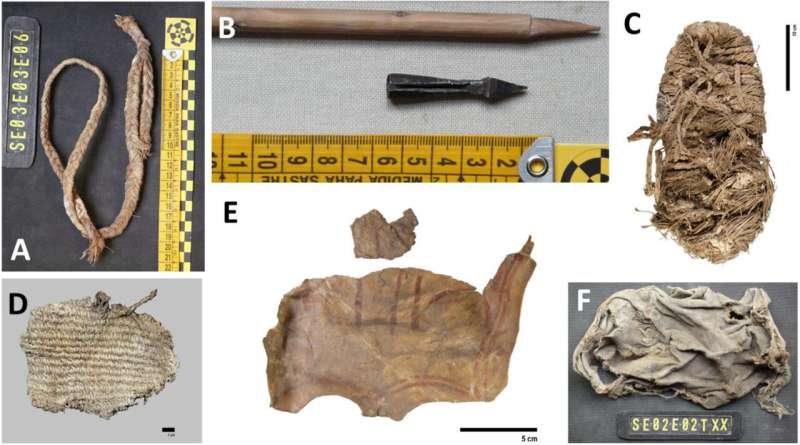
    In a detailed archaeological-style excavation of 12 ancient vulture nests, scientists unearthed 226 human-made artifacts — including woven sandals, a crossbow bolt, a decorated piece of leather, and a wooden lance. Carbon-14 dating placed some items as far back as the 14th century, effectively transforming these nests into natural time capsules of Mediterranean life.

    The Perfect Preservation Chambers

    The caves and rock shelters where these birds nest are typically dry, cool, and protected — ideal for preserving organic materials that would normally decay. The nests, layered with droppings and debris accumulated over centuries, acted like mini-museums, maintaining not only the vultures’ biological traces (bones, hooves, eggshells) but also clues to human activity across time.

    Bridging Ecology and Anthropology

    Beyond the fascination of finding medieval footwear in a bird’s nest, this discovery carries deeper scientific significance. The remains provide valuable data on ecological shifts, animal diversity, and human presence in the region over hundreds of years. The researchers note that such sites could help scientists reconstruct past ecosystems, informing modern conservation and reintroduction efforts for endangered species like the Bearded Vulture.

    Nature as an Unlikely Historian

    This study challenges us to see nature not just as a living system but as a long-term archive of human and environmental interaction. The Bearded Vulture, unwittingly collecting fragments of human life in its nesting rituals, becomes both a symbol of ecological resilience and a partner in preserving history.


    Reflection

    The discovery reminds us that the boundary between human and natural history is far thinner than we often imagine. Just as archaeologists dig through ruins to uncover civilization’s past, ecologists can now turn to the animal world — where centuries of nesting, hunting, and scavenging quietly document stories of both species and societies.


    Sources:
    Kasal, K. (2025). Bearded Vulture nests found to have hoards of cultural artifacts—some up to 650 years old. Phys.org.
    Published in Ecology (2025), DOI: 10.1002/ecy 70191.

  • 🌾 Kenya’s Agriculture in 2025: Growth, Productivity, and Climate Challenges

    🌾 Kenya’s Agriculture in 2025: Growth, Productivity, and Climate Challenges

    The National Agriculture Production Report (2025) paints a picture of a recovering yet uneven sector.
    Agriculture remains Kenya’s economic backbone, contributing roughly 22.5% of GDP in 2024, and employing over 60% of the labor force, either directly or indirectly.

    While key cash crops showed strong gains, staple food crops suffered from erratic weather — underlining Kenya’s ongoing struggle with climate-sensitive food systems.

    Overall Sector Performance

    Year Agriculture GDP Growth (%) Marketed Production (KSh Billion) Sector Share of GDP (%)
    2023 7.1 643.0 23.1
    2024 4.4 690.0 22.5

    Agricultural output grew by 4.4% in 2024, supported by tea, sugarcane, and dairy recovery.
    Growth slowed from 7.1% in 2023 due to maize losses, reduced horticultural exports, and input cost constraints.

    Crop Performance Summary (2024 vs 2023)

    Crop Unit 2023 2024 % Change Comment
    Maize Million bags 47.6 44.7 –6.1% Erratic rains lowered yields in key regions (Rift Valley, Eastern).
    Wheat ’000 tonnes 309.5 312.2 +0.9% Minor recovery from mechanized farming in Narok & Uasin Gishu.
    Rice ’000 tonnes 229.1 282.2 +23.2% Irrigation expansion at Mwea and Ahero boosted output.
    Green Leaf Tea ’000 tonnes 2,577.8 2,687.2 +4.2% Favorable rainfall and input subsidy support.
    Coffee ’000 tonnes 48.7 49.5 +1.6% Higher cherry prices and cooperative reforms.
    Sugarcane ’000 tonnes 5,550.7 9,365.3 +68.7% Drastic recovery after factory reopenings and cane replanting.
    Fresh Horticultural Produce ’000 tonnes 468.4 402.2 –14.1% EU market rejections and pest outbreaks affected exports.

    Interpretation:
    Production gains in high-value cash crops balanced the fall in cereals. The expansion of irrigation and input subsidy programs under the National Agriculture Value Chain Development Project (NAVCDP) proved vital in mitigating weather impacts.


    Livestock and Dairy Subsector

    Indicator 2023 2024 % Change
    Milk Sold Centrally (Mn Litres) 806.6 908.4 +12.6%
    Beef Production (’000 Tonnes) 156.1 164.3 +5.3%
    Poultry Production (’000 Tonnes) 171.8 182.0 +5.9%
    Egg Production (Mn) 2,896.2 3,051.4 +5.4%

    Dairy remains Kenya’s strongest-performing livestock segment, supported by:

    • Cooler weather in the Rift Valley and Central Kenya.

    • Increased uptake of artificial insemination (AI) and feed fortification.

    • Government’s Dairy Industry Revitalization Strategy (2024–2028).

    Fisheries and Aquaculture

    Source 2023 Quantity (Tonnes) 2024 Quantity (Tonnes) % Change Value (KSh Million)
    Inland Capture 108,000 109,600 +1.5% 25,480
    Marine Capture 8,500 9,200 +8.2% 3,250
    Aquaculture 44,800 49,600 +10.7% 10,896

    🎣 Fish output increased to 168,400 tonnes (KSh 39.6 billion) — a 5.1% rise — thanks to enhanced fish farming and enforcement against illegal fishing in Lake Victoria.

    Climate and Environmental Factors

    • Average annual rainfall: 1,126 mm (↑ from 1,050 mm in 2023).

    • Forest cover: 8.83% of total land mass — still below the 10% constitutional target.

    • Soil degradation: Persistent in semi-arid counties; 26% of arable land classified as moderately degraded.

    • Irrigation area expanded: From 520,000 ha to 570,000 ha (+9.6%).

    Climate-smart agriculture programs (CSA) under the Kenya Climate-Smart Agriculture Project (KCSAP) increased resilience, but yield gains were offset by locust infestations and pest resurgence in dry areas.


    Regional Contributions to Agricultural Output (2024)

    Region % of National Output Key Commodities
    Rift Valley 34% Maize, Wheat, Milk
    Central 22% Tea, Dairy, Coffee
    Western 14% Sugarcane, Fish
    Eastern 11% Fruits, Pulses, Livestock
    Nyanza 10% Horticulture, Fish
    Coastal 9% Coconuts, Cashew, Aquaculture

    The Rift Valley and Central regions continued to dominate total production, but Western Kenya’s sugar revival marked one of the year’s standout improvements.


    Policy Implications and Economic Insights

    Policy Area Observation Recommendation
    Food Security Reduced maize and horticultural output affected supply chains. Expand irrigation and drought-resistant seed distribution.
    Agro-Industry Linkages Agro-processing remains below potential; 20% of produce is still unprocessed. Incentivize local value addition through tax rebates and credit access.
    Market Access EU rejections affected horticulture; limited cold-chain capacity. Strengthen Kenya Plant Health Inspectorate (KEPHIS) standards and invest in cold storage logistics.
    Climate Resilience Overreliance on rainfall remains a risk. Scale up CSA and water-harvesting infrastructure.
    Financial Inclusion Only 34% of smallholders accessed formal credit in 2024. Expand crop insurance and mobile-based lending models.

    Outlook for 2025–2026

    Indicator Projection Direction
    Agriculture GDP Growth 5.0–5.3% ↑ Moderate recovery expected
    Export Earnings (Agri) KSh 1.05 Trillion ↑ Driven by tea and coffee
    Irrigated Land Area 600,000 ha ↑ Ongoing NAVCDP expansion
    Food Inflation 3.8–4.2% Stable unless drought reemerges
    Livestock Output +8–10% Supported by feed subsidy and disease control

    Conclusion

    Kenya’s agricultural sector in 2024 demonstrated strength in diversity but weakness in dependence.
    While traditional cash crops and dairy showed resilience, food staples and horticulture underscored structural issues — rainfall dependency, limited mechanization, and market inefficiencies.

    If current policy momentum in irrigation, climate-smart farming, and agribusiness value chains is sustained, 2025–2026 could mark a transition toward modernized, climate-resilient, and export-competitive agriculture.

    DatalytIQs Academy Insight

    Students and researchers can use this report to:

    • Build agricultural output trend models (2020–2025).

    • Perform sectoral contribution analyses to GDP.

    • Examine linkages between rainfall, production, and inflation using regression modeling.

    • Design policy briefs on Kenya’s path to sustainable agri-industrial transformation.

  • Kenya’s Economic Landscape 2025: A Deep-Dive Analysis of the KNBS Economic Survey

    Kenya’s Economic Landscape 2025: A Deep-Dive Analysis of the KNBS Economic Survey

    The KNBS Economic Survey 2025 provides a clear, data-driven view of how Kenya performed economically in 2024, covering growth, employment, inflation, trade, fiscal policy, and sectoral performance. The numbers tell a story of resilience amid global headwinds, but also of structural vulnerabilities that demand reform.

    Macroeconomic Performance at a Glance

    Indicator 2023 2024 Change Interpretation
    Real GDP Growth 5.7% 4.7% ↓ –1.0 pp Growth slowed due to mixed weather and weaker manufacturing.
    GDP (Current Prices) KSh 15.0 Trillion KSh 16.2 Trillion ↑ +8.0% Nominal growth steady; economy expanding in size and scope.
    Inflation (CPI) 7.7% 4.5% ↓ –3.2 pp Inflation was contained via improved food supply and stable fuel prices.
    CBR (Policy Rate) 12.5% 11.3% ↓ –1.2 pp CBK eased slightly after tightening to curb 2023 inflation.
    Exchange Rate (KES/USD) 139.8 134.8 ↑ +3.6% The shilling stabilized on reduced import demand and higher remittances.
    GDP Per Capita KSh 291,769 KSh 309,460 ↑ +6.0% Real income per person improved modestly.

    Interpretation:
    Kenya’s macroeconomic fundamentals remained stable — low inflation, modest growth, and a narrowing trade deficit — despite global volatility. Fiscal ratios improved, but public debt remains high relative to GDP.


    Fiscal and Monetary Trends

    Fiscal Indicator 2023/24 2024/25 Trend
    Revenue as % of GDP 20.0% 20.0% Steady
    Expenditure as % of GDP 26.4% 26.4% High, driven by debt service
    Net Lending/Borrowing as % of GDP –6.3% –6.3% Persistent fiscal deficit
    VAT Collections (2024/25) KSh 0.7 Trillion Main revenue source
    Public Debt Transactions KSh 703 Billion Reflects high debt service load

    Interpretation:
    Fiscal consolidation remains slow. Kenya’s expenditure still outpaces revenue, primarily due to debt repayments and social spending. Maintaining a primary surplus remains key for medium-term debt sustainability.


    External Sector and Trade

    Indicator 2023 2024 Trend
    Total Trade KSh 3.62 Trillion KSh 3.82 Trillion ↑ +5.5%
    Exports (FOB) KSh 906.3 B KSh 932.1 B ↑ +2.9%
    Imports (CIF) KSh 2.61 T KSh 2.71 T ↑ +3.6%
    Trade Balance –KSh 1.60 T –KSh 1.59 T ↔ Slight improvement
    Export-Import Ratio 38.6% 41.1% ↑ Better coverage

    Top Exports (2024):

    • Tea – KSh 203.6B

    • Horticulture – KSh 189.1B

    • Apparel – KSh 56.8B

    • Coffee – KSh 38.4B

    • Edible Oils – KSh 30.3B

    Top Imports (2024):

    • Petroleum products – KSh 552.4B

    • Machinery – KSh 312.9B

    • Fats and Oils – KSh 139.2B

    • Plastics and Iron/Steel – KSh 113.4B, 101.8B

    Interpretation:
    Kenya’s export sector is recovering, with tea and apparel leading growth. However, reliance on imported energy and machinery continues to weigh on the balance of trade.


    Sectoral Performance Snapshot

    Sector 2023 Growth 2024 Growth Observation
    Agriculture 7.1% 4.4% Slowed due to maize declines; tea, sugarcane, and rice improved.
    Manufacturing 2.2% 2.8% Gradual rebound from supply shocks.
    Construction 2.9% 2.8% Slight slowdown; credit to the sector declined.
    Services (Overall) 5.3% 5.5% Led GDP growth through trade, ICT, and finance.
    Tourism +19% arrivals +14.7% arrivals Strong recovery post-pandemic.
    Energy Generation 13,400 GWh 14,100 GWh ↑ +5.1% from new hydro and geothermal capacity.

    Employment, Earnings, and Wages

    • Formal sector employment grew 2.4% to 3.4 million jobs (2024).

    • Private sector wage bill: KSh 2.1 trillion (+7.3%).

    • Public sector wage bill: KSh 881 billion (+5.8%).

    • Informal employment: Dominates at 83.6% (17.4 million workers).

    • Annual inflation: 4.5% — real wages remain nearly flat.

    Implication: Job creation remains slower than population growth. The informal sector continues to absorb the majority of new labor entrants.

    Policy Interpretation & Economic Lessons

    Monetary and Fiscal Coordination

    • CBK’s cautious stance effectively contained inflation without suppressing growth.

    • Fiscal policy, however, remains expansionary, increasing pressure on interest rates.

    External Sector

    • The slight improvement in the balance of payments (–KSh 208.9B) reflects higher remittances and service exports.

    • Need for export diversification beyond traditional commodities.

    Industrial Policy

    • Manufacturing’s 2.8% growth signals recovery but is still below Vision 2030 goals (10% GDP share).

    • Incentivizing local production and reducing input costs through energy and transport reforms are key.

    Agriculture and Climate

    • Crop diversification and irrigation investment are crucial to mitigate rainfall dependency.

    • The sharp 68.7% jump in sugarcane output shows potential for domestic value addition.

    Digital & Financial Transformation

    • ICT output reached KSh 701 billion, driven by mobile money transactions worth KSh 21.9 trillion — a core driver of financial inclusion.

    • Kenya remains a regional fintech leader, but must strengthen cybersecurity, as online crimes surged in 2024.


    Outlook: 2025–2026

    Indicator Projection Trend
    GDP Growth 5.1–5.4% Stable recovery led by services and construction.
    Inflation 4.2–4.8% Within the CBK target range.
    Exchange Rate KES 155–158/USD Expected mild depreciation.
    Trade Deficit ~KSh 1.55 Trillion Gradual narrowing.
    Fiscal Deficit 5.3% of GDP Slowly improving.

    Conclusion

    Kenya’s 2025 Economic Survey shows a maturing, stabilizing economy.
    Growth has slowed but remains broad-based, inflation is controlled, and structural reforms are starting to yield results. The challenge now lies in translating macro stability into inclusive growth — tackling poverty, joblessness, and inequality while fostering investment-led productivity.

    DatalytIQs Academy Insight

    Students of Macroeconomics, Fiscal Policy, and Development Economics can use this report to:

    • Conduct time-series GDP growth and inflation trend analysis.

    • Apply Keynesian and monetarist frameworks to interpret fiscal-monetary coordination.

    • Model sectoral elasticity of GDP using KNBS data.

    • Develop policy case studies on trade diversification and fiscal consolidation.

  • Kenya’s Economic Pulse: Analysis of Leading Indicators (June 2025)

    Kenya’s Economic Pulse: Analysis of Leading Indicators (June 2025)

    The Kenya National Bureau of Statistics (KNBS) Leading Economic Indicators (LEI) for June 2025 offer a detailed snapshot of the country’s macroeconomic performance midway through the year.
    The data confirm Kenya’s steady post-pandemic recovery, anchored by resilient agriculture, expanding services, and cautious monetary management by the Central Bank of Kenya (CBK).


    Key Statistical Highlights

    Indicator June 2024 June 2025 % Change Economic Interpretation
    Real GDP Growth (Q2 est.) 4.8 % 5.1 % ▲ +0.3 pp Modest acceleration driven by services, agriculture, and construction.
    12-Month Inflation Rate 7.2 % 3.8 % ▼ –3.4 pp Inflation halved due to stable fuel prices, improved food supply, and CBK’s 9.5 % policy rate.
    Exchange Rate (KES/USD) 157.5 155.8 ▲ +1.1 % The shilling strengthened slightly, reflecting lower import demand and higher remittances.
    Current Account Balance –KSh 96 B –KSh 84 B ▼ 12.5 % Smaller deficit—export earnings and tourism receipts improved.
    Tea Export Volume (MT) 45.2 k 50.6 k ▲ +11.9 % Tea output recovery after favorable rainfall and lower fertilizer costs.
    Tourist Arrivals (’000) 128.1 147.6 ▲ +15.2 % Tourism rebound supported by regional travel and conferencing.
    Electricity Generation (GWh) 1,122 1,186 ▲ +5.7 % Expanding geothermal capacity; stable industrial energy demand.
    Broad Money (M3, KSh B) 4,821 5,064 ▲ +5.0 % Reflects credit growth, especially in trade and manufacturing.
    Nairobi Securities Exchange (NSE-20 Index) 1,630 1,768 ▲ +8.5 % Renewed investor confidence; lower inflation boosted equity prices.

    Interpretation of the Data

    🔹 a) Output and Demand

    The economy expanded by 5.1 % in Q2 2025, a slight improvement over the previous year’s pace.
    Agriculture and services remain dominant, jointly accounting for nearly two-thirds of GDP.
    The manufacturing sector, though still under pressure from high energy costs, showed marginal gains due to increased domestic demand and regional exports.

    🔹 b) Inflation and Monetary Policy

    The dramatic fall in inflation—from 7.2 % to 3.8 %—underscores the CBK’s effective inflation-targeting framework.
    A stable policy rate of 9.5 % maintained price stability without choking credit growth.
    Food prices normalized after improved harvests, while fuel prices eased on global markets.

    🔹 c) External Sector

    Kenya’s current-account deficit narrowed to KSh 84 billion, driven by:

    • Rising tea, coffee, and horticultural exports,

    • A surge in tourism receipts, and

    • Sustained diaspora remittances (≈ US$460 million monthly).

    Nevertheless, dependence on imported petroleum and industrial machinery continues to strain the trade balance.

    🔹 d) Financial and Capital Markets

    The NSE-20 Index gained 8.5 % year-on-year, reflecting a rebound in investor confidence.
    Broad money growth (M3 ↑ 5 %) signals healthy liquidity, though the CBK must monitor potential asset-price pressures.
    Commercial bank lending rates averaged 15 %, slightly above 2024 levels but manageable for corporate borrowers.

    🔹 e) Employment and Real Sector Activity

    Employment growth was strongest in agriculture, trade, and tourism, while manufacturing employment remained stagnant.
    Electricity generation (+5.7 %) implies expanding industrial capacity utilization, consistent with real-sector recovery.


    Analytical Takeaways for DatalytIQs Academy Learners

    1. GDP–Inflation Dynamics:
      Kenya illustrates a case of non-inflationary growth—output rising while inflation falls. Students can model this relationship using the Phillips curve or output gap analysis.

    2. Exchange-Rate Management:
      The near-stable shilling reflects coordinated fiscal-monetary policy and demonstrates the role of FX reserves in stabilizing open economies.

    3. Sectoral Contribution Analysis:
      With agriculture and services leading, learners can construct sectoral GDP decomposition charts or apply growth-accounting techniques to quantify contributions.

    4. Capital Market Response:
      The NSE performance shows how macro stability directly improves equity valuations—an application for finance and econometrics students studying monetary transmission to markets.


    Policy Implications

    Policy Area Recommended Action Expected Impact
    Monetary Policy Maintain current CBR at 9.5 %, monitor credit expansion. Preserve price stability while sustaining growth.
    Fiscal Policy Enhance revenue efficiency and contain recurrent spending. Reduce pressure on domestic borrowing and crowding-out.
    Trade & Industry Expand export diversification (manufacturing, digital services). Narrow current-account gap and boost foreign-exchange inflows.
    Energy & Infrastructure Continue geothermal and green-energy investments. Lower production costs, attract manufacturing FDI.
    Social Policy Strengthen vocational training and rural enterprise support. Tackle unemployment and income inequality.

    Economic Outlook (H2 2025 – 2026)

    • Real GDP: Projected to average 5.2–5.5 % through 2026 if macro stability persists.

    • Inflation: Expected to remain around 4.5 %, contingent on food and fuel prices.

    • Exchange Rate: Stable within KES 155–158 per USD.

    • Key Risks: Global oil price shocks, climate variability, and slower global demand.

    Conclusion

    Kenya’s mid-2025 indicators tell a story of balance and cautious optimism.
    Macroeconomic fundamentals remain sound—growth steady, inflation contained, and external imbalances easing.
    Yet, to translate stability into broad prosperity, Kenya must deepen structural transformation, foster inclusive industrialization, and strengthen human-capital development.