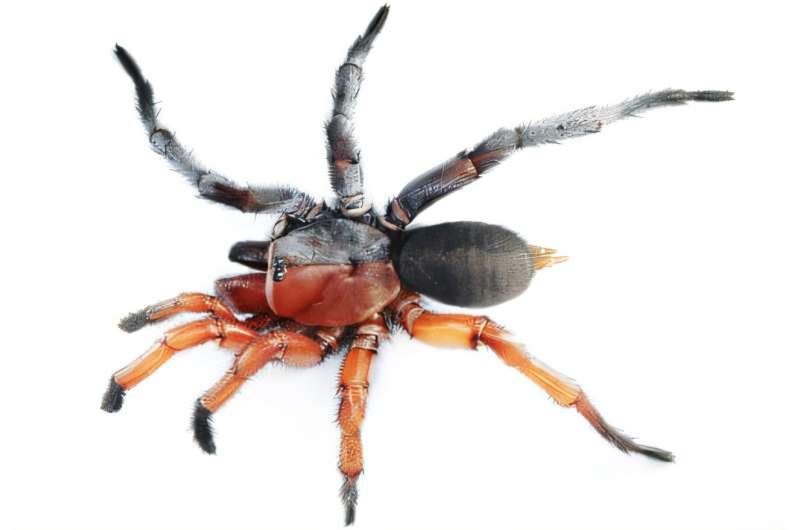
In the quiet forests of Kanchanaburi, western Thailand, researchers have uncovered something extraordinary — a new species of spider that has stunned arachnologists not only for its striking colors and structure but also for a rare intersex condition found in one of its specimens.
The discovery, made near Nong Rong in Phanom Thuan District, was recently published in the journal Zootaxa and represents both a new species in the genus Damarchus and the first-ever reported gynandromorph in the spider family Bemmeridae.
A Hidden Treasure in Thailand’s Forests
The newly found spiders were first presented to researchers at the Chulalongkorn University Museum of Natural History, where a detailed morphological analysis began. Using a stereomicroscope, the team compared the specimens with known members of the genus Damarchus — a group of mygalomorph spiders known for building distinctive “wishbone”-shaped burrows that open into the ground.
While molecular data have not yet fully confirmed their taxonomic placement, all evidence so far suggests that this new species belongs to Damarchus, a genus spread across South and Southeast Asia.
Male and Female Worlds Apart
One of the most fascinating features of this discovery lies in the dramatic sexual dimorphism — the visible differences between male and female spiders.
-
🕷️ Males measure around 0.6 inches long, are gray in color, and are coated in a mysterious white substance whose composition remains unknown. When preserved in alcohol, they turn a reddish-brown hue.
-
🕸️ Females, on the other hand, grow to about 1 inch, display a bright orange coloration, and lack the white coating entirely.
These contrasts are not merely cosmetic — they hint at different ecological behaviors or mating adaptations yet to be studied.
The Gynandromorph: Half-Male, Half-Female
Among the collected specimens was one that stood out as truly exceptional — a gynandromorph, an organism divided between male and female characteristics along a perfect midline.
Unlike hermaphrodites, which possess both sex organs but retain bilateral symmetry, gynandromorphs are split right down the middle, with one side appearing male and the other female. In this spider, the left side displayed the orange hue of the female, while the right side bore the white coloration of the male — a vivid, living expression of biological duality.
A Name Inspired by Anime and Biology
The species has been named Damarchus inazuma sp. nov. — “Inazuma”, after the gender-fluid character from the Japanese manga One Piece. Inazuma’s ability to change between male and female perfectly mirrors the bilateral asymmetry seen in this unique spider.
“The color arrangement closely mirrors the sexual dimorphism observed in this species,” the authors wrote, noting that the orange and white color split reflects the biological differences between males and females in the species.
A Rare Genetic Mystery
This is only the third recorded case of gynandromorphism in mygalomorph spiders — and the first within the Bemmeridae family. Earlier cases were reported in the Theraphosidae (tarantula) family.
The underlying cause of this condition remains uncertain. The authors suggest, referencing earlier work by arachnologist Benjamin Kaston, that gynandromorphism might result from chromosomal irregularities, such as the loss of one or more X chromosomes in a developing female zygote. Such genetic disruptions could be influenced by environmental stressors or infections — including those caused by nematodes.
Regardless of the cause, the finding highlights the complexity of biological development and the intricate dance of chromosomes that determine sex in living organisms.
Why It Matters
This discovery adds not just a new species to science but a rare biological phenomenon that expands our understanding of sex differentiation, genetic mutation, and biodiversity in Southeast Asia.
It underscores how much of Earth’s biodiversity remains unexplored — and how even small forest patches can hide species that defy expectations.
From a scientific standpoint, Damarchus inazuma will help deepen studies on genetic development, arachnid taxonomy, and the evolutionary mechanisms that lead to such unusual conditions.
And from an artistic perspective — as its name and coloration suggest — it’s a reminder that nature’s creativity rivals even the most imaginative fiction.
Citation & Acknowledgments
Source Article:
Kasal, K. (2025). “Rare intersex spider among new species discovered in Thailand.” Phys.org.
Edited by: Gaby Clark
Reviewed by: Robert Egan
Original Study: Zootaxa (2025). DOI: 10.11646/zootaxa 5696.3.6
Institution: Chulalongkorn University Museum of Natural History, Thailand
Author: Collins Odhiambo — DatalytIQs Academy Life Sciences & Biodiversity Blog
Category: Zoology & Genetics










You must be logged in to post a comment.