In a stunning breakthrough for astrophysics, astronomers have identified what may be the most pristine star ever observed — a rare cosmic relic that offers a direct glimpse into the universe’s earliest moments after the Big Bang.
The discovery, led by Dr. Alexander Ji and his team at the University of Chicago, focuses on a red giant known as SDSS J0715−7334. This ancient star, found in the outskirts of the Milky Way, is believed to have formed from nearly untouched cosmic material — hydrogen, helium, and just trace amounts of lithium — before heavier elements ever dominated the universe.
A Window into the First Generation of Stars
To understand why this discovery is so significant, it helps to recall how stars evolve. The first stars, often called Population III stars, were born from the primordial gases that filled the universe soon after the Big Bang. Inside their blazing cores, these stars fused lighter elements into heavier ones — a process known as stellar nucleosynthesis. When they exploded as supernovae, they scattered these newly forged elements, seeding future generations of stars with heavier materials like iron, carbon, and oxygen.
Over cosmic time, this process enriched the interstellar medium, meaning every new generation of stars contained more heavy elements — what astronomers refer to as higher metallicity. But SDSS J0715−7334 stands out because it seems to have escaped this enrichment.
The Most Metal-Poor Star Ever Found
The research team’s spectroscopic analysis revealed that SDSS J0715−7334’s total metallicity — symbolized as Z — is less than 7.8 × 10⁻⁷, making it the most metal-poor star known. For comparison, the previous record-holder, J1029+1729, had a metallicity of about 1.4 × 10⁻⁶, while another famous low-iron star, SMSS J0313−6708, still contained over ten times more heavy elements than this newly discovered relic.
What’s even more astonishing is that SDSS J0715−7334 also shows extremely low carbon content. This combination of low iron and low carbon makes it a truly exceptional find, potentially marking it as a direct descendant of a single massive Population III supernova — likely one from a star around 30 times the mass of our Sun.
A Journey from the Large Magellanic Cloud
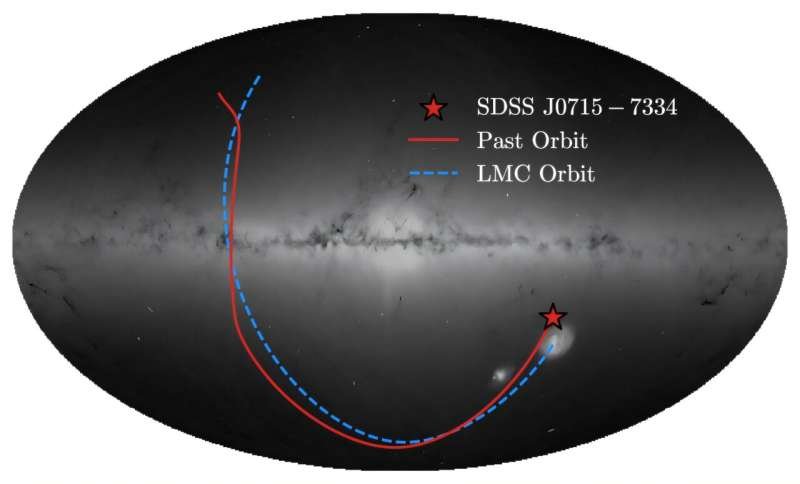
Using Gaia spacecraft data and advanced orbital modeling, the team traced SDSS J0715−7334’s movement and found that it most likely originated in the Large Magellanic Cloud (LMC) — a small satellite galaxy orbiting the Milky Way. At some point in its long journey, gravitational interactions appear to have pulled it into our galaxy’s outer halo.
This finding adds an intriguing twist to the story: not only is this the most pristine star known, but it may have migrated across galaxies, carrying with it an untouched record of early cosmic chemistry.
Cooling the Early Universe: Dust, Not Metals
Another remarkable insight from this discovery involves how such ancient stars formed in the first place. Normally, gas clouds cool and condense more efficiently when heavy elements are present because they help radiate away energy. Yet SDSS J0715−7334 exists below the “fine structure cooling threshold” — a critical point where traditional cooling via heavy elements becomes impossible.
This means that dust particles may have played a key role instead, enabling early gas clouds to lose heat and collapse into stars even in environments nearly devoid of metals. This supports the idea that “dust cooling” was crucial for the formation of low-metallicity stars in the early universe — and that similar processes might occur in other galaxies beyond the Milky Way.
A Living Fossil from the Dawn of Time
SDSS J0715−7334 is more than just a star — it’s a cosmic time capsule. Its composition preserves evidence of how the very first stars lived, died, and gave birth to the complex, element-rich universe we inhabit today. Each observation of such pristine stars brings us closer to understanding the conditions that shaped the first galaxies, first elements, and ultimately, the origin of life itself.
As Dr. Ji’s team notes, “J0715−7334 is an especially clean probe of Population III, as its distant halo orbit completely precludes significant surface contamination from the interstellar medium.” In other words, it is as close as astronomers have ever come to studying pure, unpolluted starlight from the dawn of creation.
Citation & Acknowledgments
Source Article:
Kasal, K. (2025). “Astronomers discover the most ‘pristine’ star in the known universe.” Phys.org.
Edited by Gaby Clark, reviewed by Robert Egan.
Research by Alexander Ji et al., University of Chicago.
Data: Gaia Mission, arXiv Preprint Server (2025).
Author: Collins Odhiambo – DatalytIQs Academy Science & Space Blog
Category: Astronomy & Cosmology
Leave a Reply
You must be logged in to post a comment.