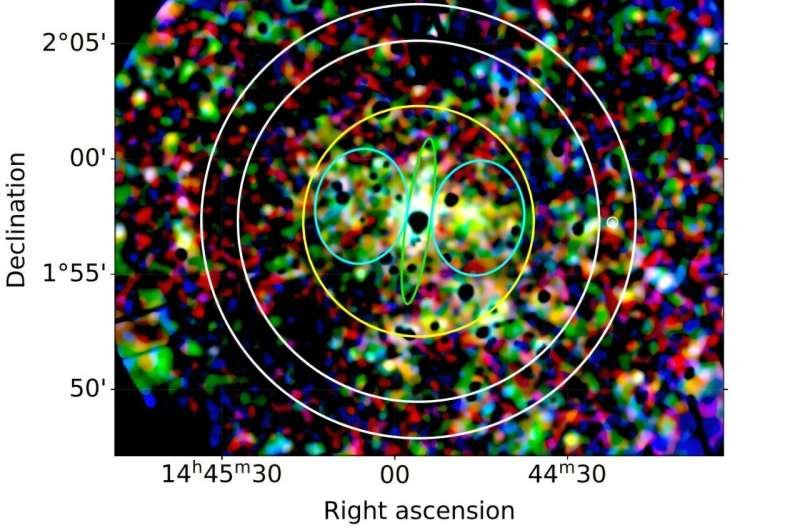
XMM-Newton’s deep-space view uncovers a vast X-ray halo and signs of past stellar activity in a massive spiral galaxy.
Astronomers using the European Space Agency’s XMM-Newton satellite have discovered a hot gaseous outflow extending from the massive spiral galaxy NGC 5746.
This new observation reveals a vast halo of diffuse, high-temperature plasma and two massive hot bubbles stretching tens of thousands of light-years above and below the galaxy’s plane — a sign of an ancient galactic wind that once blew through the system.
The findings, posted on October 1, 2025, to the arXiv preprint server (DOI: 10.48550/arxiv.. 2510.00868), promise to deepen our understanding of how galactic outflows regulate star formation and evolution in large spiral galaxies like our own Milky Way.
A Massive Galaxy on the Edge
Located about 94.5 million light-years away, NGC 5746 is a barred spiral galaxy seen almost edge-on from Earth — a vantage point that provides an ideal view of its disk and halo.
With a stellar mass between 110 and 130 billion Suns, NGC 5746 is a true giant, forming part of a galaxy pair with NGC 5740 and serving as the largest member of the NGC 5746 Group.
For years, scientists have debated whether this galaxy hosts a halo of hot gas — a key feature in understanding how galaxies exchange material with their cosmic environment.
Earlier X-ray studies using NASA’s Chandra Observatory had hinted at such a halo, but later analyses questioned its existence due to data sensitivity limits.
Now, new evidence from XMM-Newton brings the debate to a close.
A Sharper Look with XMM-Newton
Led by Roman Laktionov of the Dr. Karl Remeis Observatory in Bamberg, Germany, the research team used XMM-Newton’s European Photon Imaging Camera (EPIC) to take deep exposures of NGC 5746 across multiple X-ray bands.
“EPIC’s larger effective area and superior low-energy response make it far more sensitive to faint, diffuse X-ray emission than Chandra,”
the researchers wrote in their study.
By merging four separate observations, they produced a three-color composite X-ray image, mapping:
-
🔴 Soft X-rays (0.3–0.7 keV) in red,
-
🟢 Medium X-rays (0.7–1.2 keV) in green, and
-
🔵 Hard X-rays (1.2–5.0 keV) in blue.
The resulting image revealed a diffuse X-ray halo extending over 100,000 light-years on average — and even up to 130,000 light-years east and west of the galaxy’s disk.
The halo’s plasma temperature, around 0.56 keV, is notably higher than that of halos around most spiral galaxies — suggesting an energetic and dynamic history.
The Ghost of a Galactic Wind
Within this enormous halo, XMM-Newton detected two hot, bubble-like regions rising symmetrically above and below the galactic plane.
These structures form a biconical outflow, likely remnants of a powerful stellar wind or past starburst episode.
Unlike the chaotic, clumpy winds seen in more active galaxies, the outflow in NGC 5746 appears smoother and more extended — evidence that the event is no longer active.
Astronomers believe the gas was heated long ago and has since expanded and cooled into the faint, diffuse halo now observed.
“The signs of a recent stellar outflow indicate that the star-forming activity in this galaxy is higher than previously thought,”
the authors reported.
Revised estimates suggest a star formation rate (SFR) of about 2.9 solar masses per year — nearly three times higher than earlier estimates.
The Disk: X-ray Binaries at Work
The study also revealed that NGC 5746’s disk emits strong diffuse X-rays with a plasma temperature of 0.7 keV, dominated by unresolved X-ray binaries — systems where a compact object (like a neutron star or black hole) accretes matter from a companion star.
This emission, coupled with the halo’s hot gas, provides clues about how energy and matter flow between the disk and the surrounding intergalactic medium.
What It Means for Galaxy Evolution
The discovery of this vast, faint X-ray halo offers valuable insights into feedback processes — the mechanisms through which galaxies regulate their own growth.
Hot gaseous outflows, driven by supernova explosions or bursts of star formation, can expel material into the galactic halo, influencing how future stars and planets form.
NGC 5746’s halo also reinforces the view that even galaxies with moderate star formation can generate large-scale outflows over cosmic timescales.
These processes may help explain why some galaxies stop forming stars earlier than others, and how metals and energy are distributed across the universe.
Reference
Laktionov, R., Nowakowski, T., et al. (2025).
Detection of a Hot Gaseous Outflow and X-ray Halo in NGC 5746.
arXiv preprint DOI: 10.48550/arxiv.2510.00868
Image Credit: ESA/XMM-Newton/EPIC; Dr. Karl Remeis Observatory.
A Galaxy That Breathes Fire
The discovery of a halo glowing with million-degree plasma transforms our picture of NGC 5746 from a quiet spiral to a galaxy that once breathed fire into space.
Though the outflow has now calmed, its hot remnants remain — a silent record of the energetic forces that shape galaxies across the universe.
Leave a Reply
You must be logged in to post a comment.