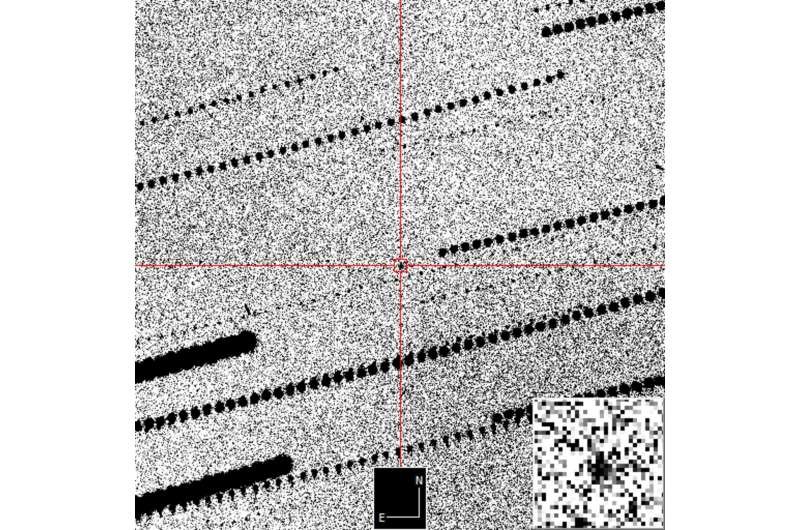
Asteroid 2025 TF zipped just 428 km above Antarctica — the second-closest asteroid flyby ever recorded.
On October 1, 2025, a small asteroid silently swept past Earth, flying closer than the orbit of the International Space Station (ISS). Designated Asteroid 2025 TF, the rock passed only 428 kilometers (266 miles) above Antarctica — a breathtakingly close shave in cosmic terms.
Yet, in an ironic twist, astronomers didn’t spot it until hours after it was gone.
A Near-Miss You Couldn’t See
The asteroid measured between 1 and 3 meters (3–10 feet) across — small enough that it would have burned up harmlessly if it had entered our atmosphere, likely creating a spectacular fireball over the icy southern continent.
But this near miss underscores a growing challenge for planetary defense: tiny asteroids are incredibly hard to detect until they’re already upon us.
“Finding small, fast-moving objects in the vast darkness of space is like searching for a charcoal pebble against a black velvet curtain,”
explained astronomer Fraser Cain during a Universe Today segment on asteroid detection.
Discovery After the Flyby
Astronomers at the Kitt Peak National Observatory in Arizona first spotted 2025 TF just six hours after its closest approach using the Bott Telescope.
Follow-up observations came from the Catalina Sky Survey and the European Space Agency’s Planetary Defense Office, working with the Las Cumbres Observatory in Siding Spring, Australia.
These quick collaborations confirmed that 2025 TF had already skimmed past Earth safely — but not by much.
How Close Was It?
At 428 km, the asteroid passed through the same orbital neighborhood as the International Space Station, which circles Earth at altitudes between 370 and 460 km.
Had the two crossed paths, the outcome could have been catastrophic. Fortunately, space is vast even in low Earth orbit, and the ISS was nowhere near the asteroid’s trajectory.
Still, this proximity highlights an increasing concern: our orbit is crowded, with satellites, space stations, and debris forming a dense shell around the planet.
A Record-Setting Flyby
Asteroid 2025 TF now ranks as the second-closest asteroid flyby ever observed, just behind 2020 VT4, a slightly larger 5–10 m rock that passed 386 km above the Pacific Ocean in 2020.
That earlier asteroid went undetected until 15 hours after its pass, while 2025 TF was found only six hours later — a small but meaningful improvement in detection capability.
The Hidden Risk: Orbital Collisions
Though too small to threaten Earth’s surface, these objects pose a serious hazard to satellites and space stations.
A direct hit could produce a cloud of fragments that might trigger Kessler Syndrome — a chain reaction of collisions that could render low Earth orbit unusable for decades.
With the number of satellites growing rapidly, particularly from megaconstellations like Starlink, the odds of such an event are slowly rising.
Why Detection Is So Difficult
Detecting small asteroids like 2025 TF is challenging because:
-
They’re tiny — often just a few meters wide.
-
They reflect very little light and are nearly invisible against the background sky.
-
Many approach Earth from the direction of the Sun, where telescopes can’t look safely.
To improve planetary defense, scientists need more dedicated telescopes, both on the ground and in space, linked into global monitoring networks.
“We need a worldwide, coordinated system to spot these dark, fast-moving objects before they reach our neighborhood,”
researchers from the ESA’s Planetary Defense Office noted.
What Comes Next?
For now, small asteroids like 2025 TF are reminders of the fragile security of our orbital zone.
Future missions — such as NASA’s NEO Surveyor space telescope and ESA’s Flyeye system — aim to catch such objects before they pass by. But until they’re operational, astronomers remain reliant on existing observatories and a bit of luck.
Reference
Tomaswick, A. (2025).
An Asteroid Recently Flew Closer to Earth Than the ISS.
Universe Today.
Credit: ESA / Las Cumbres Observatory.
A Close Call — and a Wake-Up Call
Asteroid 2025 TF’s silent flyby reminds us that space is not empty — it’s alive with movement, chance, and risk.
While this small rock posed no real danger, the next one might not be so forgiving.
Until our detection systems catch up, we’ll keep relying on cosmic luck to avoid an encounter that could light up our skies — or darken our future.
Leave a Reply
You must be logged in to post a comment.