Unified Model Reveals Why Giant Planets Have Opposite Jet Streams
By the Netherlands Research School for Astronomy (NOVA)
Edited by Lisa Lock • Reviewed by Robert Egan
Commentary and educational analysis by DatalytIQs Academy
A Long-Standing Cosmic Mystery
For decades, astronomers have marveled at the wild jet streams encircling the gas giants — Jupiter, Saturn, Uranus, and Neptune. These atmospheric rivers reach breathtaking speeds between 500 and 2,000 km/h, making them the fastest winds in the solar system.
Yet there’s always been a puzzle:
-
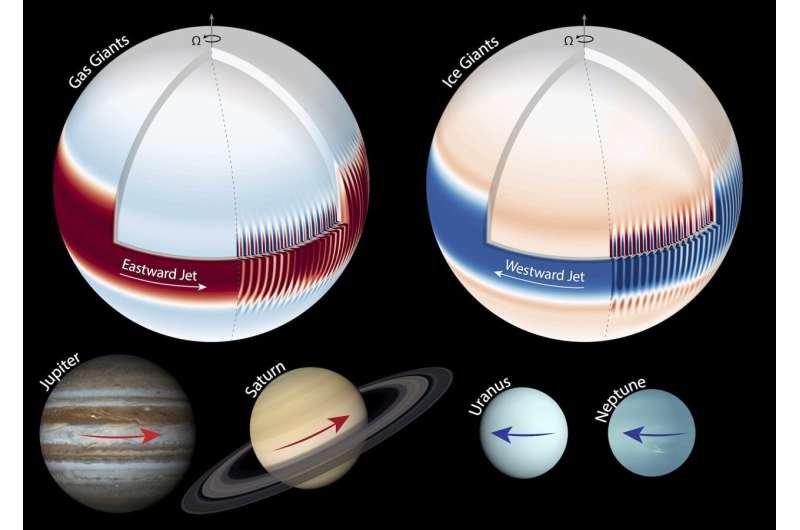
Jupiter and Saturn have eastward-flowing equatorial jets.
-
Uranus and Neptune have westward-flowing ones.
How could planets with such similar structures, heat sources, and rotation rates have winds blowing in opposite directions?
A Unified Theory Emerges
A team led by Dr. Keren Duer-Milner of Leiden Observatory and SRON (Netherlands Institute for Space Research) has finally cracked the code.
Using sophisticated global circulation models, they discovered that fast-rotating convection — swirling updrafts that carry heat through a planet’s atmosphere — can produce either eastward or westward jet streams, depending on how deep the atmospheric layer is.
This system exhibits what scientists call a bifurcation: under nearly identical conditions, the atmosphere can stabilize into two different equilibrium states — one with eastward jets, one with westward jets.
That means the same physical process explains both behaviors — a single elegant mechanism governing the climate engines of all four giant planets.
How It Works
Imagine the atmosphere as a colossal conveyor belt.
Near the equator, powerful convection cells circulate vertically — rising, cooling, and sinking again. These movements interact with the planet’s rapid rotation to create vast horizontal flows.
Depending on how thick or thin the convective layer is, the conveyor belt can flip direction — spinning the jet stream eastward or westward.
It’s the same principle that shapes Jupiter’s colorful bands, Saturn’s golden stripes, and Neptune’s dark storms — all arising from a universal dance between heat, rotation, and depth.
Beyond Our Solar System
Dr. Duer-Milner’s team believes this model could also explain atmospheric flows on exoplanets, helping scientists interpret data from the James Webb Space Telescope (JWST) and future missions.
By linking jet direction to internal heat and depth, researchers can now make more accurate climate predictions for planets light-years away.
As the study notes, data from NASA’s Juno mission — now orbiting Jupiter — may soon confirm whether these convective “conveyor belts” truly exist.
🎓 Educational Significance – DatalytIQs Academy Perspective
At DatalytIQs Academy, we celebrate breakthroughs like this because they bridge theoretical physics, atmospheric science, and planetary modeling — disciplines central to our STEM and data-driven learning philosophy.
Our educators highlight this unified jet-stream model as a perfect example of:
-
Cross-disciplinary thinking in astronomy and fluid dynamics,
-
Model-based reasoning is used in advanced mathematics and computational physics, and
-
The power of data visualization and simulation in uncovering hidden universal laws.
Through projects in Climate Modeling, Space Analytics, and Planetary Systems, DatalytIQs Academy encourages learners to explore how such research informs both Earth’s weather prediction systems and exoplanet climatology — proving that science is indeed a language of patterns shared across worlds.
In Summary
“We’ve finally found a simple, elegant explanation for a complex phenomenon,”
— Dr. Keren Duer-Milner, Lead Author
A single model now unites the turbulent atmospheres of the giant planets — from Jupiter’s roaring eastward winds to Neptune’s howling westward gales — illuminating not only our solar system, but potentially thousands of worlds beyond.
And at DatalytIQs Academy, we continue our mission to make such discoveries accessible, educational, and inspiring for the next generation of data-driven explorers.
Leave a Reply
You must be logged in to post a comment.