Rethinking Cosmic Acceleration
Why is the universe expanding at an ever-increasing rate? This question—one of the greatest mysteries in modern cosmology—has long puzzled scientists. Since observations in the late 1990s revealed that the universe’s expansion is accelerating, researchers have invoked the existence of a hypothetical form of energy known as “dark energy” to explain it. Yet, despite decades of investigation, the origin and nature of dark energy remain elusive.
An international research team from the Center for Applied Space Technology and Microgravity (ZARM) at the University of Bremen (Germany) and the Transylvanian University of Brașov (Romania) has proposed a bold alternative:
Perhaps the universe’s accelerated expansion can be explained—at least in part—without invoking dark energy at all.
Beyond Einstein: A New Geometric Framework
In conventional cosmology, the evolution of the universe is described by Einstein’s General Theory of Relativity (GR) and the Friedmann equations derived from it. However, when these equations are applied to the large-scale universe, they fail to account for the observed acceleration—unless a dark energy term is manually added.
Unsatisfied with this artificial addition, the research team explored a deeper theoretical foundation. Their approach is based on an extension of general relativity known as Finsler gravity, which generalizes the concept of spacetime geometry itself.
“The Finsler model allows for a more precise description of how gravitational forces interact with matter and radiation,” explains Christian Pfeifer, physicist at ZARM and co-author of the study. “It’s a broader geometric framework than Einstein’s spacetime, and this flexibility may hold the key to explaining cosmic acceleration naturally.”
The Finsler-Friedmann Equations
By extending the classical Friedmann equations into the Finsler geometry framework, the researchers derived what they call the Finsler-Friedmann equations. To their surprise, these new equations predict an accelerated expansion of the universe even in a vacuum, without the need for any external “dark energy” contribution.
This result suggests that spacetime itself may inherently possess properties that drive acceleration—a profound shift in understanding the universe’s dynamics.
“This is an exciting indication that we may be able to explain the accelerated expansion of the universe without dark energy,” says Pfeifer. “The new geometry opens up entirely new possibilities for understanding the fundamental laws governing the cosmos.”
A Window into the Future of Cosmology
While these results do not entirely rule out the existence of dark energy, they provide a compelling geometric alternative that could reshape the way scientists think about the fabric of the universe.
The team’s findings, published in the Journal of Cosmology and Astroparticle Physics (JCAP), invite further exploration into how generalized spacetime geometries might explain other unresolved cosmological phenomena—such as dark matter effects or the early universe’s inflationary phase.
Acknowledgements
The authors and editors(By Birgit Kinkeldey, Zentrum für angewandte Raumfahrttechnologie und Mikrogravitation (ZARM)
Edited by Lisa Lock, reviewed by Robert Egan) acknowledge the following organizations and contributors for their support and collaboration in communicating and expanding access to this research:
-
The Zentrum für angewandte Raumfahrttechnologie und Mikrogravitation (ZARM) at the University of Bremen, for theoretical and institutional leadership.
-
The Transylvanian University of Brașov (Romania) for joint mathematical modeling and cosmological simulations.
-
Dr. Christian Pfeifer (ZARM) and Dr. László Árpád Gergely for their pivotal roles in developing the Finsler-Friedmann theoretical framework.
-
The German Research Foundation (DFG) and the European Space Agency (ESA) for research funding and academic support.
-
The Journal of Cosmology and Astroparticle Physics (JCAP) is for the peer review and publication of the findings.
Through its educational platform and outreach materials, DatalytIQs Academy continues to bridge the gap between advanced research and accessible learning for students and professionals worldwide.DatalytIQs Academy contributes to science education, public engagement, and interdisciplinary dissemination of frontier research in physics, cosmology, and data-driven innovation.
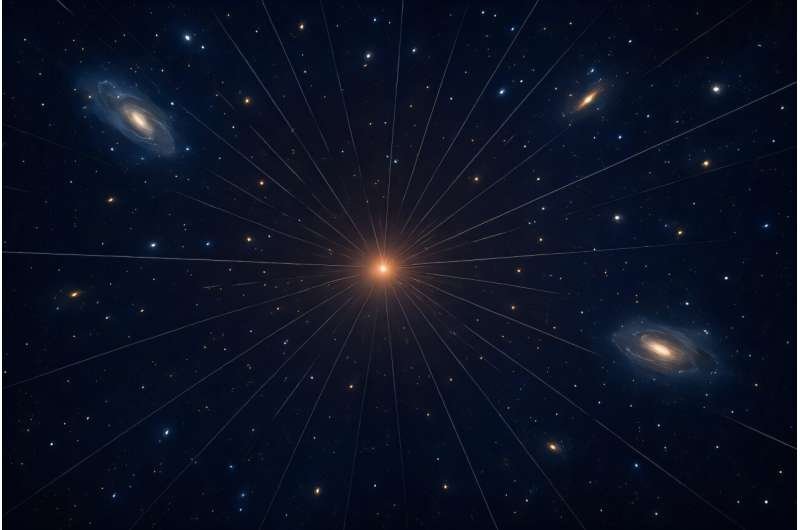
Special appreciation goes to AI-assisted visualization contributors, including Christian Pfeifer and the ZARM visualization team, for producing the conceptual image of the universe’s Finsler expansion.
Leave a Reply
You must be logged in to post a comment.