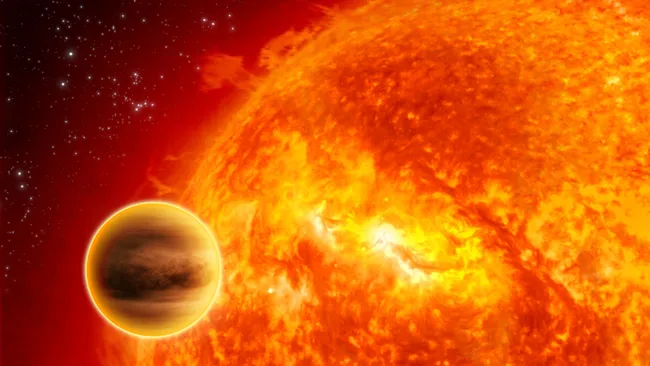
“It was just a matter of time before we found them.”
On October 6, 1995, the world of astronomy changed forever.
That was the day scientists announced the discovery of 51 Pegasi b, the first planet ever found orbiting a sun-like star outside our solar system.
This marked the beginning of the exoplanet era — a new age in which planets were no longer confined to our imagination or to the few worlds circling our own sun. Suddenly, we knew that other solar systems existed — and that the galaxy was likely teeming with them.
A Strange World Close to Its Sun
51 Pegasi b was nothing like anything we had ever seen before.
It was a gas giant, roughly half the mass of Jupiter, yet it orbited its star in just over four Earth days — so close that its atmosphere blazes at around 1,830°F (1,000°C).
This new type of world was later dubbed a “Hot Jupiter” — a planet so near to its star that it completes a year in less than a week. Its discovery shocked astronomers, forcing them to rethink how planetary systems form and evolve.
A Planet That Made the Universe Bigger
Before 51 Pegasi b, the only planets known to science were the ones in our solar system. The idea of worlds orbiting other stars had long been speculated — even philosophically expected — but never confirmed.
That changed when Michel Mayor and Didier Queloz, two Swiss astronomers at the University of Geneva, used a new instrument called ELODIE on a telescope in southern France to look for stellar wobbles — tiny shifts in a star’s light caused by the gravitational tug of an orbiting planet.
It was delicate, precise work — measuring changes smaller than the width of a human hair in the starlight.
But it worked. In 1995, they spotted a clear, repeating signal from the star 51 Pegasi, located about 50 light-years away in the constellation Pegasus.
“When the first exoplanet was discovered, I remember thinking that it was really cool,” recalled Amanda Hendrix, director of the Planetary Science Institute in Arizona. “But also thinking — of course there are planets out there!”
How to Detect an Invisible World
So how does a planet make its star “wobble”?
It’s a simple case of gravity’s tug-of-war.
Imagine a parent and child on a seesaw. The heavier parent doesn’t stay completely still — they rock slightly as they balance the lighter child. Likewise, a star doesn’t remain motionless as a planet orbits it; both circle a common center of mass.
ELODIE detected these gentle wobbles by analyzing the Doppler shifts in the star’s light — tiny changes in color as it moved toward or away from Earth.
From those patterns, Mayor and Queloz could infer the presence of a planet — unseen, but unmistakably there.
From One Planet to Thousands
That first detection opened the cosmic floodgates.
Today, scientists have confirmed over 6,000 exoplanets, with thousands more awaiting verification. The statistics are staggering: nearly every star in our Milky Way — roughly 200 billion of them — likely has at least one planet.
Among these are super-Earths, mini-Neptunes, rogue planets, and even Earth-sized worlds orbiting in their stars’ habitable zones. Instruments like NASA’s Kepler, TESS, and the James Webb Space Telescope (JWST) continue to push the boundaries of detection, revealing planets that may one day prove to be potentially life-bearing.
A Legacy Written in Starlight
For their groundbreaking discovery, Michel Mayor and Didier Queloz were awarded the 2019 Nobel Prize in Physics — recognition for a discovery that fundamentally reshaped our understanding of the cosmos.
What began with a wobbling star in 1995 has evolved into one of science’s most profound pursuits: the search for another Earth, and perhaps, life beyond our own world.
Key Takeaway
The discovery of 51 Pegasi b transformed astronomy forever.
It proved that our solar system is not unique — that planetary systems are the rule, not the exception, and that the universe is full of worlds waiting to be found.By Space.com Staff
Adapted for DatalytIQs Academy Science & Astronomy Blog
Image Credit: NASA / JPL-Caltech
Credits:
-
NASA / JPL-Caltech – Artist’s depiction of 51 Pegasi b
-
Space.com archives
-
Mayor & Queloz (1995), Nature
-
Planetary Science Institute interview archives
Leave a Reply
You must be logged in to post a comment.