A Rare Glimpse into Earth’s Changing Face
For the first time, scientists have directly observed a subduction zone — one of Earth’s most powerful tectonic engines — breaking apart in real time.
This extraordinary finding, published in Science Advances (2025), offers new insight into how Earth’s surface reshapes itself and what that means for the future of seismic activity in the Pacific Northwest.
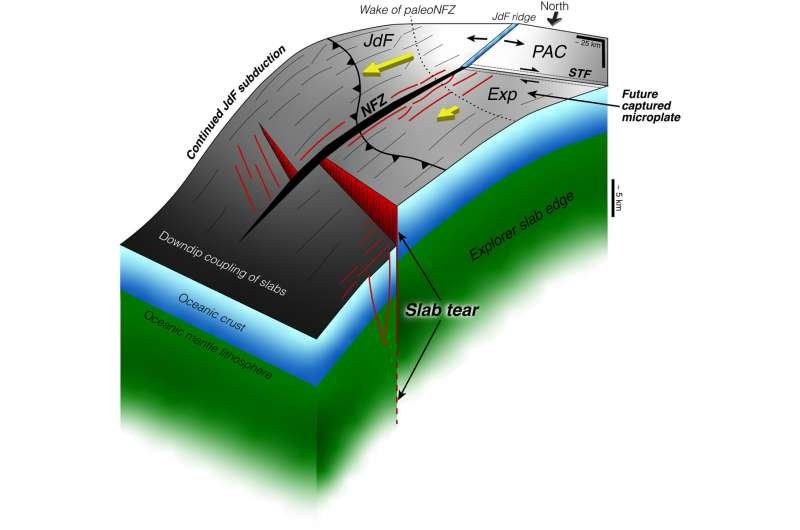
Using cutting-edge seismic imaging and earthquake data, researchers have captured the Juan de Fuca plate, off the coast of Vancouver Island, in the process of tearing itself to pieces.
It’s a geologic drama unfolding deep beneath the ocean floor — and while it sounds ominous, it’s actually part of Earth’s natural renewal cycle.

Subduction Zones: Earth’s Hidden Powerhouses
Subduction zones are the collision points between tectonic plates, where one slab of crust dives beneath another and sinks into the mantle. These zones:
-
Drive continental drift,
-
Generate massive earthquakes and tsunamis, and
-
Fuel volcanic arcs that recycle crustal material.
But like all things geological, subduction zones have lifespans. They don’t last forever.
When they finally die, they leave behind mountain ranges, volcanic chains, and fragments of ancient oceanic plates — Earth’s geological fingerprints through time.
Cascadia’s Slow-Motion Breakup
The research, led by Dr. Brandon Shuck (Louisiana State University, formerly at Columbia University’s Lamont-Doherty Earth Observatory), used seismic reflection imaging — essentially an “ultrasound” of the planet’s crust — to peer beneath the Pacific seafloor.
Data from the 2021 Cascadia Seismic Imaging Experiment (CASIE21) aboard the Marcus G. Langseth research vessel revealed something never seen so clearly before:
The Juan de Fuca plate is actively fracturing and breaking off in segments.
“It’s like watching a train derail — one car at a time,” said Dr. Shuck.
“Instead of shutting down all at once, the plate is ripping apart piece by piece, creating new boundaries and smaller microplates.”
The Mechanics of a Dying Subduction Zone
-
Slab Fragmentation: The Juan de Fuca plate is tearing along multiple fractures, including one massive 75-kilometer-long tear where the plate has dropped nearly 5 kilometers.
-
Piecewise Detachment: The breakup isn’t sudden — it happens episodically, with one portion detaching while others remain active.
-
Microplate Formation: These fragments slowly become independent mini-plates, like the fossilized remains of the ancient Farallon Plate off Baja California.
-
Seismic Signature: Detached segments stop producing earthquakes, leaving “quiet gaps” in seismic activity — a telltale sign of subduction shutdown in progress.
“Once a piece has completely broken off, it no longer produces earthquakes because the rocks aren’t stuck together anymore,” Shuck explained.
Why It’s Not All Bad News
At first glance, Earth’s crust tearing apart sounds alarming. But this natural process may actually reduce long-term tectonic strain by breaking down the massive energy of subduction into smaller, manageable pieces.
Co-author Dr. Suzanne Carbotte from Lamont-Doherty notes:
“We’ve known that subduction can stall when buoyant regions of oceanic crust reach a subduction zone, but we’ve never had such a clear picture of the process in action.”
In essence, the Juan de Fuca plate’s gradual disintegration could help release geological stress more gently, rather than through one catastrophic rupture.
A Window into Earth’s Past—and Future
The Cascadia findings also solve a long-standing geological puzzle:
How did the Farallon Plate, which once dominated the eastern Pacific, disintegrate into a patchwork of smaller plates millions of years ago?
Cascadia now offers the missing link — showing that subduction zones don’t die in one massive collapse, but instead unravel step by step over millions of years.
This model helps explain:
-
Fossilized microplates across ancient ocean floors,
-
Abrupt shifts in volcanic activity, and
-
The uneven distribution of earthquake zones in modern subduction systems.
What About Earthquake Risks?
For now, these findings don’t dramatically alter the hazard outlook for the Pacific Northwest.
The Cascadia subduction zone remains capable of generating massive earthquakes and tsunamis, much like the event that struck Japan in 2011.
However, this new understanding will refine models of how fault complexity and plate fragmentation influence rupture propagation — crucial for improving seismic hazard forecasts in the region.
“This is the first time we’ve caught a subduction zone in the act of dying,” Shuck said.
“Understanding how it unravels helps us better predict what might happen next — not just here, but in subduction zones worldwide.”
Key Takeaway
The Earth beneath the Pacific Northwest is not collapsing — it’s evolving.
The Juan de Fuca plate’s slow disintegration is part of the natural rhythm of plate tectonics, helping scientists piece together the life and death cycles of oceans, mountains, and continents themselves.By Bianca Scolaro, State of the Planet
Edited by Lisa Lock, reviewed by Robert Egan
Published in: Science Advances (2025)
DOI: 10.1126/sciadv.ady8347
References:
Scolaro, B. (2025). Earth’s crust is tearing apart in the Pacific Northwest—and that’s not necessarily bad news. State of the Planet.
Published in Science Advances (2025). DOI: 10.1126/sciadv.ady8347
Leave a Reply
You must be logged in to post a comment.